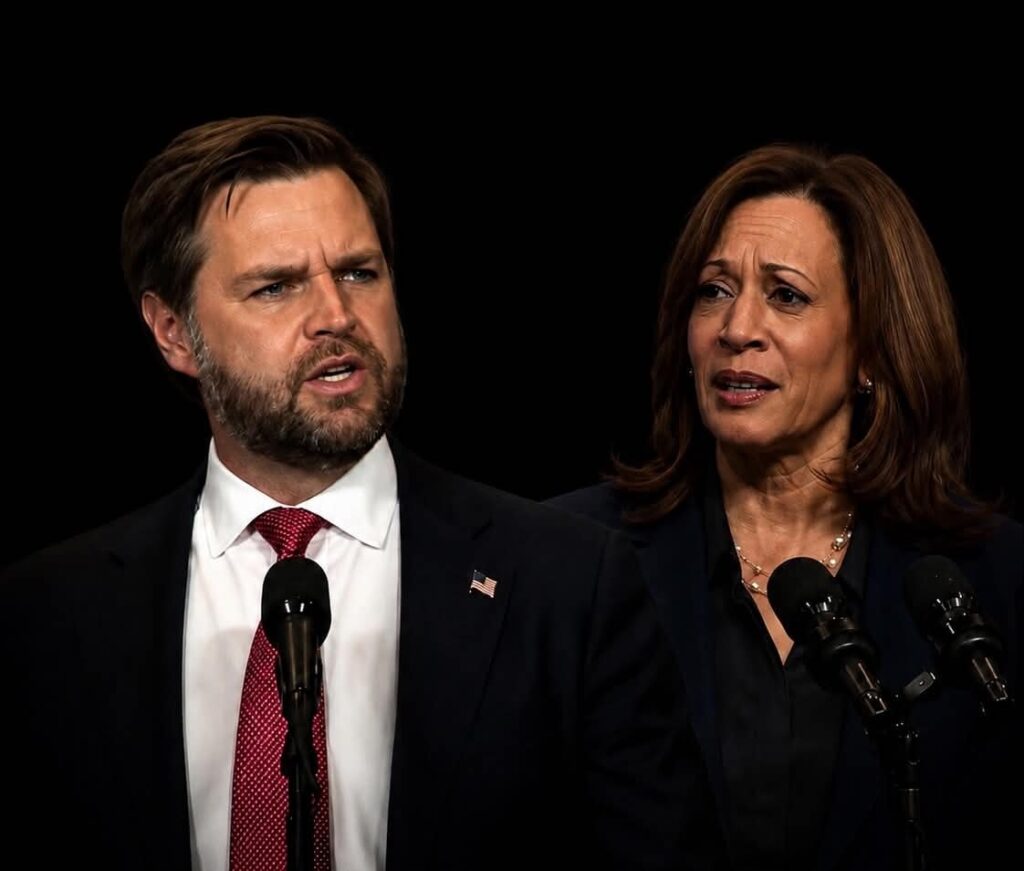
Vice President JD Vance & Former VP Kamala Harris ( Rapid Reports Photo – Benjamin Harris )
Kamala Harris Pushes Radical Rule Changes After Losing to Trump
Former Vice President Kamala Harris is once again stirring controversy inside the Democratic Party with a set of remarks that reveal just how far some Democrats are willing to go to rewrite the rules of American democracy. In a speech last week at the National Urban League Conference in Nashville, Harris called for revisiting the Electoral College, expanding the Supreme Court, and granting statehood to both Puerto Rico and Washington, D.C.

[poll id=”4″]
The timing of these comments, coming after her decisive loss to President Donald Trump in 2024, has fueled speculation that Harris is positioning herself for another presidential run in 2028. More importantly, the proposals themselves signal a continued push by elements of the Democratic Party to alter foundational institutions whenever election outcomes do not go their way.
Harris Calls for Ending the Electoral College
“I know this is going to be controversial coming from me, in particular,” Harris said before listing her priorities. “We need to revisit the Electoral College. We need to revisit the point of expanding the court, to 13 justices like we have 13 district courts. We need to revisit, if they so want, statehood for Puerto Rico and D.C.”
The Electoral College has been a frequent target of Democrats after losses in presidential elections. Critics of Harris’s position argue that calls to abolish or fundamentally alter it amount to an attempt to change the constitutional framework that has governed American elections for more than two centuries simply because it did not deliver the preferred result in 2024.
Court-Packing Proposal Returns
Harris also revived the idea of expanding the Supreme Court to 13 justices. During her 2024 campaign, she had avoided openly endorsing court packing and instead supported term limits and a binding ethics code for justices. The shift is notable. Expanding the Court has long been viewed by many Americans as a direct threat to judicial independence, a way for one party to dilute the influence of justices it disagrees with.
Supporters of the current constitutional structure point out that the size of the Court is not required to match the number of appellate circuits. The comparison Harris drew has been widely criticized as a political talking point rather than a serious institutional reform.
Statehood Push for Puerto Rico and D.C.
Harris endorsed statehood for Washington, D.C., during her previous campaign, but her public support for Puerto Rican statehood as part of the same package marks a further expansion of the idea. Granting statehood to both would add multiple new senators and representatives, a move that critics say is driven more by partisan advantage than by genuine questions of representation or self-determination.
Any such change would face enormous legal and political obstacles. Abolishing or significantly altering the Electoral College would almost certainly require a constitutional amendment. Expanding the Supreme Court or creating new states would demand substantial majorities in Congress that do not currently exist.
A Clear Pattern of Moving the Goalposts
One of the most consistent criticisms of Harris’s latest remarks is the perception that Democrats only demand structural changes after they lose. When they win under the existing rules, those same institutions are treated as legitimate. When they lose, the rules themselves become the problem.
This pattern has become a central theme in the post-2024 Democratic debate. Rather than conducting a clear-eyed examination of why voters rejected their message on the economy, the border, crime, and cultural issues, some party figures continue to focus on redesigning the system.
2028 Speculation Intensifies
Although Harris insisted she has not decided whether to run again, saying she is “fully, sincerely, focused on these midterms,” her comments have kept her at the center of early 2028 speculation. Recent polling compiled by RealClearPolitics has shown her leading early Democratic primary surveys over potential rivals including California Gov. Gavin Newsom, former Transportation Secretary Pete Buttigieg, and Rep. Alexandria Ocasio-Cortez.
Harris has also held conversations with progressive figures, including New York City Mayor Zohran Mamdani and Rep. Alexandria Ocasio-Cortez. Those meetings have drawn attention as the party continues to debate whether it should move further left or attempt to reconnect with the working-class and moderate voters who shifted toward President Trump.
Democrats Still Struggling With Accountability
The broader context for Harris’s remarks includes the Democratic Party’s ongoing difficulty in confronting the reasons for its 2024 defeat. Even liberal voices have criticized the party’s delayed and widely panned election autopsy as lacking substance and avoiding difficult subjects. The failure to produce a serious self-examination has left the field open for high-profile figures to test more aggressive structural proposals instead of addressing the policy failures that cost them the election.
What These Proposals Really Signal
At their core, the ideas Harris floated—scrapping or gutting the Electoral College, packing the Supreme Court, and creating new states—represent a belief that the current constitutional order is an obstacle rather than a foundation. For millions of Americans who supported President Trump’s agenda of secure borders, energy dominance, and an America First foreign policy, these proposals confirm that significant parts of the Democratic Party remain more interested in changing the rules than in persuading voters.
President Trump won under the same Electoral College system that has elected presidents for generations. The Supreme Court he helped shape continues to operate under long-standing norms. Attempts to upend both after a clear electoral defeat are unlikely to sit well with voters who value stability and constitutional continuity.
Looking Toward 2028
Harris’s speech has succeeded in one respect: it has kept her name in the conversation and forced Democrats to confront how far they are willing to go. Whether these ideas gain traction or further alienate moderate and independent voters remains an open question. What is already clear is that the former vice president is testing the boundaries of how much institutional change her party is prepared to embrace.
For now, the American people continue to live under the Constitution as written. President Trump’s victory in 2024 demonstrated that the existing system still works when candidates present a message that resonates with a broad coalition of voters. Attempts to rewrite that system after the fact are likely to face strong resistance from those who believe the rules should not change simply because one side lost.
This article may contain commentary which reflects the author’s opinion.

Benjamin Harris is a RapidReports front page contributor and editor,proud father of four.