Dangerous Dust Storm Raises Valley Fever Concerns Across Arizona
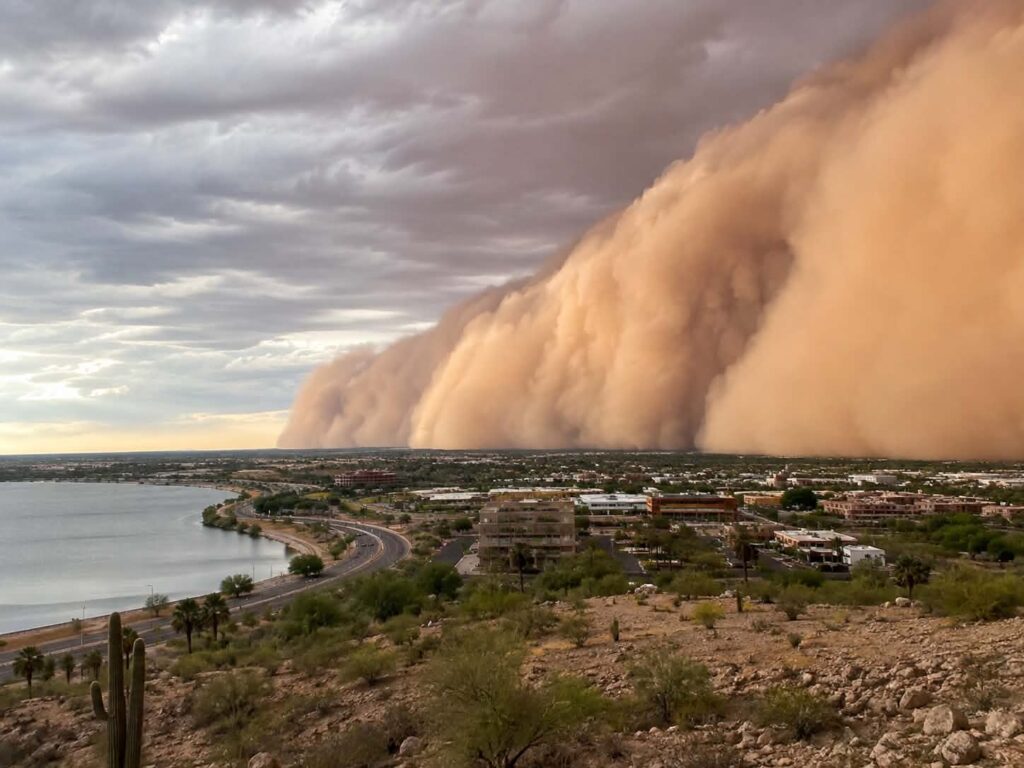
A dangerous dust storm rolling across Arizona could kick up more than dirt. Forecasters warned Tuesday that strong winds and thunderstorms may send walls of dust across southeastern Arizona, raising fresh concerns about Valley fever, a potentially serious lung infection caused by fungal spores that live in desert soil.
The National Weather Service issued a blowing dust advisory from 2 p.m. to 8 p.m. local time. Visibility could suddenly drop to near zero as storms develop. Residents with respiratory conditions were urged to stay indoors until the dust clears, while drivers were advised to pull off the road if they encounter a dust wall.
Where the Advisory Applies
The immediate alert covered southeastern Arizona, including eastern Cochise County, the Upper Gila and San Pedro River valleys, and several mountain ranges: the Chiricahua, Dragoon, Mule, Huachuca, Santa Rita, Galiuro, and Pinaleño Mountains.
The warning followed a violent dust storm that hit outside Phoenix on Monday evening and stretched as far as Tucson, more than 100 miles south. Meteorologist Jorge Torres noted that poor air quality lingered Tuesday morning, with readings ranging from unhealthy to hazardous. Sensitive groups were advised to limit outdoor time early in the day.
Understanding the Valley Fever Risk
Experts have warned that so-called “fungal storms” could pose a broader threat across at least 11 states where the fungus Coccidioides may be present. The fungus can be disturbed when dry soil is kicked into the air by construction, farming, wind, or monsoon storms. Once airborne, the microscopic spores can be inhaled into the lungs.
For many people, Valley fever causes mild or flu-like symptoms. For others, it can become far more serious, spreading beyond the lungs to the bones, brain, or other organs. Arizona officials have not confirmed that Tuesday’s dust storm contains the fungus, but the storm is moving through a region where Coccidioides is known to live.
Monsoon Season Heightens the Threat
The timing matters. The Southwest is moving deeper into the North American monsoon season, when thunderstorms and powerful winds can whip desert soil into massive walls of dust. The weather service warned that dust could reduce visibility to between one-quarter mile and one mile shortly after storms develop, with gusts expected to exceed 40 mph. Local meteorologists said winds could reach 60 mph.
Official guidance remains clear: “If you encounter blowing dust or blowing sand on the roadway or see it approaching, pull off the road as far as possible and put your vehicle in park. Turn the lights all the way off and keep your foot off the brake pedal. Remember, ‘Pull Aside, Stay.’”
Rising Cases Across the Southwest
Valley fever has become a growing public-health concern in Arizona and across the Southwest. The fungus grows naturally in dry, sandy soils in arid regions with hot summers, mild winters, and low rainfall. It is usually not a problem until the soil is disturbed and spores become airborne.
The CDC says Valley fever infections are still considered rare, but the agency has acknowledged that outbreaks have appeared in places where scientists did not previously expect the fungus to live. Arizona remains one of the hardest-hit states. Maricopa County alone recorded 4,498 confirmed Valley fever cases during the first six months of 2026. More than 12,000 cases were reported statewide last year, and Arizona typically accounts for roughly two-thirds of all U.S. infections.
Sharp Increases in Recent Years
Researchers have found Valley fever cases rising sharply in recent years across the Southwest, though experts are still studying exactly why the infections are increasing so quickly. In the Phoenix area, infections surged in 2024, climbing 42 percent to 12,522 cases from 8,841 the year before, according to state health data. The national count also rose, jumping from 16,746 cases to 22,244.
For Arizona residents, Tuesday’s advisory serves as a reminder that the desert’s biggest health threat is not always the heat. Sometimes it is what the wind pulls out of the ground. Staying informed, limiting outdoor exposure during dust events, and following official safety guidance remain the most effective steps for reducing risk.

Benjamin Harris is a RapidReports front page contributor and editor,proud father of four.