Trump Says He’ll Report NBC’s Kristen Welker to the FCC — NBC Responds by Standing Behind Its Host
Trump Escalates His Criticism of NBC Journalist
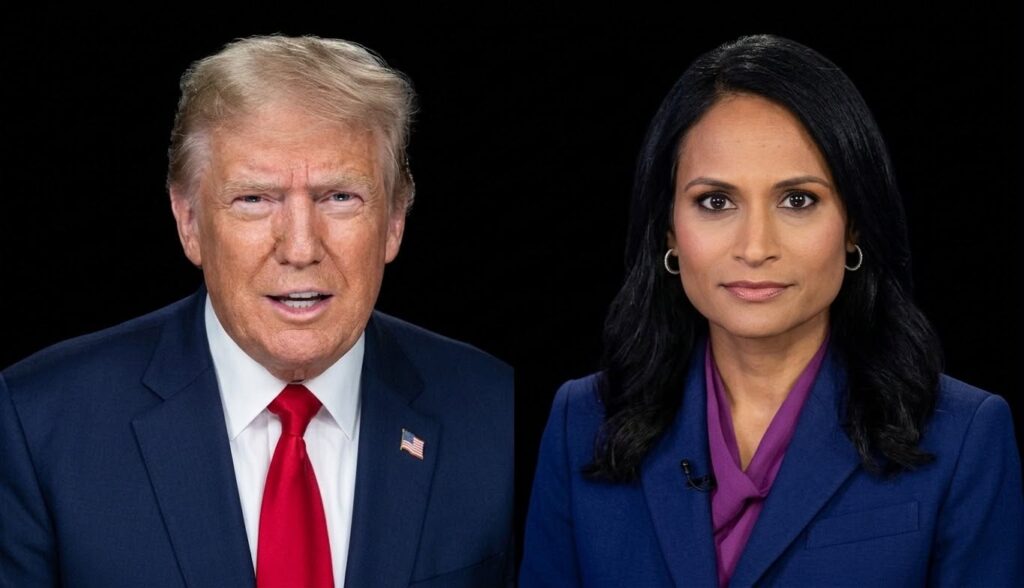
President Donald Trump has escalated his criticism of NBC News journalist Kristen Welker, saying he intends to report her to the Federal Communications Commission after objecting to a comment she made about his record of endorsing political candidates.
Trump made the statement on Sunday, August 30, after Welker appeared on NBC’s Washington, D.C., affiliate ahead of her weekly program, Meet the Press.
During the segment, Welker said Trump would “loom large” over the upcoming midterm elections. She also noted that he had endorsed several candidates in Republican primaries and described the results as “mixed.”
Trump strongly disputed that characterization.
He argued that his endorsement record was far more successful than Welker’s description suggested and accused the journalist of making what he called a “purposeful inaccuracy.”
Trump Calls for FCC “Rebuke or Punishment”
Trump said Welker would be reported to the FCC for what he described as inaccurate coverage.
His comments added another chapter to his long-running conflict with news organizations and journalists whose reporting he believes is unfair to him.
The president has repeatedly criticized major media outlets and has increasingly called on federal regulators to scrutinize broadcasters.
In this case, however, the issue raises an important question: What authority does the FCC actually have over news reporting?
The answer is considerably more complicated than Trump’s statement might suggest.
The FCC regulates broadcasters in specific areas, but the agency has limited authority to police the accuracy or viewpoint of ordinary news coverage.
The commission itself has stated that it generally cannot prevent broadcasters from presenting a particular point of view.
What Kristen Welker Actually Said
The controversy began with a brief comment rather than an extended report.
Welker was discussing the upcoming midterm elections and Trump’s role in Republican primary contests.
She noted that Trump had endorsed a number of candidates and said his endorsements had produced “some mixed results.”
The wording immediately drew Trump’s attention.
He argued that recent victories demonstrated the strength of his political influence and rejected the suggestion that his endorsement record could reasonably be described as mixed.
Trump pointed to successful candidates, including Darline Graham and Mike Mazzei, while emphasizing his own assessment of his endorsement record.
The disagreement therefore centers partly on how political success should be measured.
Trump Disputes the Characterization
Trump has repeatedly emphasized the number of candidates he has endorsed who have won their races.
In his criticism of Welker, he highlighted what he described as extremely high success rates among his endorsed candidates.
However, political endorsement records can be calculated in different ways.
A simple overall percentage can look very different depending on whether uncontested or highly competitive races are included, which offices are considered, and whether primary and general-election contests are treated separately.
That makes the word “mixed” a matter of political interpretation rather than something that can necessarily be resolved by a single statistic.
For Trump, however, the phrase was significant enough to prompt a public demand for regulatory attention.
NBC News Stands by Welker
NBC News responded by defending its journalist.
The network described Welker as “one of the best in the business” and said it stood by her.
That response is important because it shows that the dispute is not simply between Trump and an individual reporter.
It has become a broader confrontation between the president and one of the country’s major news organizations.
NBC’s defense also signals that the network does not believe the comment warrants disciplinary action against Welker.
The network has continued to stand behind her work as moderator of Meet the Press.
Can the FCC Punish a Journalist for News Coverage?
This is perhaps the most important part of the story.
The Federal Communications Commission does not function as a general fact-checking agency for television journalism.
Its authority primarily concerns communications regulation, including areas involving broadcast licenses, technical standards, ownership rules, and certain public-interest requirements.
The agency does not ordinarily determine whether an individual journalist’s political analysis is sufficiently accurate.
According to reporting on the dispute, the FCC’s own rules and guidance provide significant limits on the government’s ability to intervene in broadcast viewpoints.
That means Trump’s call for a “rebuke or punishment” does not automatically translate into a regulatory penalty against Welker.
Why the FCC Has Become Part of the Political Fight
The dispute comes amid heightened attention surrounding the FCC and its Republican chairman, Brendan Carr.
The commission has taken a more aggressive approach toward several major media companies during Trump’s second administration.
That history helps explain why Trump’s latest statement has attracted so much attention.
Critics argue that government pressure on broadcasters can create a chilling effect on journalism.
Supporters of Trump’s approach argue that broadcasters using public airwaves should be held accountable when they believe coverage is unfair or misleading.
The disagreement therefore extends well beyond one television segment.
It touches on broader questions about press freedom, government regulation, media accountability, and presidential power.
Welker Has Faced Trump’s Criticism Before
The latest dispute is not the first time Trump and Welker have clashed.
Welker has covered Trump extensively throughout her career and became moderator of Meet the Press in 2023.
Her role has placed her in a particularly visible position during one of the most politically contentious periods in modern American politics.
She has interviewed Trump and other major political figures while navigating criticism from both sides of the political spectrum.
Trump has previously expressed strong dissatisfaction with her coverage.
The latest confrontation therefore represents another episode in an already complicated relationship between the president and one of NBC’s most prominent political journalists.
The Larger Debate Over Media and Politics
The incident also highlights the increasingly difficult relationship between political leaders and the news media.
Presidents have always criticized journalists.
But social media has dramatically changed how those disputes unfold.
Instead of waiting for a newspaper story or television segment to be answered through a formal statement, political leaders can now respond directly to millions of followers.
That can turn a brief comment into a national controversy within hours.
Trump has made particularly extensive use of social media to challenge journalists, news organizations, polls, and political commentators.
The Welker dispute followed that familiar pattern.
A short statement about an election became the subject of a presidential attack, a response from the network, and a broader debate about government oversight of journalism.
Why the “Mixed Results” Comment Matters
At the center of the dispute is a deceptively simple question: How successful have Trump’s endorsements actually been?
Trump argues that his record is overwhelmingly successful.
Critics point to losses among some of his preferred candidates and argue that the results are not uniformly positive.
Both sides can emphasize different races to support their arguments.
That is one reason political analysts often distinguish between raw win percentages and the competitiveness of individual contests.
A candidate winning an overwhelmingly safe district is different from a candidate winning a closely contested primary in which Trump’s endorsement may have played a decisive role.
The political significance of an endorsement can therefore be difficult to measure with one number.
A Broader Question About Presidential Power
The dispute raises a larger question about how much influence a president should have over independent news organizations.
The First Amendment provides strong protections for freedom of the press, and government officials generally cannot punish journalists simply because they dislike unfavorable coverage.
At the same time, broadcasters operate within a regulatory system because they use licensed public airwaves.
That tension has existed for decades.
The challenge becomes especially significant when a sitting president publicly asks a federal regulator to take action against a journalist.
Supporters may see such requests as demands for accountability.
Critics may view them as an attempt to pressure the press.
The outcome of this particular dispute could therefore attract attention well beyond NBC and Welker.
What Happens Next?
For now, there is no indication that Welker has been formally punished by the FCC.
Trump said he would report her, but making a complaint and successfully obtaining regulatory action are two very different things.
The FCC’s authority over editorial news content is limited, and reporting on the dispute indicates that there is no straightforward FCC procedure for challenging an individual news report simply because a viewer believes it is inaccurate or biased.
The commission had not publicly announced a punishment against Welker at the time of the latest reports.
That distinction is important because the political rhetoric surrounding the controversy is considerably stronger than the regulatory mechanism available to resolve it.
Why NBC’s Response Matters
NBC’s decision to stand behind Welker sends a clear message to its journalists and viewers.
The network is signaling that it considers her coverage defensible and does not believe Trump’s criticism warrants removing her from her position.
For Welker, the support comes at a time when political journalism is facing intense scrutiny.
Reporters covering national politics increasingly find themselves criticized not only by politicians but also by supporters and opponents of those politicians.
Maintaining editorial independence can therefore become difficult when criticism comes directly from the White House.
NBC’s public defense suggests the network intends to continue allowing Welker to perform her role without changing its position because of Trump’s complaint.
The Bigger Story Is Still Unfolding
What began as a disagreement over two words has developed into a larger confrontation involving the presidency, a major television network, a prominent journalist, and a federal regulatory agency.
Trump says Welker’s characterization of his endorsement record was inaccurate.
Welker and NBC have not accepted that criticism as grounds for disciplinary action.
Meanwhile, the FCC’s limited authority over news content makes the prospect of a straightforward punishment far from certain.
The dispute therefore remains as much about political power and press freedom as it is about the original comment.
Final Thoughts
President Donald Trump’s decision to say he would report NBC’s Kristen Welker to the FCC has intensified the ongoing battle between the president and major news organizations.
The immediate trigger was Welker’s description of Trump’s recent endorsement record as producing “some mixed results.”
Trump strongly rejected that characterization and said he believed the journalist should face a regulatory “rebuke or punishment.”
NBC News, however, has stood firmly behind Welker, calling her “one of the best in the business.”
The crucial question now is whether Trump’s complaint will lead to any actual regulatory action.
Based on the FCC’s limited authority over news content, such an outcome is far from automatic.
For viewers, the controversy offers a revealing look at the increasingly complicated relationship between political power and the modern news media.
And as the midterm elections approach, disagreements over political endorsements, media coverage, and the role of journalists are likely to remain at the center of the national conversation.
Benjamin Harris is a RapidReports front page contributor and editor,proud father of four.