Homeland Security Secretary Says Cyberattack Not Ruled Out After Nationwide FAA Ground Stop
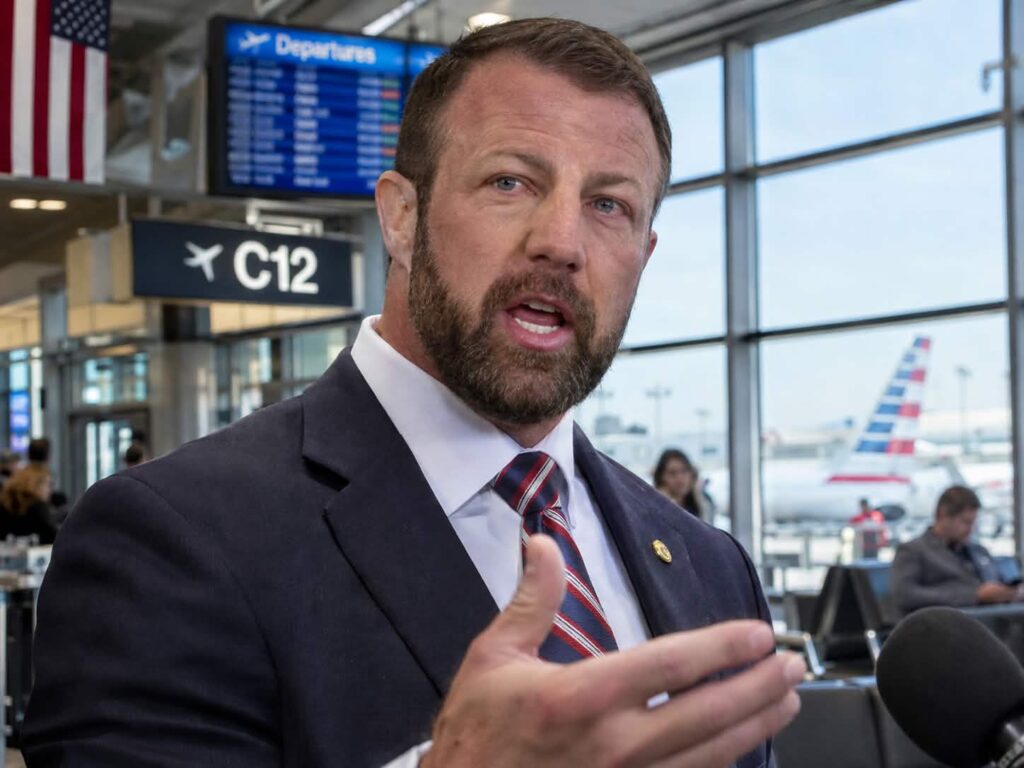
Homeland Security Secretary Markwayne Mullin said officials had not ruled out a possible cyberattack after a telecommunications outage triggered a nationwide ground stop across U.S. airports, disrupting air travel and affecting thousands of flights.
Speaking to reporters outside the White House on Thursday evening, Mullin said there was no evidence at that point indicating that the disruption was a deliberate attack or an immediate threat to national security.
He described the incident as a communications outage affecting the Federal Aviation Administration (FAA) and said flights had been grounded as a precaution while officials worked to establish what had happened.
“There was no indication as of yet that this was a nefarious attack,” Mullin told reporters, adding that the situation appeared to involve a telecommunications problem.
However, when asked directly whether a cyberattack could be ruled out, the Homeland Security secretary said investigators were not excluding any possibility.
Mullin explained that officials were prioritizing public safety and the security of passengers and aircraft while the technical investigation continued.
He also sought to reassure families concerned about people traveling by air, saying officials had no reason to believe the incident posed a direct threat to Americans.
Mullin Says Officials Have Not Identified Evidence of a Cyberattack
Mullin’s comments reflected the cautious position adopted by federal officials as they investigated the nationwide disruption.
Although he declined to completely exclude the possibility of a cyberattack, he emphasized that there was no indication at the time that the outage resulted from malicious activity.
The secretary also addressed comparisons with previous national emergencies, saying the situation should not be confused with the September 11, 2001, terrorist attacks.
His remarks were intended to distinguish the technical aviation disruption from a national security emergency involving an attack on the United States.
Transportation Secretary Sean Duffy similarly attributed the ground stop to a communications problem affecting air traffic control operations.
Neither official publicly identified a confirmed cause for the outage in the statements described during the initial response.
FAA Orders Nationwide Ground Stop Across U.S. Airports
The Federal Aviation Administration issued a nationwide ground stop shortly before 4 p.m. Eastern time on Friday, directing departing aircraft at airports across the United States to remain on the ground.
The agency cited extraordinary circumstances and safety concerns in its advisory.
The FAA instructed airports to hold departing traffic until further notice. International flights already approaching the United States were to be handled individually, depending on the circumstances.
Aircraft that were already airborne were generally permitted to continue to their destinations, while new departures were temporarily halted.
The decision was intended to prevent additional pressure on an air traffic control system experiencing widespread communications problems.
The nationwide measure affected flight operations at airports throughout the country, creating disruption for passengers, airlines, and airport personnel.
Communications Problems Affect Multiple Air Traffic Control Centers
Transportation Secretary Sean Duffy said the disruption involved a communications issue affecting all Air Route Traffic Control Centers.
FAA technicians began investigating problems involving radio frequencies and communications systems used to coordinate aircraft traveling between airports.
Reports also described disruptions affecting some automation and radar-related systems at several facilities.
Areas associated with air traffic control centers in Kansas City, Chicago, New York, and Boston were among those mentioned in reports about the disruption.
These centers play an important role in managing aircraft movements across large portions of U.S. airspace. Reliable communications are essential for controllers to coordinate flights, maintain separation between aircraft, and manage traffic safely.
When communications systems become unavailable or unreliable, aviation authorities may need to restrict operations until normal procedures can be maintained.
The FAA’s decision to halt departures reflected the importance of maintaining safe operations while technicians assessed the technical problems.
Thousands of Flights Affected by Nationwide Disruption
The ground stop quickly created widespread disruption across the U.S. aviation network.
Flight-tracking information showed thousands of delays and cancellations developing as airlines adjusted their schedules to the restrictions.
At various points during the afternoon, estimates indicated that more than 7,000 flights had been affected.
The impact extended beyond aircraft scheduled to depart during the initial ground stop. Delays can spread throughout the aviation network when aircraft and crews are unable to reach their next scheduled destinations.
Passengers connecting through major airports may also experience disruptions even when their own departure airport is not directly affected by the original technical problem.
Airlines and airport operators faced the challenge of managing stranded passengers, adjusting aircraft schedules, and preparing for the gradual resumption of normal operations.
The FAA and Department of Transportation said further updates would be provided as the investigation progressed.
Nationwide Ground Stops Are Rare in U.S. Aviation
A nationwide ground stop is an unusual measure because of the extensive disruption it can cause across the country’s aviation system.
One of the most recent comparable incidents occurred in January 2023, when a technical problem involving the FAA’s Notice to Air Missions system, known as NOTAM, disrupted the distribution of important flight safety information.
That incident was traced to a contractor-related error involving a database file and resulted in a nationwide departure pause.
The September 11, 2001, terrorist attacks also led to an unprecedented grounding of civilian aircraft across the United States.
Although the current communications outage prompted comparisons with earlier nationwide aviation disruptions, Mullin stressed that officials had no indication that the latest incident represented a similar national security threat.
The circumstances surrounding the latest ground stop remained under investigation.
Investigation Continues as Officials Assess the Cause
The central question facing federal authorities is what caused the communications problems and whether the outage resulted from a technical failure, a telecommunications provider issue, or another form of disruption.
Mullin’s refusal to rule out a cyberattack means investigators have left that possibility open, but it should not be interpreted as evidence that a cyberattack occurred.
Officials have not publicly established that malicious activity was responsible for the incident.
For passengers, the immediate priority is the restoration of reliable aviation communications and the safe return of normal flight operations.
The FAA and Department of Transportation are continuing to assess the technical problems, while federal officials have said they will provide additional information as it becomes available.
Until investigators establish the cause, the nationwide ground stop remains a reminder of how heavily modern air travel depends on reliable communications and coordination between aviation facilities.

Benjamin Harris is a RapidReports front page contributor and editor,proud father of four.