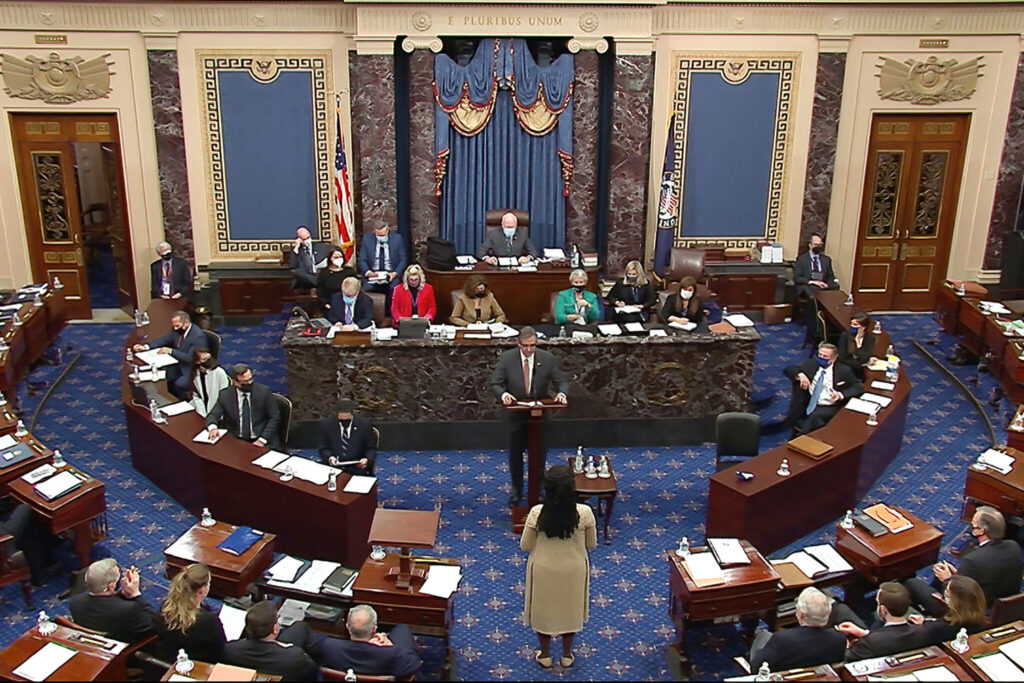
Hakeem Jeffries Faces Early Leadership Questions After Democrats Miss Key House Votes
House Democratic Leader Hakeem Jeffries is facing questions about his party’s ability to maintain voting discipline after Democrats experienced two difficult episodes on the House floor in consecutive days.
The setbacks came shortly after Democrats’ strong performance in the 2026 midterm elections, which put the party on course to regain control of the House of Representatives in January.
With Democrats projected to win at least 255 seats, Jeffries is expected to become the next House speaker when the new Congress convenes. However, recent developments have drawn attention to the organizational challenges facing the Democratic caucus as it prepares to move from minority status to majority control.
The first controversy involved a Republican effort to send impeachment articles against Defense Secretary Pete Hegseth to committee. Eleven Democrats missed the key procedural vote, helping Republicans prevent the resolution from advancing.
A day later, Democrats faced criticism after a major Republican-backed veterans’ benefits package passed the House through a voice vote without a recorded tally of individual lawmakers’ positions.
Together, the incidents have prompted debate within Democratic circles about attendance, floor strategy, and the responsibilities of party leadership.
Eleven Democrats Miss Hegseth Impeachment Vote
The first setback occurred Tuesday, when the House considered a procedural motion involving impeachment articles introduced by Republican Rep. Thomas Massie of Kentucky against Defense Secretary Pete Hegseth.
Republican leaders moved to refer Massie’s resolution to the House Judiciary Committee rather than allow an immediate vote on the impeachment effort.
The motion succeeded by a vote of 211-204, effectively shelving the proposal for the remainder of the current Congress.
Eleven Democrats were absent when the vote took place. Their absence quickly became a source of frustration among lawmakers and activists who had supported efforts to hold Hegseth accountable over the administration’s military policies.
The attendance issue attracted particular attention because several Democrats had previously expressed support for impeachment proceedings.
The vote was also politically sensitive for Jeffries, who had publicly criticized Hegseth and called for accountability over his actions as defense secretary.
However, the precise effect of the absences remains a matter of political and procedural debate. ABC News reported that the outcome could have changed if enough missing Democrats had voted against referring the resolution to committee. The Washington Post, meanwhile, reported that Katherine Clark argued that Republican absences and the narrow party margin complicated the calculations.
Missing Lawmakers Offer Explanations
Several Democrats who missed the vote said traffic delays prevented them from reaching the House chamber before the voting period ended.
Reps. Melanie Stansbury of New Mexico and Laura Gillen of New York were among those who cited a traffic incident near the Capitol.
Stansbury later issued an emotional apology, expressing disappointment that she had not been present when the vote closed.
Other lawmakers offered different explanations. Rep. Lou Correa of California cited a medical issue, while Rep. Steven Horsford of Nevada said he had experienced a personal emergency.
Former House Speaker Nancy Pelosi was also among those absent. Her office said she had returned to California to attend a longstanding Veterans Day event and supported impeaching Hegseth.
Some Democrats had reportedly been returning from an off-campus political fundraising event when traffic delays affected their journey to the Capitol.
The explanations did little to prevent criticism from party supporters who argued that the vote should have received greater attention from Democratic lawmakers.
Fred Trump III, President Donald Trump’s nephew, criticized the absences in a post on X, questioning whether the party’s failure to assemble its members had weakened its impeachment effort.
Progressive activists also expressed frustration.
Demand Progress Executive Director Sean Vitka criticized Democratic leaders for failing to ensure that enough lawmakers were present for a vote that had been anticipated.
The controversy placed renewed attention on the role of the party’s floor leadership in coordinating attendance and securing votes.
Veterans’ Benefits Bill Passes Without a Recorded Final Vote
Democrats faced another difficult episode on Wednesday during consideration of a major veterans’ benefits package.
The Republican-backed Take Care of America’s Veterans Act included provisions intended to expand compensation for certain combat-injured military retirees.
However, the legislation also included changes to how disability benefits for conditions such as tinnitus and sleep apnea would be calculated for some future recipients.
Democratic lawmakers objected to that approach, arguing that the proposal would increase benefits for one group of veterans while reducing potential compensation for others.
Despite their objections, the House approved the legislation through a voice vote.
Under the procedure, the presiding officer asked members to indicate their support or opposition verbally. After hearing the response, the chair announced that the measure had passed.
No lawmaker requested a recorded roll-call vote during the final passage proceedings, meaning individual members’ positions on the bill were not formally listed in a final tally.
Democratic lawmakers criticized the circumstances surrounding the vote, arguing that the process prevented members from having their positions publicly recorded.
Republicans defended the outcome and said Democrats had an opportunity to make their objections known.
The episode generated additional criticism of Democratic floor coordination, although the controversy centered on the handling of the final voice vote rather than an absence of all recorded procedural votes on the legislation.
What the Veterans’ Bill Would Change
The legislation was designed in part to address a longstanding issue affecting military retirees with combat-related disabilities.
Under existing rules, some medically retired service members with fewer than 20 years of military service must give up part of their retirement pay when receiving Department of Veterans Affairs disability compensation.
The bill sought to change that arrangement, potentially allowing an estimated 58,000 eligible retirees to receive both forms of compensation in full.
The Congressional Budget Office estimated that the change could provide an average increase of approximately $1,450 per month for affected retirees.
However, the Republican proposal included provisions that would alter future disability ratings for tinnitus and sleep apnea. Those changes could reduce compensation for some future veterans with those conditions, although current recipients would not be affected in the same way.
Democrats opposed using reductions in one category of veterans’ benefits to finance expanded payments for another.
The Veterans of Foreign Wars also criticized the use of a voice vote, arguing that lawmakers should have been required to publicly record their positions on such an important measure.
The dispute illustrates why the legislation became politically contentious despite broad agreement that combat-injured retirees should receive fair compensation.
Democratic Leaders Face Questions About Floor Strategy
The consecutive controversies have intensified scrutiny of the Democratic leadership team as it prepares to take control of the House.
Jeffries currently leads Democrats in the minority and is widely expected to seek the speakership in January.
However, the recent votes have raised questions about how effectively the party can coordinate its members when narrow margins or complicated parliamentary procedures make attendance especially important.
Democratic strategist Mike Nellis acknowledged that some members were frustrated by the party’s handling of the impeachment vote.
He told Fox News Digital that there appeared to be dissatisfaction with vote coordination and uncertainty about where the breakdown had occurred.
Nevertheless, Nellis cautioned against interpreting the incidents as an immediate threat to Jeffries’ leadership ambitions. He also noted that the New York Democrat did not appear to face a significant challenger for the speakership.
Other Democrats defended Jeffries, arguing that missed votes and procedural complications occur in Congress under both parties and should not automatically be attributed to the party leader.
Rep. Jared Moskowitz of Florida rejected the suggestion that Jeffries should be held personally responsible for the absences.
House Minority Whip Katherine Clark, meanwhile, emphasized that lawmakers have a responsibility to be present when votes are scheduled.
Her message to members was straightforward: they need to arrive on time and be available when their votes are required.
Democrats Prepare for a Return to House Majority
Democrats’ projected gains in the 2026 midterm elections have placed the party in a strong position to take control of the House in January.
The change will give Democratic leaders greater influence over the legislative agenda, committee assignments, and the chamber’s daily operations.
But holding a majority will also bring new responsibilities.
The party will need to coordinate its members on legislation, manage disagreements within the caucus, and respond to Republican procedural strategies.
The recent controversies have provided an early reminder that electoral victories do not automatically translate into smooth congressional operations.
For Jeffries, the coming weeks will offer an opportunity to demonstrate that his leadership team can address internal frustrations and prepare members for the demands of governing.
The Hegseth impeachment vote and the veterans’ benefits dispute do not, by themselves, determine whether Democrats will be able to govern effectively. However, they have placed attendance, parliamentary strategy, and internal coordination at the center of the party’s preparations for its return to power.
EXPLORE MORE:
FAA Orders Nationwide Ground Stop for All Departing Flights Across the United States Amid Major Aviation Disruption
Air travel across the United States has been thrown into uncertainty after the Federal Aviation Administration (FAA) ordered all departing flights nationwide to remain grounded until further notice. The extraordinary directive, announced Friday, cited safety concerns and unusual circumstances but did not immediately explain what triggered the sweeping aviation restriction.
The nationwide ground stop represents a significant escalation from the airport-specific delays and equipment-related disruptions reported earlier in the afternoon.
Airlines, airport operators, passengers, and aviation personnel were left waiting for additional instructions as federal authorities worked to address the situation.
In an advisory cited by CNN, the FAA instructed aircraft operators to keep departing flights on the ground until further notice.
“Traffic should remain ground stopped until further notice,” the agency stated.
The FAA also indicated that international flights would be handled individually, suggesting that certain departures could receive separate consideration depending on the circumstances.
However, officials had not announced a specific time for normal departure operations to resume.
FAA Issues Extraordinary Nationwide Ground Stop
The Federal Aviation Administration’s nationwide directive affected departing flights across the United States, creating uncertainty for travelers planning to fly on Friday.
The order was issued for what the agency described as extraordinary circumstances and safety reasons.
Unlike an ordinary airport delay, which generally affects a particular location or group of flights, a nationwide ground stop can prevent aircraft from departing airports throughout the country.
Such restrictions are designed to help aviation authorities manage potential safety concerns and coordinate air traffic operations.
The FAA did not immediately provide a detailed explanation of the circumstances behind Friday’s announcement.
Passengers were therefore left relying on airline notifications and airport announcements for information about their individual flights.
The agency’s decision also highlighted the importance of centralized air traffic management when disruptions affect multiple regions simultaneously.
What Caused the FAA to Ground Flights Nationwide?
The exact cause of the nationwide aviation disruption remained unclear following the announcement.
Earlier Friday, reports indicated that frequency outages had affected parts of the country.
These developments raised questions about whether communications or other technical problems within the aviation system contributed to the decision.
However, officials had not publicly established that the reported frequency outages were responsible for the nationwide ground stop.
The distinction is important because air traffic control relies on several systems to coordinate aircraft movements, communicate with pilots, and maintain safe separation between planes.
When essential equipment experiences technical problems, aviation authorities may introduce restrictions while evaluating the situation.
The FAA can also issue broader operational instructions when it determines that normal departure activity should temporarily be suspended.
Until officials provide an explanation, the precise relationship between the earlier technical disruptions and the nationwide order remains uncertain.
Chicago Airports Experience Earlier Ground Stops
Before the nationwide directive was announced, equipment-related restrictions had already disrupted operations at two major Chicago airports.
The FAA issued ground stops affecting Chicago O’Hare International Airport and Chicago Midway International Airport.
Both restrictions were initially scheduled to remain in effect until 4:30 p.m. Eastern Time.
The disruptions added pressure to airport operations as airlines attempted to manage delayed departures and changing flight schedules.
O’Hare is one of the busiest aviation hubs in the United States, handling domestic and international passenger traffic.
Midway also serves a substantial number of travelers, particularly those flying on domestic routes.
When operations at major airports are restricted, the effects can extend beyond the immediate locations.
Aircraft may arrive late at connecting airports, airline crews can experience scheduling complications, and passengers may miss connecting flights.
The earlier Chicago restrictions therefore represented an important part of the broader aviation disruption unfolding Friday.
Newark, Las Vegas and Phoenix Report Equipment-Related Delays
The aviation problems were not limited to Chicago.
Equipment-related departure delays were also reported at Newark Liberty International Airport, Las Vegas, Phoenix, and Teterboro Airport in New Jersey.
These developments demonstrated the geographic reach of the operational difficulties before the FAA issued its nationwide advisory.
At approximately 4 p.m. Eastern, Chicago O’Hare was reporting average departure delays of around 45 minutes, with delays increasing.
Teterboro was reporting average departure delays of approximately one hour, also increasing.
The reported delays indicated that aircraft were experiencing significant interruptions even before the nationwide ground stop took effect.
For travelers, these disruptions created additional uncertainty about departure times, connecting flights, and possible cancellations.
Airlines operating through affected airports also faced the challenge of reorganizing aircraft movements while waiting for further instructions from aviation authorities.
Houston and Orlando Also Report Departure Delays
Other airports reported operational problems as the situation developed.
Houston’s George Bush Intercontinental Airport and Orlando International Airport also posted departure delays associated with equipment-related traffic restrictions.
The involvement of airports in different parts of the country highlighted the potential impact of the disruption on the wider national aviation network.
Houston is an important connecting hub for domestic and international travel, while Orlando handles substantial passenger traffic associated with tourism and business travel.
When airports experience technical restrictions, even relatively short interruptions can create delays that continue throughout the day.
Aircraft schedules are closely connected, meaning a delayed departure at one airport can affect later flights involving the same aircraft and crew.
Passengers traveling through connecting hubs may therefore experience disruptions even when their original departure airport is not directly affected by a ground stop.
International Flights to Be Handled on a Case-by-Case Basis
One important detail in the FAA advisory concerned international departures.
The agency indicated that international flights would be managed on a case-by-case basis.
This means international departures were not necessarily subject to exactly the same handling as every domestic flight.
However, the FAA did not provide a complete explanation of the circumstances under which individual international flights might be permitted to depart.
Travelers scheduled to fly internationally should therefore avoid assuming that their flights are automatically exempt from the restrictions.
Airlines must follow applicable FAA instructions and provide passengers with updated information concerning individual departures.
International travelers may also face additional complications if delays affect connecting flights, airport transfers, or arrival arrangements at overseas destinations.
For passengers with international itineraries, checking directly with the operating airline remains particularly important.
How a Nationwide FAA Ground Stop Affects Passengers
A nationwide ground stop can create significant challenges for travelers because it affects the movement of aircraft before they leave the airport.
Passengers may experience several different types of disruption depending on their airline, departure airport, destination, and scheduled flight time.
Some flights may remain at the gate, while others may experience delays before passengers are permitted to board.
Aircraft that have already departed are not necessarily affected in the same way as aircraft preparing to take off, since the advisory specifically concerns departing traffic.
Nevertheless, wider operational restrictions can affect arrival schedules and connecting services as airlines adjust their operations.
Travelers may also encounter:
Delayed departure times.
Flight cancellations or schedule changes.
Missed connecting flights.
Longer airport waiting periods.
Changes to aircraft and crew assignments.
Delayed baggage and onward travel arrangements.
The exact impact depends on how long the FAA restrictions remain in place and whether additional operational measures become necessary.
What Should Travelers Do During the Nationwide Flight Disruption?
Passengers scheduled to depart from U.S. airports should monitor their airline’s official communication channels for the latest information.
Flight schedules can change quickly during major aviation disruptions, and information displayed at airport terminals may not always update at the same moment as airline notifications.
Travelers should consider the following steps:
1. Check flight status frequently.
Use the airline’s official website or mobile application to check whether the scheduled departure has been delayed, canceled, or placed on hold.
2. Avoid leaving for the airport without checking updates.
Passengers should review airline instructions before changing their travel plans. Some airlines may still require passengers to arrive at the airport even when departure operations are delayed.
3. Monitor connecting flights.
Travelers with connecting itineraries should check the status of every segment rather than focusing only on the first departure.
4. Contact the airline about rebooking options.
If a flight is canceled or significantly delayed, passengers should ask the airline about available alternatives and applicable travel policies.
5. Follow official FAA announcements.
The FAA remains the primary federal authority responsible for issuing air traffic restrictions and updating operational instructions.
These precautions can help passengers make informed decisions while the aviation system works through the disruption.
Why the FAA Can Order a Nationwide Ground Stop
The Federal Aviation Administration is responsible for overseeing civil aviation safety and managing the national airspace system.
Its responsibilities include coordinating air traffic control, regulating aircraft operations, and responding to conditions that could affect aviation safety.
A ground stop is one of the operational measures available to aviation authorities when departures need to be temporarily restricted.
Depending on the circumstances, restrictions can apply to a single airport, multiple airports, or a much wider portion of the national aviation network.
The purpose is to prevent aircraft from departing when operational conditions require additional coordination or assessment.
A nationwide ground stop is particularly significant because of the interconnected nature of American air travel.
Major airports depend on coordinated arrival and departure schedules, and disruptions at one location can affect operations elsewhere.
When restrictions expand across the country, airlines must coordinate with aviation authorities while adjusting their schedules and communicating with passengers.
When Will Flights Resume Across the United States?
At the time of the reported announcement, the FAA had not provided a specific time for lifting the nationwide departure restrictions.
Its advisory instructed traffic to remain grounded until further notice.
This means passengers and airlines must wait for additional instructions before assuming that normal departure operations have resumed.
The duration of a ground stop depends on the circumstances that prompted the restriction and the time required to address any relevant safety or operational concerns.
The FAA may issue updated advisories as the situation develops.
Airlines will then use the updated instructions to determine when affected departures can proceed.
For passengers, the most important information will be the official resumption notice and any updated departure time issued by their airline.
Nationwide Aviation Disruption Raises Questions About Air Traffic System Reliability
Friday’s disruption has also drawn attention to the importance of reliable technology and communication systems within the American aviation network.
Modern air traffic management depends on coordination between pilots, controllers, airport personnel, airlines, and technical infrastructure.
Communication systems play a critical role in maintaining safe aircraft movements.
Technical interruptions can therefore create operational challenges that require immediate attention.
However, the available information does not establish that a particular system failure caused Friday’s nationwide ground stop.
Aviation authorities will need to provide further details before the underlying cause can be determined.
The incident also demonstrates why air traffic restrictions can have consequences extending far beyond the airport where an initial technical problem occurs.
Because commercial aviation operates through a highly connected network, a disruption involving important systems can create scheduling difficulties across multiple regions.
What Happens Next?
The immediate priority is for the Federal Aviation Administration to provide additional guidance explaining the nationwide restriction and determining when departures can resume.
Passengers, airlines, airport operators, and aviation personnel will be watching for updated advisories.
The agency has not yet publicly established the precise cause of the extraordinary circumstances cited in its announcement.
Until further instructions are issued, departing flights remain subject to the restrictions described in the advisory.
For millions of Americans who depend on air travel, the central question is now how long the nationwide ground stop will remain in place and whether normal airline operations can resume without further disruption.
EXPLORE MORE:
Paul LePage Leads Maine’s 2nd District Race as Matt Dunlap Concedes
Former Maine Republican Gov. Paul LePage holds a 5,418-vote lead over Democrat Matt Dunlap in the race for Maine’s 2nd Congressional District, after Dunlap conceded Thursday. However, state election officials say the contest must still undergo ranked-choice tabulation because LePage fell short of a majority of first-choice votes.
The race is to fill the seat held by Democratic Rep. Jared Golden, who decided not to seek reelection after four terms. Golden developed a reputation as one of the more moderate members of the House Democratic caucus and occasionally broke with his party on major votes.
According to the Maine Secretary of State’s Office, 341,248 ballots were cast in the congressional contest. LePage received 170,263 first-choice votes, representing 49.894% of the total. Dunlap received 164,845 votes, or 48.307%.
Declared write-in candidates received 123 votes, accounting for 0.036%, while 6,017 ballots, or 1.763%, were left blank in the race.
LePage’s first-choice advantage stands at 5,418 votes.
Ranked-choice tabulation still required
Although LePage declared victory Wednesday and Dunlap conceded Thursday, Maine’s election law requires a ranked-choice tabulation when no candidate receives a majority of the total ballots cast.
The Secretary of State’s Office announced that the tabulation will begin Monday, November 9, at 10 a.m. at the Department of Public Safety headquarters in Augusta. The process is open to the public and is scheduled to be livestreamed.
The state’s decision to proceed with the tabulation means the contest has not yet been formally resolved through the required counting process.
Dunlap said he was disappointed with the result but congratulated LePage and thanked the volunteers who supported his campaign. His campaign also indicated that it did not expect the ranked-choice process to change the outcome.
LePage’s campaign has likewise expressed confidence that his lead will hold.
The remaining ballots include 6,017 that were left blank in the congressional race and 123 write-in votes. In previous ranked-choice contests in the district, most blank ballots did not transfer to another candidate. However, the official process must still be completed.
A potential Republican pickup in Maine
If the result is confirmed, LePage will take over a district represented by Democrats since Jared Golden defeated Republican incumbent Bruce Poliquin in 2018.
The 2nd District covers much of rural and northern Maine and is the largest congressional district by land area east of the Mississippi River. It has also been more favorable to Republican presidential candidates in recent elections, voting for Donald Trump in 2016, 2020 and 2024.
The district’s political profile has made it a competitive target for both parties in recent congressional elections.
LePage returns to elected office
LePage previously served as mayor of Waterville from 2004 to 2011 and as governor of Maine from 2011 to 2019.
After leaving the governor’s office, he relocated to Florida before returning to Maine to run for another term in 2022. He lost that election to Democratic Gov. Janet Mills but carried the 2nd Congressional District.
His congressional campaign marks another return to Maine electoral politics and an attempt to move from state leadership to federal office.
What the result could mean for the House
A confirmed LePage victory would give Republicans a pickup in a district previously held by a Democrat. The outcome would be notable in a midterm election cycle in which Democrats have made substantial gains nationally and secured control of the House, according to current election projections.
The Maine race also illustrates how ranked-choice voting can delay the formal resolution of a close congressional contest, even after one candidate concedes.
For now, LePage has the advantage in the first-choice count, while the state prepares to complete the tabulation required under Maine law.
EXPLORE MORE:
Gina Hinojosa Faces Key Decision on Texas Border Security After Defeating Greg Abbott
Texas Governor-elect Gina Hinojosa faces an early test of her leadership as she prepares to take office: deciding what to do with Operation Lone Star, the multibillion-dollar border-security initiative established by outgoing Republican Gov. Greg Abbott.
Hinojosa’s victory over Abbott makes her the first Democratic governor of Texas since Ann Richards left office in January 1995. Her position on immigration enforcement could bring significant changes to the state’s approach to border security.
Abbott launched Operation Lone Star in 2021 as illegal border crossings increased during former President Joe Biden’s administration. The initiative expanded into a major state operation involving National Guard deployments, law-enforcement personnel and construction of barriers along the U.S.-Mexico border.
Texas has spent more than $11 billion on the program, with more than 10,000 National Guard members participating in its operations.
Hinojosa Criticizes Operation Lone Star Spending
During her campaign, Hinojosa repeatedly criticized Operation Lone Star and voted against its original funding while serving in the Texas Legislature.
However, she has not explicitly promised to eliminate the entire initiative after becoming governor.
“As governor, I’ll put in the work to secure the border, not waste working Texans’ money on political theater,” Hinojosa said.
She has argued that some of the program’s expenditures have delivered questionable value to taxpayers. One area of criticism involves spending on prosecutions of migrants accused of trespassing, while public funds also support legal representation for defendants.
“Public safety shouldn’t be a political stunt,” Hinojosa said.
“I will spend the money it takes to keep our community safe, not for political theater,” she added.
Her comments suggest that she intends to maintain a border-security role for the state while reviewing how Texas spends money on enforcement.
Border Barriers and Federal Immigration Enforcement
Hinojosa has also opposed additional border-wall construction in the Big Bend region, questioning whether barriers in that area would meaningfully improve security.
She has criticized some Immigration and Customs Enforcement operations and aspects of Texas cooperation with federal immigration authorities. She previously accused Abbott of allowing the state to become a “staging ground” for federal enforcement activities she opposed.
At the same time, Hinojosa has acknowledged the significant decline in illegal border crossings since President Donald Trump returned to office. She has credited Trump administration policies with helping reduce illegal immigration.
That position adds complexity to the debate over Operation Lone Star. Hinojosa could argue that lower crossing numbers reduce the need for an extensive state deployment, while Republicans could contend that the existing operation helped establish deterrence and enforcement capacity.
Abbott launched the initiative under different border conditions, when encounters reached elevated levels during the Biden administration. Trump subsequently reversed several Biden-era immigration policies and expanded federal enforcement.
The federal government retains primary responsibility for immigration enforcement, although states can undertake certain border-related law-enforcement and infrastructure activities.
Republican Legislature Could Limit Changes
Hinojosa’s ability to overhaul Operation Lone Star will depend partly on negotiations with the Republican-controlled Texas Legislature.
Republicans retained control of the Texas Senate, creating a potential obstacle to major changes involving state spending, border policy and the program’s legal framework.
Border funding could therefore become an early point of disagreement between the incoming Democratic governor and Republican lawmakers.
Abbott’s approach placed Texas at the center of national immigration disputes. The state deployed troops and law-enforcement officers, installed razor wire, constructed barriers and transported migrants to Democratic-led cities elsewhere in the country.
Hinojosa’s election could mark a shift away from that confrontational state strategy, although the extent of any changes remains uncertain.
Affordability and Other Campaign Priorities
Beyond immigration, Hinojosa campaigned on affordability, education and reducing what she described as excessive corporate influence in state government.
She has proposed using Texas budget reserves to provide eligible households with one-time payments of $1,500 and supports expanding Medicaid.
Those proposals could also face negotiations with Republican lawmakers, particularly over state spending and health policy.
For now, Operation Lone Star remains one of the most consequential questions facing the governor-elect. Hinojosa has promised to secure the border while eliminating expenditures she considers ineffective or politically motivated.
Whether that approach results in targeted reforms or the dismantling of major parts of Abbott’s signature initiative will become clearer as her administration develops its budget and policy plans.
After five years and more than $11 billion in reported spending, the future of Texas’ state-led border operation is set to become a major test of the state’s political transition.