Delta Air Lines Faces Widespread Flight Delays After Technical Outage Disrupts Atlanta Operations
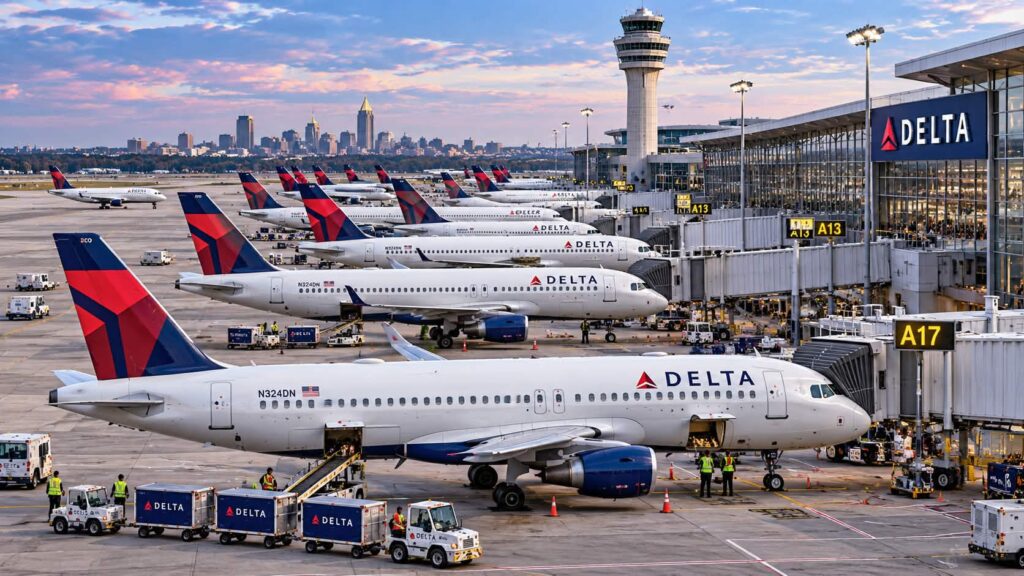
Delta Air Lines faced widespread flight delays Sunday morning after a technical outage affected the automated weight-and-balance system used to prepare aircraft for departure.
The system failure disrupted normal operations at Hartsfield-Jackson Atlanta International Airport, Delta’s primary hub, prompting the airline to request temporary restrictions on flights heading to the airport. The Federal Aviation Administration (FAA) responded by issuing a carrier-specific ground stop before transitioning to a ground delay program designed to manage congestion and reduce pressure on airport operations.
Although the FAA lifted the initial restrictions later that morning, the technical problem had already affected hundreds of flights. Delays accumulated at Atlanta and spread to other airports as aircraft and flight crews fell behind schedule.
The disruption came at a particularly challenging time for the airline industry, with Thanksgiving travel activity beginning to increase and millions of passengers preparing to fly across the United States.
FAA Issues Temporary Ground Stop for Delta Flights Bound for Atlanta
The FAA implemented a ground stop for Delta flights bound for Atlanta at approximately 7:46 a.m. Eastern Time on Sunday.
The restriction applied to Delta mainline and subsidiary flights departing from 14 of the 20 air traffic control center areas across the contiguous United States.
A ground stop is an aviation safety and traffic-management measure that temporarily prevents affected aircraft from departing for a particular airport. Airlines and air traffic controllers use these restrictions when airport conditions, weather, technical problems or other operational issues make it necessary to control incoming traffic.
The initial restriction was scheduled to remain in effect until 9 a.m. Eastern Time.
However, the FAA modified its response before that deadline. At approximately 8:32 a.m., the agency canceled the ground stop and replaced it with a ground delay program covering Delta flights traveling to Atlanta from across the country.
The revised program was initially scheduled to continue until 12:59 p.m. Eastern Time.
Under the program, flights were assigned an average delay of approximately 57 minutes, while the longest projected delays reached 111 minutes.
The change allowed aircraft to continue operating while controlling the rate at which flights arrived at Atlanta. Instead of stopping all affected departures, the delay program distributed arrival times to help manage airport capacity.
By shortly before noon, the FAA’s National Airspace System status website no longer listed the ground delay program.
The agency also indicated that the disruption was unrelated to its own air traffic control systems. The problem involved Delta’s operational technology rather than a failure of the FAA’s air traffic management infrastructure.
What Caused the Delta Flight Disruption?
Delta confirmed that the disruption was connected to an outage affecting its automated weight-and-balance system.
The technology is an important part of an airline’s departure preparation process. Before an aircraft can safely take off, its operating weight and center of gravity must be calculated to ensure they remain within approved limits.
These calculations account for several factors, including:
- The aircraft’s basic operating weight.
- The amount of fuel carried for the flight.
- The number and weight of passengers.
- Checked baggage and carry-on items.
- Cargo and other onboard equipment.
- The distribution of weight throughout the aircraft.
Airlines use this information to establish whether an aircraft is properly loaded and balanced for takeoff.
Weight distribution matters because an aircraft’s center of gravity affects its handling, stability and performance. An improperly calculated loading arrangement can create safety risks, making accurate weight-and-balance information essential before departure.
When Delta’s automated system became unavailable, employees had to rely on manual calculations and alternative procedures.
The airline said its teams were carrying out those calculations while technical specialists worked to restore the automated system.
Although manual procedures allowed flights to continue operating, they were slower than the normal automated process. That reduced the number of aircraft Delta could prepare for departure within its usual time frames.
The result was a bottleneck affecting aircraft turnaround times, gate availability and the movement of passengers through the Atlanta hub.
Delta Uses Manual Procedures While Technicians Work to Restore Automation
Delta said employees were using manual workarounds to keep flights operating safely while the company worked to resolve the technical issue.
In a statement, the airline said:
“Delta teams are using manual workarounds this morning to safely get flights departed while work continues to restore automation. We thank our customers for their patience and our people for their professionalism.”
The company also said it was coordinating with air traffic control to manage the number of aircraft arriving at its Atlanta hub.
Delta explained that it was working with air traffic control “to strategically enact programs to protect airport gates and tarmac areas from congestion at our Atlanta hub.”
The airline’s approach was intended to prevent too many aircraft from arriving at the same time when available gates and ground-handling resources were already under pressure.
This is particularly important at a large connecting hub such as Atlanta. Delta operates a substantial number of connecting flights through the airport, meaning a disruption to incoming aircraft can affect passengers traveling to destinations far beyond Georgia.
For example, a delayed arrival can prevent an aircraft from departing on its next scheduled route. Passengers waiting for connecting flights may then miss their planned departures, while crews and aircraft become unavailable for subsequent services.
Even after the original technical problem is addressed, airlines can require additional time to restore normal schedules.
Hundreds of Delays Reported at Hartsfield-Jackson Atlanta International Airport
Flight-tracking data showed that the disruption had a substantial effect on airport operations throughout the morning.
By approximately 10 a.m., Hartsfield-Jackson had recorded 364 flight delays across all airlines. The reported total included roughly 200 arriving flights and 164 departures.
The number increased as the morning continued.
Later figures showed more than 700 delays at the airport near midday, while approximately 1,000 Delta flights were reported delayed across the airline’s network by late morning.
Those delays represented an estimated 20% to 30% of Delta’s Sunday schedule.
Earlier operational advisories had warned that more than 3,500 flights could potentially be affected by the disruption.
The figures illustrate how a technical problem affecting one airline’s operations at a major hub can spread through the wider aviation network.
Atlanta is one of the most important connecting points in the United States. Flights arriving from different regions feed passengers into connecting services traveling to domestic and international destinations.
When the movement of aircraft slows at the hub, the effects can extend well beyond the airport itself.
Passengers may encounter delayed departures, missed connections, longer waiting times and changes to their scheduled arrival times.
The disruption also creates challenges for airline employees responsible for coordinating aircraft, flight crews, baggage handling, maintenance and customer service.
Flight Delays Spread to New York, Boston and California
The operational effects were not limited to Atlanta.
Delays were also reported at several other major airports, including New York’s LaGuardia Airport, Newark Liberty International Airport and Boston Logan International Airport.
Several airports in California also experienced disruptions as aircraft and crews became delayed throughout Delta’s network.
This type of disruption is common when an airline experiences problems at a major hub.
Airlines operate interconnected schedules in which the same aircraft may complete several flights during a single day. A delay on one route can affect the aircraft’s next departure, creating a chain reaction across multiple cities.
Flight crews also operate under scheduling and duty-time requirements. When an aircraft arrives late, the crew assigned to its next flight may not be able to depart as originally planned.
Airlines may need to reposition aircraft, assign replacement crews or adjust departure times to recover from significant delays.
For passengers, this means a flight that is not traveling to Atlanta can still be affected by an operational problem at the airport if its aircraft or crew is scheduled to operate through the hub.
Why Weight-and-Balance Calculations Are Essential for Airline Safety
The technical issue also highlighted an important part of commercial aviation that many passengers rarely consider.
Weight-and-balance calculations are required before an aircraft departs because pilots and airline dispatch teams must know that the aircraft is operating within its approved performance and loading limits.
An aircraft’s total weight affects the amount of lift required for takeoff, its fuel consumption, climb performance and landing characteristics.
The location of that weight is also important.
If the aircraft’s center of gravity is too far forward or too far aft, its handling characteristics can change. An aircraft that is improperly balanced may become more difficult to control, particularly during critical phases of flight.
For this reason, airlines have established procedures to verify loading information before departure.
Automated systems help process large amounts of data quickly, particularly at busy airports where aircraft operate on tight schedules.
When those systems become unavailable, airlines may use approved manual procedures to continue operations. However, the additional work can increase preparation times and reduce the number of flights that can depart within a given period.
Delta’s use of manual calculations was intended to maintain safe operations while the automated technology was being restored.
The incident demonstrates why airline technology is important not only for convenience and efficiency but also for supporting the operational checks required before takeoff.
Thanksgiving Travel Period Adds Pressure to Delta’s Atlanta Hub
The timing of the outage increased its potential impact.
The disruption occurred as airlines and airports entered the busy Thanksgiving travel period, one of the most demanding periods of the year for the U.S. aviation industry.
Hartsfield-Jackson Atlanta International Airport had projected that more than 4 million passengers would travel through the airport between the start of the Thanksgiving period and December 1.
That represented an increase of approximately 5% compared with the same period a year earlier.
Higher passenger volumes can make it more difficult for airlines to recover from unexpected disruptions.
When airports are operating near capacity, there may be fewer available gates, fewer opportunities to reposition aircraft and less flexibility in departure schedules.
A technical failure that might create manageable delays during a quieter period can therefore produce a much larger operational problem during a major holiday travel window.
Passengers traveling through Atlanta may also face additional challenges because Delta uses the airport as a central connecting hub.
A traveler flying from one part of the country to another may have to pass through Atlanta even when neither the departure nor destination city is in Georgia.
As a result, problems at the hub can affect passengers across the airline’s national network.
Incident Follows Nationwide FAA Ground Stop Earlier in November
The Delta disruption also occurred less than two weeks after a separate nationwide aviation incident involving the FAA.
On November 13, a telecommunications failure affected air traffic control facilities and led to a nationwide ground stop.
The incident caused widespread flight cancellations and delays as airlines adjusted their schedules and waited for normal operations to resume.
The aviation system required several days to recover fully from the disruption.
The two incidents involved different systems and should not be confused.
The November 13 event involved telecommunications infrastructure supporting air traffic control operations, while Sunday’s disruption involved Delta’s own automated weight-and-balance technology.
The FAA indicated that Sunday’s delays were not caused by a problem with its air traffic systems.
Nevertheless, the incidents have renewed attention on the technology and infrastructure that support commercial aviation.
Airlines and federal aviation authorities depend on complex systems to coordinate flight planning, communications, aircraft loading, airport capacity and passenger operations.
When one of those systems becomes unavailable, the consequences can extend well beyond the original technical problem.
What Passengers Should Know About Delta Flight Delays
Passengers scheduled to travel with Delta during a major operational disruption should monitor their flight status before leaving for the airport.
A flight may remain listed as scheduled even when an aircraft or crew is already experiencing delays elsewhere in the airline’s network. Departure times can also change as the airline adjusts its operations.
Travelers connecting through Atlanta should pay particular attention to their onward flight information.
Useful steps include:
- Check flight status regularly. Use Delta’s official website or mobile application to review departure times, arrival estimates and gate information.
- Confirm connecting-flight details. Passengers with short connections should monitor both flights because delays on the first leg can affect the rest of the journey.
- Pay attention to airline notifications. Delta may send updates about schedule changes, cancellations, rebooking options and other travel arrangements.
- Allow additional time at the airport. During major disruptions, check-in counters, customer-service desks and security areas may experience increased passenger traffic.
- Keep important travel information accessible. Boarding passes, reservation details and airline notifications can help passengers respond more quickly if their itinerary changes.
Passengers should also review the airline’s current policies regarding rebooking and refunds. The options available can depend on whether a flight is delayed, canceled or significantly changed.
Delta Faces the Challenge of Restoring Normal Operations
The FAA’s decision to lift the ground delay program removed the immediate traffic-management restrictions affecting Atlanta-bound Delta flights.
However, lifting a ground delay program does not automatically return an airline’s schedule to normal.
Aircraft may still be out of position, crews may be approaching duty-time limits, and passengers may have missed connections. Airlines must work through those issues while continuing to operate scheduled flights.
The technical team must also ensure that the automated weight-and-balance system is functioning reliably before normal procedures can fully resume.
For Delta, the priority was to continue operating safely through manual workarounds while restoring the technology needed to support its regular departure process.
The disruption served as a reminder of how dependent modern airlines are on interconnected operational systems.
A technical outage at a single major hub can affect thousands of passengers, disrupt aircraft schedules across multiple states and create difficulties for travelers who may be nowhere near the airport where the original problem occurred.
With Thanksgiving travel volumes increasing, Delta and other airlines face additional pressure to maintain reliable operations and respond quickly when unexpected technical problems arise.
Although the FAA restrictions were lifted, the broader effects of Sunday’s outage demonstrated how quickly a problem involving airline technology can spread across the national flight network.

Benjamin Harris is a RapidReports front page contributor and editor,proud father of four.