Nate Silver Says Trump Could Face Impeachment Over Nvidia AI Chip Sales to China
Political analyst Nate Silver says President Donald Trump could face serious political and constitutional consequences over his administration’s decisions involving advanced artificial intelligence chips manufactured by Nvidia and AMD and approved for export to Chinese companies.
Speaking on the November 25 episode of the Still Counting podcast, Silver discussed congressional findings that the Trump administration had approved export licenses covering nearly 900,000 advanced AI chips destined for Chinese companies, some of which a House committee has alleged have connections to China’s military.
Silver argued that the controversy could become a major political liability for Trump, particularly if evidence emerged that the president personally benefited financially from decisions involving the technology.
During the discussion, Silver said he considered a roughly 25% probability of Trump being impeached by the House of Representatives and convicted by the Senate before the end of his current term to be “entirely reasonable.”
However, his comments were an assessment of a possible political and constitutional scenario, not a finding that Trump had committed an impeachable offense.
The controversy has attracted additional attention because Trump acknowledged helping persuade Nvidia’s board to reinstate chief executive Jensen Huang after Huang’s departure from the company. Reports also indicated that Trump’s Nvidia investments increased in value following the announcement.
The developments have raised questions about export controls, national security, presidential influence over private companies and potential conflicts of interest.
Nate Silver Discusses Trump’s Impeachment Possibilities
Silver made his remarks while discussing the political implications of the Nvidia controversy with his Still Counting co-hosts Galen Druke and Clare Malone.
The conversation turned to prediction markets and the possibility that Trump could be impeached and removed from office before his second presidential term ends.
Druke suggested that the markets were placing the possibility at approximately 25%.
Silver responded that the estimate was “entirely reasonable,” particularly if investigators uncovered evidence that the president had helped facilitate the transfer of strategically important technology to China for personal financial benefit.
Silver argued that if Trump were found to have aided or facilitated improper activity, the issue could become serious enough to produce bipartisan support for congressional action.
He also connected the possibility to Trump’s declining political approval, suggesting that a further deterioration in public support could make Republican lawmakers more concerned about the electoral consequences of defending the administration.
However, Silver’s co-host Clare Malone expressed skepticism about the likelihood of Trump actually being removed from office.
Malone questioned the reliability of prediction-market estimates and argued that Trump’s removal through impeachment and Senate conviction remained unlikely.
The disagreement demonstrated that even within the podcast, the participants did not share a single assessment of how the controversy might develop.
Silver’s position was that the possibility should not be dismissed if evidence of presidential wrongdoing emerged. He did not claim that impeachment was inevitable or that the constitutional requirements had already been met.
House Committee Raises Questions About Nearly 900,000 AI Chips
The controversy intensified after the House Foreign Affairs Committee released information concerning U.S. export licenses for advanced artificial intelligence chips.
According to congressional materials discussed in subsequent reporting, the Department of Commerce had approved 21 license applications covering approximately 879,868 advanced AI chips for Chinese companies as of May 11, 2026.
The chips involved included products manufactured by Nvidia and AMD, two major companies in the global semiconductor industry.
Some of the Chinese companies identified in the congressional investigation were alleged to have connections to China’s military or broader strategic technology sector.
The allegations have raised concerns about whether advanced American semiconductor technology could strengthen China’s artificial intelligence capabilities, including systems with potential military applications.
The distinction between an approved export license and a completed shipment is important.
An authorization to export does not necessarily establish that every approved chip was delivered, that every recipient violated the law or that the administration knowingly transferred technology for military use.
Those questions require examination of the specific companies, products, licenses, end users and applicable export-control requirements.
The controversy nevertheless places renewed attention on the government’s responsibility to determine which advanced technologies can be sold to foreign buyers.
Why Advanced AI Chips Are Important to National Security
Advanced artificial intelligence chips have become strategically important because they provide much of the computing power required to train and operate sophisticated AI systems.
These processors can perform enormous numbers of calculations and are used in data centers, scientific research, commercial applications and increasingly sophisticated military-related technologies.
Nvidia is a leading supplier of high-performance AI accelerators, while AMD is another major competitor in the market.
The United States has introduced export restrictions designed to limit China’s access to certain advanced semiconductor technologies. The stated national security concern is that access to powerful computing equipment could help Beijing develop advanced AI capabilities with both civilian and military applications.
The issue has become politically complicated because American semiconductor companies have argued that carefully controlled sales can preserve their international market positions and discourage foreign customers from turning to competing suppliers.
Supporters of allowing some exports argue that restricting every sale could damage American companies and reduce their influence over the global technology market.
Critics counter that allowing advanced chips to reach companies with potential military connections could undermine national security objectives.
The debate is therefore not simply about whether American companies should be permitted to sell products abroad. It concerns the balance between commercial interests, technological leadership and national security.
Trump’s Role in Jensen Huang’s Return to Nvidia
The controversy surrounding chip exports gained another dimension after Nvidia chief executive Jensen Huang returned to the company’s leadership following his departure in November.
Huang stepped down as CEO on November 12 after reports concerning his personal relationships and questions surrounding possible national security implications.
One report involved an alleged relationship with a Chinese executive whom U.S. officials reportedly suspected of having connections to Chinese intelligence.
These reports raised questions about whether sensitive corporate information could have been exposed. However, allegations involving personal relationships and suspected intelligence connections should not be treated as proof that Huang transferred classified information or committed an export-control violation.
Nvidia’s board subsequently agreed unanimously to reinstate Huang.
Trump acknowledged that he had helped persuade the board to bring Huang back.
In remarks reported by CNBC, the president said, “I convinced them,” referring to the company’s decision.
Trump argued that Huang was an important figure in the American technology industry and that his leadership was valuable to the country’s ability to compete in artificial intelligence.
The president also expressed confidence in Huang and suggested that the executive did not pose the national security risk described in some reports.
The intervention attracted criticism because the decision involved a major private company operating in an industry with significant national security implications.
It also raised questions about how closely the administration should become involved in corporate leadership decisions.
Reports of Trump’s Nvidia Investment Gains Add to the Controversy
Financial reporting added another element to the debate after Nvidia shares increased following news of Huang’s return.
The Financial Times reported that Trump’s Nvidia holdings increased in value by as much as approximately $15 million during the market movement.
That figure has attracted attention because the president had publicly acknowledged playing a role in the company’s leadership decision.
However, an increase in the market value of an investment is not automatically equivalent to a realized profit. It is also not, by itself, proof that the president’s actions were motivated by personal financial interests.
The distinction matters when evaluating allegations of conflicts of interest.
A meaningful investigation would need to examine the president’s actual holdings, the timing and nature of any transactions, applicable financial disclosure information and whether official decisions were influenced by private financial considerations.
Trump has denied that he uses the presidency to enrich himself.
The reported increase in Nvidia investment value has nevertheless added to public scrutiny of the relationship between presidential decision-making and the financial interests of powerful technology companies.
Silver’s hypothetical argument was specifically that evidence of Trump personally profiting from improper chip sales could substantially change the political and legal significance of the controversy.
He did not establish that such a personal profit scheme had occurred.
Republican Senators Call for Further Scrutiny
The controversy has also attracted attention from Republican lawmakers.
Senators Tom Cotton and Tim Scott have indicated that they intend to examine aspects of the Nvidia situation and the broader national security questions surrounding advanced technology exports.
Their interest is politically significant because it suggests that scrutiny of the issue is not necessarily limited to Democratic lawmakers.
Members of Congress have raised questions about export-control compliance, the administration’s decision-making and the potential consequences of allowing advanced computing technology to reach Chinese companies.
The investigation could examine the role of the Commerce Department, the licensing process and the safeguards intended to ensure that sensitive technology is used only by approved recipients.
It could also examine whether companies and government agencies adequately evaluated potential risks involving Chinese military-linked organizations.
The congressional scrutiny does not establish that the administration violated the law. It does, however, create the possibility of further hearings, document requests and public questioning of officials and company executives.
Huang was also scheduled to testify before the Senate Banking Committee on December 3, according to reporting by the Associated Press.
His testimony could provide lawmakers with an opportunity to question him about Nvidia’s business decisions, national security concerns and the company’s relationship with the administration.
How Impeachment and Removal Would Work
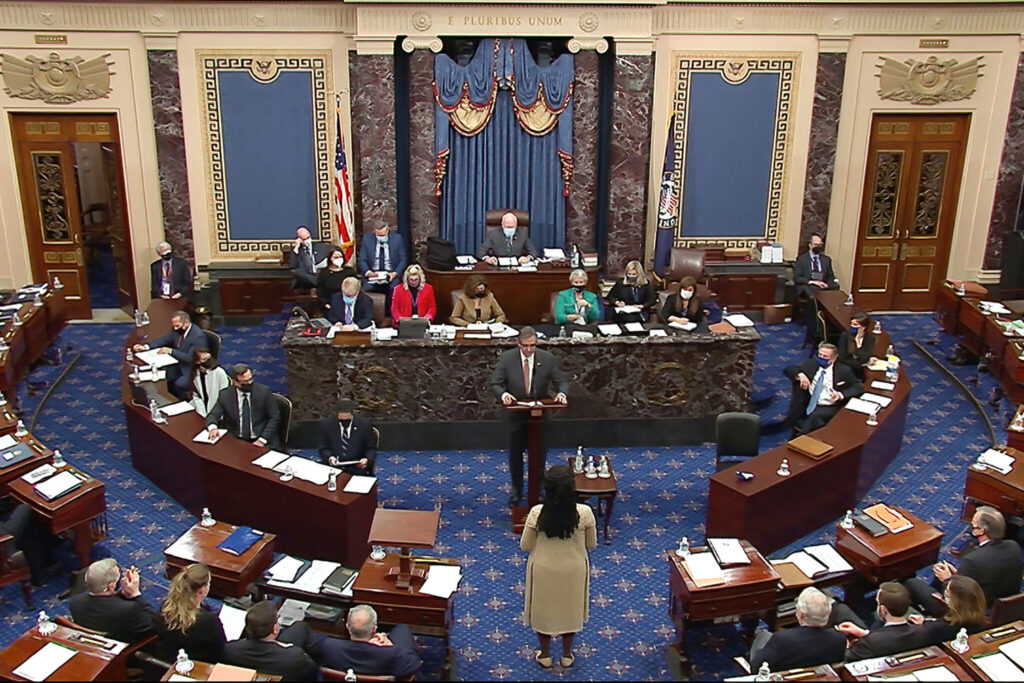
Silver’s comments referred to two separate constitutional steps: impeachment by the House of Representatives and conviction by the Senate.
Under the U.S. Constitution, the House has the authority to impeach a president by approving articles of impeachment through a simple majority vote.
Impeachment is comparable to a formal accusation. It does not automatically remove a president from office.
The process then moves to the Senate, which conducts a trial.
Removing a president requires a two-thirds vote of senators present to convict.
That is a substantial constitutional hurdle, particularly in a closely divided Senate.
Trump has already been impeached twice by the House during his first presidential term.
In both cases, the Senate acquitted him, allowing him to remain in office.
The Nvidia controversy would therefore represent a potential third impeachment proceeding if the House approved new articles against him.
But the existence of political controversy, criticism or congressional investigations does not automatically establish grounds for conviction.
Lawmakers would need to identify specific conduct and determine whether it meets the constitutional standard for impeachment.
Any allegation involving personal financial gain, misuse of presidential authority or assistance to foreign entities would require evidence and legal analysis.
Could Democrats Pursue Impeachment?
The political situation could become more complicated as the next Congress prepares to take office.
Following the November 2026 midterm elections, Democrats are expected to have greater congressional power, creating opportunities for additional investigations into the administration.
Silver suggested that Democrats could examine whether bipartisan support might emerge for stronger restrictions on advanced technology exports to China.
He also discussed the possibility of Congress passing stricter export-control legislation, potentially with enough support to overcome a presidential veto.
The question of impeachment, however, is different from the question of whether Congress should impose additional restrictions on semiconductor exports.
Lawmakers can investigate government decisions, conduct oversight hearings and pass legislation without necessarily pursuing impeachment.
Even if the House were to approve articles of impeachment, conviction in the Senate would remain a separate and much more difficult step.
The political calculations of individual lawmakers would also matter. Senators and representatives would have to consider the evidence, constitutional questions, national security implications and the views of their constituents.
For now, Silver’s 25% figure should be understood as his assessment of a possible future outcome, not an established forecast or official congressional position.
The Broader Debate Over America’s AI Competition With China
The Nvidia controversy reflects a wider disagreement over how the United States should maintain its technological advantage over China.
The Trump administration has emphasized the importance of keeping American companies competitive in the global AI market.
Nvidia’s products are central to the development of advanced AI infrastructure, and the company has a significant commercial interest in selling computing technology internationally.
However, the national security community has repeatedly warned that advanced computing capabilities can have applications beyond ordinary commercial activity.
Artificial intelligence can support scientific research, manufacturing, logistics and medical innovation. It can also potentially assist military planning, intelligence analysis, autonomous systems and cyber operations.
This creates a difficult policy question: how can the United States preserve the commercial success of its technology industry while preventing strategically sensitive products from strengthening potential adversaries?
The controversy has also exposed disagreements within the political right.
Some conservative lawmakers and commentators favor stricter restrictions on advanced chip exports to China, arguing that national security should take priority over corporate revenue.
Others emphasize the importance of maintaining American technological leadership and preventing foreign competitors from gaining an advantage.
Trump’s support for Huang’s return has therefore attracted attention not only from Democrats but also from Republicans who want stronger scrutiny of the administration’s China policy.
What Happens Next?
Several developments could determine whether the Nvidia controversy becomes a larger political crisis for Trump.
First, congressional investigators may seek additional information about the 21 approved export-license applications and the companies that were authorized to receive the chips.
Second, lawmakers may question Commerce Department officials about how the export decisions were evaluated and what safeguards were applied.
Third, Jensen Huang’s scheduled Senate testimony could bring additional attention to Nvidia’s internal decision-making and its interactions with the U.S. government.
Finally, any credible evidence connecting presidential actions to personal financial benefits could intensify demands for investigations into potential conflicts of interest.
Each of these developments would require careful examination. An approved export license is not proof of illegal conduct, and an increase in the value of a president’s investment does not independently demonstrate corruption.
The central questions concern what the administration knew, why particular export decisions were made, whether the relevant restrictions were followed and whether any official action was influenced by personal financial interests.
Nate Silver’s Warning Highlights a Growing Political Dispute
Nate Silver’s comments have placed the Nvidia controversy into a broader discussion about presidential accountability, technology policy and the political consequences of decisions involving China.
His suggestion that a 25% chance of impeachment and Senate conviction was reasonable reflects his view that the issue could become more serious if evidence of personal presidential benefit or improper assistance emerged.
His co-hosts expressed different assessments of whether removal was realistically possible, highlighting the uncertainty surrounding the political implications.
For now, no conclusion has been established that Trump personally profited from improper chip sales or committed an impeachable offense through his administration’s export decisions.
What is clear is that the issue has attracted congressional scrutiny, raised questions about national security and placed the relationship between the White House and one of America’s most influential technology companies under renewed examination.
The coming weeks may provide more information about the export licenses, Nvidia’s leadership controversy and the administration’s role in the decisions.
Until then, the distinction between documented actions, allegations and hypothetical scenarios remains essential to understanding the story.

Benjamin Harris is a RapidReports front page contributor and editor,proud father of four.