Musk Draws Attention as Bernie Sanders Pushes 50% AI Ownership Tax on Major Companies
Elon Musk and Sen. Bernie Sanders have once again found themselves on opposite sides of a debate over taxes, technology and the future of artificial intelligence — this time over an unusually broad proposal that would give the American public a major ownership stake in large AI companies.
Sanders, an independent senator from Vermont, introduced the American AI Sovereign Wealth Fund Act in June. Rather than imposing a conventional tax on corporate profits, the legislation would require qualifying AI companies to transfer 50% of their equity to a federally managed sovereign wealth fund.
The proposal would eventually give the public a financial stake in some of the country’s largest AI businesses while also giving a government-appointed commission voting power over those holdings.
Musk, whose companies include xAI and SpaceX, has been one of the technology industry’s most prominent voices on the economic effects of artificial intelligence. Sanders himself has cited Musk’s earlier support for government payments to Americans as AI potentially eliminates jobs.
The latest dispute therefore centers on a broader question: who should benefit financially from the rapid expansion of AI, and how much influence should the federal government have over the companies developing it?
Sanders’ Proposal Is a 50% Equity Tax
Sanders formally introduced his AI sovereign wealth fund legislation on June 18.
Under the proposal, companies engaged in qualifying AI activities would face a one-time tax equal to 50% of their equity, paid in shares rather than cash. The legislation would apply to companies meeting specified thresholds, including businesses generating at least $200 million in annual AI-related sales.
That distinction is important.
Sanders is not proposing to simply take half of an AI company’s annual profits. Instead, the government would receive shares representing half of the qualifying company’s equity.
Those shares would then be placed into a new American AI Sovereign Wealth Fund.
The senator’s office estimates that the fund could initially be worth approximately $7 trillion based on current valuations.
The Government Would Become a Major Shareholder
The proposal goes beyond collecting revenue.
Because the government would hold voting shares, the fund would give the public an ownership interest in participating AI companies.
The fund would be administered by an Independent Commission for Democratic AI consisting of seven commissioners nominated by the president and confirmed by the Senate. The commission would be charged with managing the fund in the public interest.
The legislation says the commission would consider goals including worker welfare, public safety, competition, environmental sustainability and the financial health of the fund.
That means the proposal is designed not merely as a revenue-generating tax but as a mechanism for giving the public an ongoing role in corporate governance.
Sanders Says AI Wealth Should Be Shared
Sanders has argued that artificial intelligence is built on decades of collective human knowledge, scientific research and creative work.
His position is that the economic gains produced by AI should therefore not accrue primarily to company founders, investors and other wealthy shareholders.
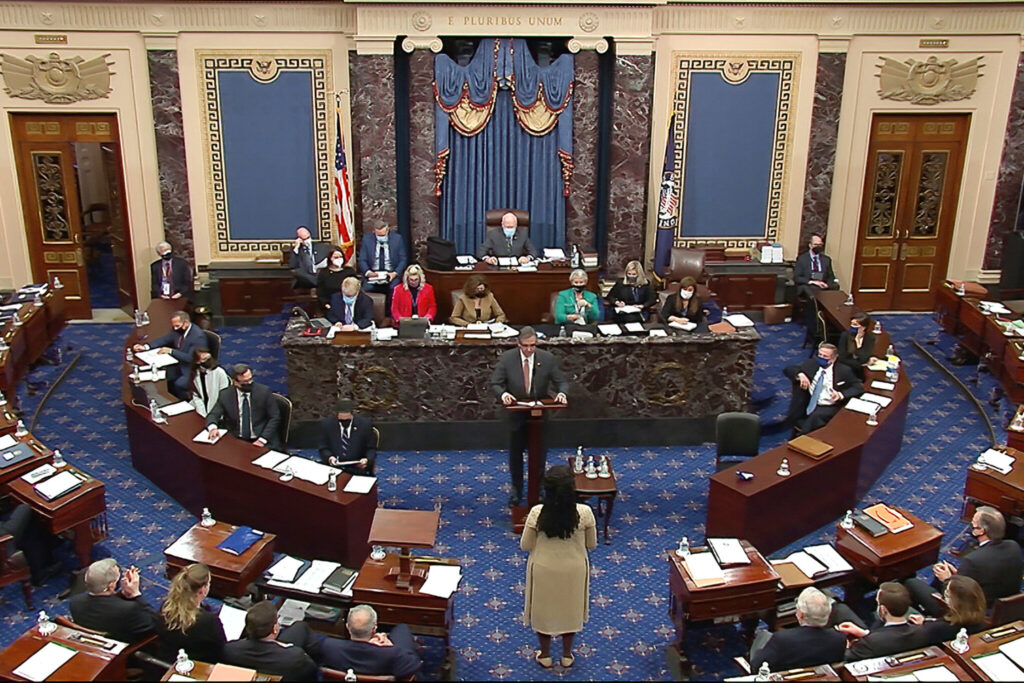
In Senate remarks introducing the proposal, Sanders specifically identified Musk and other technology billionaires while arguing that Americans should have a direct stake in the technology’s economic future.
The senator has also compared his concept with sovereign wealth funds already operating elsewhere in the world.
He has pointed to Norway’s oil-backed fund and Alaska’s Permanent Fund as examples of mechanisms through which natural-resource wealth can generate benefits for the public.
The Fund Would Pay Annual Dividends
Under Sanders’ proposal, the sovereign wealth fund would distribute 5% of its value annually.
The money could be used for direct payments to Americans as well as programs involving health care, education and housing.
Sanders’ office has estimated that a fund worth roughly $7 trillion could produce an annual distribution large enough to provide more than $1,000 per person at the outset.
Those figures are projections based on the estimated value of the proposed fund and would depend on the value of the companies transferred into it, future market performance and the structure of the eventual distributions.
The bill has not become law.
Musk’s Connection to the Debate
Musk is directly relevant to the proposal because Sanders has repeatedly cited him when discussing the distribution of AI-generated wealth.
Interestingly, Sanders’ own legislation references an earlier position from Musk supporting government payments as a response to AI-related unemployment.
The Congressional Record quotes Musk as saying that a “Universal HIGH INCOME” delivered through federal checks would be an appropriate response to unemployment caused by AI.
That idea is considerably different from Sanders’ proposal.
Musk’s earlier position centered on transferring income to people who might be displaced by automation. Sanders’ bill would instead establish public ownership of AI companies and use the resulting assets to generate ongoing payments and fund other public priorities.
Sanders’ Plan Would Cover More Than AI Model Developers
Another important feature of the legislation is the breadth of the businesses that could fall within its scope.
The proposal is not limited to companies whose primary product is an AI chatbot or foundation model.
The legislation addresses businesses involved in areas including AI data centers, computing infrastructure, AI services and advanced robotics.
That potentially brings a much wider range of technology and infrastructure companies into the debate.
The legislation also requires companies with both AI and non-AI operations to structurally separate those businesses under specified conditions.
The public ownership would then apply to the qualifying AI business rather than automatically covering unrelated operations.
The Proposal Could Reach Some of America’s Largest Technology Companies
Because the definition of qualifying AI activity is broad, analysts have noted that the legislation could affect companies well beyond startups such as OpenAI or Anthropic.
Large technology and semiconductor companies with substantial AI-related operations could potentially be affected depending on how the bill’s definitions and thresholds apply.
The legislation is therefore much broader than a tax aimed solely at a handful of AI laboratories.
It is an attempt to establish a new ownership framework for a large segment of the emerging AI economy.
Sanders Has Also Called for Stronger AI Restrictions
The sovereign wealth fund is only one part of Sanders’ broader approach to artificial intelligence.
He has also pushed for restrictions on the rapid expansion of AI infrastructure and has called for greater government oversight of advanced AI systems.
In August, Sanders called on major AI companies to pause development amid concerns about the potential risks of increasingly capable systems.
The issue has gained additional attention in September after AI executives and researchers raised concerns about the pace of development and possible safety risks.
Reuters reported Monday that Musk, OpenAI CEO Sam Altman and Anthropic CEO Dario Amodei had all expressed support for greater caution around advanced AI development, although their specific approaches differ.
That creates an unusual dynamic: some technology leaders have recently expressed concern about AI risks while continuing to disagree with lawmakers over the appropriate role of government.
The Debate Is About More Than Taxes
Supporters of Sanders’ proposal can frame it as a way to ensure that the public participates financially in an economic transformation driven partly by publicly funded research and widely shared knowledge.
Critics have raised questions about the scale of government ownership, the effects on private investment and the practical consequences of transferring half of a company’s equity to a government-controlled fund.
The proposal would also represent a significant change in the relationship between the federal government and private technology companies.
Instead of simply taxing corporate income, the government would become a major shareholder with voting rights.
That distinction makes the legislation more consequential than a conventional increase in the corporate tax rate.
Musk and Sanders Have a History of Tax Disputes
The latest debate also fits into a much longer public disagreement between Musk and Sanders over wealth and taxation.
In 2021, Sanders called for the extremely wealthy to pay more in taxes, prompting Musk to respond publicly and suggest that he could sell additional Tesla stock. The exchange became one of several public disputes between the two men over taxation and wealth.
The current AI debate is different in substance.
Sanders is now proposing a direct transfer of corporate equity into a public fund rather than simply seeking higher taxes on Musk’s personal wealth.
And Musk’s own earlier support for government payments in response to AI-driven job losses gives the current discussion an additional layer: the two have identified some of the same potential economic consequences of AI while proposing substantially different mechanisms for addressing them.
The Bill Faces a Long Legislative Path
Sanders’ legislation remains a proposal rather than enacted federal policy.
It would need to move through Congress, survive negotiations over its tax and corporate-governance provisions, and ultimately receive presidential approval before becoming law.
The proposal’s breadth also means that questions surrounding implementation would be significant.
Among them are how the government would value private companies, how equity transfers would be administered, how corporate structures would be separated, how voting rights would be exercised and how the annual distributions would be calculated.
Those questions would have to be resolved before the proposed fund could operate on the scale envisioned by Sanders.
What Happens Next in the AI Tax Debate?
The Sanders proposal has added another dimension to the rapidly expanding debate over AI policy in Washington.
Congress is simultaneously considering other approaches, including proposals focused on AI safety, government oversight and the potential dangers posed by advanced systems. Reuters reported that bipartisan Senate negotiators are considering legislation that could impose a duty of care on developers of highly capable AI systems and require safeguards against catastrophic misuse.
Sanders’ proposal takes a different route by focusing on ownership and wealth distribution.
Rather than asking only how AI should be regulated, it asks who should own a portion of the companies creating it.
That question is likely to remain contentious as lawmakers grapple with the economic consequences of increasingly powerful AI systems.
For now, Sanders’ American AI Sovereign Wealth Fund Act remains legislation under consideration, not an enacted tax. Its proposed 50% equity transfer, estimated $7 trillion fund, public voting rights and potential annual dividends represent a significant departure from conventional federal tax policy.
The debate over Musk, Sanders and AI is therefore ultimately about more than one billionaire and one senator. It is about how the United States should distribute the economic gains of a technology that is rapidly reshaping business, employment and investment — and how much ownership or control, if any, the public should have over the companies driving that transformation.

Benjamin Harris is a RapidReports front page contributor and editor,proud father of four.