Fifth Circuit Rules Pandemic-Era House Proxy Quorum Unconstitutional in 2022 Spending Bill
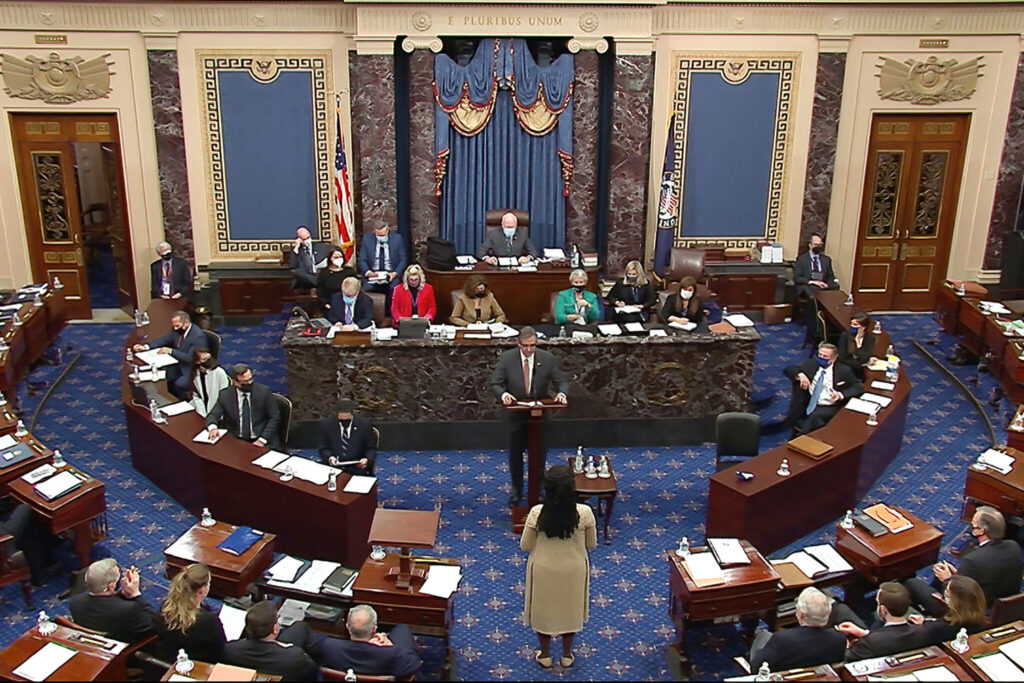
A federal appeals court has ruled that the U.S. House of Representatives violated the Constitution when it relied on pandemic-era proxy procedures to establish a quorum while passing a major government spending package in December 2022.
In a closely divided 9–8 decision issued November 20, 2026, the full 5th U.S. Circuit Court of Appeals concluded that lawmakers who were absent from the chamber could not be counted as physically present through proxy arrangements for purposes of meeting the constitutional quorum requirement.
The case involves the Consolidated Appropriations Act of 2023, a government funding package worth approximately $1.7 trillion that Congress approved during the final weeks of the 117th Congress. Former President Joe Biden signed the legislation into law.
The ruling challenges a pandemic-era procedure introduced under former Democratic House Speaker Nancy Pelosi, which allowed members unable to attend congressional proceedings to designate colleagues to cast their votes and record their presence.
However, the appeals court did not invalidate the entire spending package. Its immediate legal remedy is narrower: The federal government is prohibited from enforcing the Pregnant Workers Fairness Act against the state of Texas.
The decision nevertheless raises significant constitutional questions about congressional procedure, the limits of legislative authority and the legal consequences of emergency measures adopted during the COVID-19 pandemic.
Fifth Circuit Reaches 9–8 Decision on Congressional Proxy Voting
The ruling came from the full 5th Circuit, which reconsidered the dispute after an earlier three-judge appellate panel reached a different conclusion.
Judge Cory Wilson, who was appointed by President Donald Trump, authored the majority opinion. Eight other judges did not join his opinion, with Judge James Graves writing a principal dissent and Judge Catharina Haynes issuing a separate dissent.
The majority concluded that Article I, Section 5 of the U.S. Constitution requires a majority of House members to be present to establish a quorum before the chamber conducts legislative business.
Under the court’s interpretation, an absent lawmaker cannot become constitutionally present simply because another representative has been authorized to cast that lawmaker’s vote.
“Proxy presence” does not count, Wilson wrote.
The majority also emphasized that Congress has considerable authority to establish its own procedural rules, but that authority remains subject to constitutional limitations.
“While the chambers of the legislature have much discretion regarding their rules of procedure, the Quorum Clause’s constraints on congressional power cannot be circumvented by congressional fiat,” the opinion stated.
The judges concluded that the House’s internal rules could not override the constitutional requirement for a quorum.
The ruling does not necessarily prohibit every form of proxy voting in every legislative context. The central question before the court was whether absent members could be counted as present for purposes of establishing a constitutionally valid quorum.
The majority answered that question in the negative.
How the $1.7 Trillion Spending Package Passed the House
The case centers on the Consolidated Appropriations Act of 2023, which Congress passed on December 23, 2022.
The legislation provided funding for federal agencies and government programs and included numerous policy provisions, among them the Pregnant Workers Fairness Act.
The House approved the broader package by a vote of 225 to 201, with one member voting present and four members not voting.
However, the voting procedure became the central issue in the subsequent lawsuit.
According to the Congressional Record cited in the appeals court opinion, 226 of the 427 members who recorded a vote had their presence and votes recorded through proxy arrangements.
At the time, the House had four vacancies, meaning 431 members were serving. A majority of that membership was required to establish a quorum.
The court found that fewer than a majority of lawmakers were physically present when the House voted on the spending package.
The House nevertheless counted absent members represented through proxies toward the quorum under its existing procedural rules.
That decision allowed the chamber to proceed with the vote and approve the legislation.
The appeals court concluded that the arrangement did not satisfy the Constitution’s requirements.
Nancy Pelosi Introduced Proxy Voting During the COVID-19 Pandemic
The proxy-voting system was introduced in May 2020, when Congress was confronting the operational challenges created by the coronavirus pandemic.
At the time, lawmakers faced concerns about traveling to Washington, gathering in crowded legislative chambers and maintaining regular congressional operations during a public health emergency.
Pelosi and Democratic House leaders supported procedures that would allow representatives to participate in legislative business without necessarily being physically present in the chamber.
Under House Resolution 965, a representative could designate another member to act as a proxy.
The designated lawmaker could then cast the absent representative’s vote and record that member’s presence under the House’s procedures.
The resolution also authorized remote participation in certain committee proceedings.
A subsequent House resolution maintained the proxy system during the 117th Congress.
Democratic leaders defended the arrangement as a practical response to an extraordinary public health emergency. They argued that Congress needed to continue conducting legislative business while reducing the need for members to travel and gather in person.
The system allowed lawmakers to participate in votes even when they could not attend proceedings in Washington.
Republicans, however, challenged the practice, arguing that the Constitution’s quorum requirement could not be satisfied by counting absent representatives as present.
The dispute became particularly important as the House continued using the procedure beyond the initial stages of the pandemic.
After Republicans regained control of the House in January 2023, the chamber discontinued the pandemic-era proxy-voting arrangement.
Constitutional Dispute Centers on Article I, Section 5
The legal question involves the Quorum Clause of the U.S. Constitution.
Article I, Section 5 establishes that a majority of members of each congressional chamber constitutes a quorum necessary to conduct business.
The provision also gives each chamber authority to establish rules for compelling the attendance of absent members.
The constitutional language has been interpreted through more than two centuries of congressional practice and judicial decisions.
The Fifth Circuit majority concluded that the term requiring a majority to be present cannot be expanded through an internal House rule to include lawmakers who are absent but represented by another member.
The judges relied on the text and historical understanding of the Constitution, as well as Supreme Court precedent.
The opinion discussed the 1892 Supreme Court decision in United States v. Ballin, which addressed Congress’s authority to establish rules for determining whether a quorum exists.
The majority interpreted that precedent as recognizing congressional discretion over procedural methods while maintaining that internal rules cannot disregard constitutional restrictions.
The judges also considered the distinction between voting by proxy and being counted as present for quorum purposes.
Those are related but separate questions.
The Fifth Circuit emphasized that the case did not require it to decide whether Congress may ever permit lawmakers to cast votes by proxy. Instead, it addressed whether an absent member’s designation of a proxy could make that member constitutionally present when calculating a quorum.
The majority concluded that it could not.
Texas Attorney General Ken Paxton Brought the Lawsuit
The case originated with a lawsuit filed by Texas Attorney General Ken Paxton in 2023.
Paxton challenged the constitutionality of the Pregnant Workers Fairness Act, arguing that the House had not established a valid quorum when it passed the broader spending legislation containing the measure.
Texas maintained that the federal government could not constitutionally enforce the workplace protections against the state because the legislation had been approved using an invalid quorum procedure.
The lawsuit was directed at federal officials and agencies responsible for implementing and enforcing the law.
The federal government disputed Texas’s arguments, defending the validity of the legislation and the House’s authority to establish its procedures.
The case proceeded through a federal district court before reaching the Fifth Circuit.
The litigation eventually became a broader constitutional dispute over the relationship between congressional procedural authority and the requirements imposed by the Constitution.
What Is the Pregnant Workers Fairness Act?
The Pregnant Workers Fairness Act is a federal workplace protection law included in the 2023 spending package.
It requires covered employers to provide reasonable accommodations to qualified employees experiencing limitations related to pregnancy, childbirth or associated medical conditions.
Depending on the circumstances, accommodations may include modified work schedules, additional breaks, temporary changes in job responsibilities or adjustments to physical duties.
The law also addresses how employers must respond to accommodation requests and establishes protections against certain forms of discrimination.
For example, a pregnant employee whose job involves frequent heavy lifting may request a temporary adjustment to those responsibilities if medically necessary and reasonable under the law.
The legislation was designed to address situations in which employees could face pressure to continue working under conditions that create difficulties related to pregnancy or childbirth.
Texas challenged the federal government’s authority to enforce the measure against the state, arguing that the law was included in legislation passed without a constitutionally valid quorum.
The case therefore did not primarily concern whether pregnancy-related workplace accommodations are desirable policy. It concerned whether Congress had followed the constitutional requirements necessary to enact the law.
Federal District Court Initially Ruled in Texas’s Favor
A federal district court in Texas ruled in 2024 that the House’s use of proxy presence violated the Constitution’s quorum requirement.
The district court concluded that the House could not count absent members toward a quorum simply because they had designated colleagues to represent them.
It therefore blocked federal enforcement of the Pregnant Workers Fairness Act against Texas.
The district court’s remedy was deliberately limited.
Texas had challenged more than one provision of the spending package, including a separate $20 million appropriation connected to a Department of Homeland Security pilot program.
However, the district court found that Texas did not have standing to pursue that separate challenge.
The court granted relief concerning the Pregnant Workers Fairness Act but did not invalidate the entire appropriations package.
It also declined to issue a broader declaratory judgment concerning the legislation.
The federal government appealed the decision.
Earlier Appeals Court Panel Reversed the District Court
The litigation took another turn in August 2025, when a three-judge panel of the Fifth Circuit reversed the district court’s ruling.
That panel concluded that the Constitution did not necessarily require physical presence for a chamber of Congress to conduct legislative business.
The panel therefore vacated the injunction protecting Texas from enforcement of the Pregnant Workers Fairness Act.
The disagreement within the appellate court led to further proceedings.
The Fifth Circuit later agreed to reconsider the case with all eligible active judges participating, a procedure known as an en banc review.
The earlier panel opinion was vacated as the full court reconsidered the constitutional question.
The November 20, 2026, decision reversed the direction of the earlier appellate ruling and affirmed the district court’s injunction.
The result leaves the district court’s limited protection for Texas in place.
Fifth Circuit Does Not Strike Down the Entire Spending Law
One of the most important aspects of the decision is the distinction between the court’s constitutional reasoning and the relief it actually granted.
The majority concluded that the House’s passage of the Consolidated Appropriations Act of 2023 violated the Quorum Clause because the chamber relied on proxy presence to establish a quorum.
That conclusion is broad in its constitutional reasoning.
However, the lawsuit sought a specific remedy concerning the Pregnant Workers Fairness Act, and the court’s judgment affirmed the injunction addressing that provision.
The court did not order the entire $1.7 trillion spending package invalidated.
It did not cancel every appropriation contained in the legislation, reverse all government spending authorized under the package or automatically eliminate every other provision enacted through the same congressional vote.
Instead, the immediate injunction prohibits the federal government from enforcing the Pregnant Workers Fairness Act against Texas.
That distinction matters because a court’s legal reasoning and the practical scope of its judgment are not necessarily identical.
The majority’s interpretation of the Constitution could influence future litigation, but the decision itself does not automatically erase the entire 2023 appropriations law.
Other parties seeking to challenge different provisions would need to establish the necessary legal basis and obtain appropriate relief.
Judge James Graves Issues Strong Dissent
The decision was not unanimous.
Judge James Graves, who was appointed by former President Barack Obama, wrote a dissent criticizing the majority’s constitutional interpretation.
Graves argued that the Constitution does not explicitly require lawmakers to be physically present in the chamber in the manner demanded by the majority.
He maintained that Congress possesses substantial authority to determine how its members participate in legislative proceedings and how the chamber establishes whether a quorum exists.
The dissent also questioned the practical implications of the majority’s reasoning.
Graves noted that the spending package had received votes from hundreds of lawmakers and that the House had adopted the proxy procedure through its established internal rules.
He argued that the majority had imposed a physical-presence requirement that was not expressly stated in the constitutional text.
In particularly sharp language, Graves described the ruling as “illogical, inexplicable, and invalid.”
His dissent also raised concerns about the remedy.
If the majority concluded that the House had violated the Constitution when passing the broader spending package, Graves questioned why the resulting legal relief should be limited to one provision of that legislation.
The dissent reflects a fundamental disagreement over how courts should interpret the Quorum Clause and how much authority Congress retains to establish procedures for conducting legislative business.
Judge Haynes also issued a separate dissent, expressing concern about the judiciary’s role in intervening in the internal operations of the House.
Trump Administration Continued to Defend the Law
The litigation also crossed presidential administrations.
Although the lawsuit originated during the Biden administration, the federal government continued defending the Pregnant Workers Fairness Act after President Donald Trump returned to office.
The Justice Department argued that the House’s proxy procedures did not invalidate the legislation and that the court should not grant the relief requested by Texas.
The government’s position included arguments about the constitutional interpretation of the Quorum Clause and the legal effect of the enrolled-bill doctrine.
The enrolled-bill doctrine generally concerns the evidentiary status of legislation that has been formally authenticated by Congress and signed by the president.
The Fifth Circuit concluded that the doctrine did not prevent judicial review in this case because Texas was raising a constitutional question rather than disputing whether the enrolled legislation accurately reflected the bill passed by Congress.
The majority therefore proceeded to consider whether the proxy-presence rule itself complied with the Constitution.
The fact that the Trump administration continued defending the law is significant because the dispute was not simply a political disagreement between Republicans and Democrats. It became a legal dispute over the government’s authority to enforce a statute that had been enacted through a particular congressional procedure.
Could the Decision Lead to Additional Legal Challenges?
The Fifth Circuit’s ruling could encourage additional lawsuits involving legislation passed during the period when the House relied on proxy voting.
The House used pandemic-era procedures for several years, and numerous legislative measures were approved while those procedures were in effect.
However, the November 2026 decision does not automatically invalidate all legislation passed during that period.
Any additional challenge would face questions involving standing, jurisdiction, the specific statutory provision being challenged, the legal interests of the plaintiff and the appropriate remedy.
Courts would also need to consider whether a particular case presents the same constitutional issue addressed by the Fifth Circuit.
The ruling could become especially important if other states, employers or regulated entities seek to challenge provisions of federal law based on the same quorum argument.
Such cases would not necessarily produce identical outcomes. Different plaintiffs may have different legal interests, and courts may be asked to consider different remedies.
The possibility of further litigation also raises questions about legal certainty. Federal laws passed during the pandemic affect government programs, businesses, workers and individuals across the country.
Any broader effort to challenge those laws would require courts to consider the constitutional question alongside the practical consequences of the requested relief.
What Happens Next?
The Fifth Circuit’s November 20 decision restores the injunction preventing federal enforcement of the Pregnant Workers Fairness Act against Texas.
The federal government and other interested parties may consider further legal options, including seeking review by the U.S. Supreme Court.
Whether the Supreme Court agrees to hear the dispute remains uncertain.
If the case reaches the nation’s highest court, the justices could be asked to address the constitutional meaning of a quorum, the limits of congressional procedural authority and the extent to which courts may review the validity of legislation that has been formally enacted.
The decision could also have implications for how Congress approaches emergency procedures in future national crises.
Lawmakers may need to consider how remote participation, proxy voting and quorum requirements can operate together without creating constitutional disputes.
For now, the immediate legal effect remains limited to enforcement of the Pregnant Workers Fairness Act against Texas.
Conclusion
The Fifth Circuit’s 9–8 decision has placed a major pandemic-era congressional procedure under renewed constitutional scrutiny.
The majority concluded that absent representatives could not be counted through proxies to establish the quorum required when the House passed the $1.7 trillion Consolidated Appropriations Act of 2023.
The ruling does not invalidate the entire spending package, however. Its immediate remedy is an injunction preventing federal enforcement of the Pregnant Workers Fairness Act against Texas.
With a strong dissent and the possibility of further appeals, the case leaves important questions about congressional authority, constitutional procedure and the future treatment of pandemic-era legislation.

Benjamin Harris is a RapidReports front page contributor and editor,proud father of four.