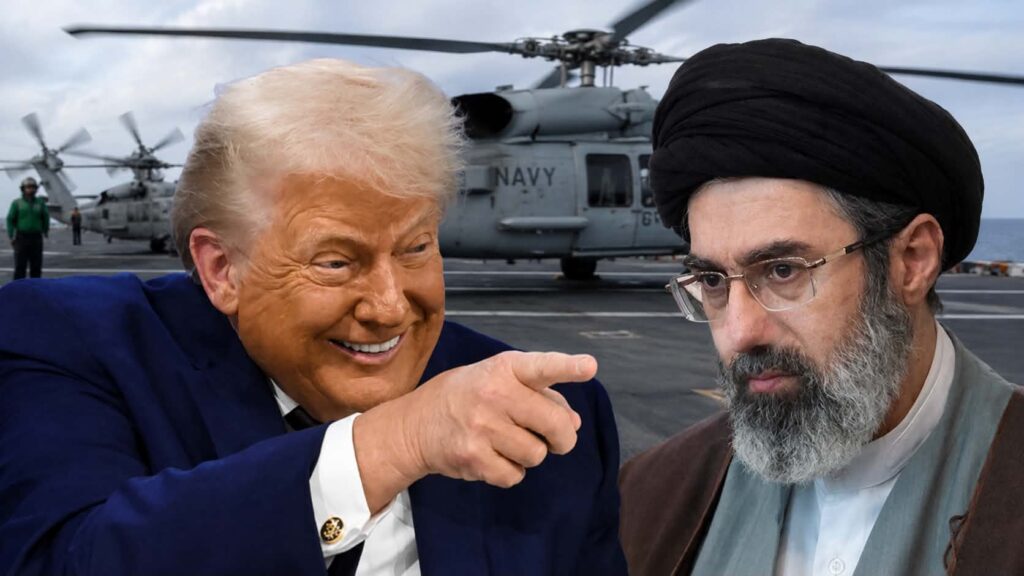
President Donald Trump & Mojtaba (Image composition: Benjamin Harris)
Iran Warns of New Weapons and Wider War as Trump Weighs Next Move
Iran is warning that any renewed U.S. military offensive could trigger a broader response, with the Islamic Revolutionary Guard Corps claiming it has additional weapons and targets that have not yet been used in the conflict.
IRGC spokesman Hossein Mohebbi said Monday that Iran would change both its weapons and the geography of its response if the United States launched another attack.
“We will introduce new weapons with new capabilities into the battle, and the world will be astonished,” Mohebbi said, according to Iranian media reports. AP separately reported that he warned Iran could alter the “geography of the war” if hostilities intensified.
Iran has not publicly provided detailed independent evidence identifying the weapons Mohebbi referenced, and their capabilities remain unclear.
The warning comes as President Donald Trump says he is considering what to do next, leaving open both renewed military action and the possibility of negotiations.
Iran Threatens to Expand the Battlefield
Mohebbi said Iran has additional targets that have not yet been attacked and indicated that Tehran would respond differently to another U.S. offensive.
The comments suggest that Iranian military planners are attempting to signal that the conflict could expand beyond the locations already targeted.
The IRGC spokesman did not publicly identify the additional weapons or targets. As a result, it is not possible to independently determine from his remarks how significant the claimed new capabilities are.
Iran has previously relied on ballistic missiles, cruise missiles and drones during the conflict, while also using threats against U.S. interests and regional targets as part of its military messaging.
Trump Says He Is in “Deciding Mode”
The Iranian warning followed Trump’s comments Sunday that his administration is considering its next step.
Speaking to Fox News correspondent Trey Yingst, Trump said he was in “deciding mode” and suggested that significant developments could occur soon.
Trump described three broad possibilities for dealing with Iran: military action, continued economic pressure or a negotiated agreement.
He also warned Tehran that “big things” could happen if Iran does not change course.
Those comments leave the administration’s next step unresolved. No new U.S. offensive was announced in the remarks.
Diplomacy Remains Possible
Despite the increasingly aggressive public rhetoric, diplomatic contacts have not completely broken down.
Iranian officials have communicated conditions for ending the conflict through intermediaries, including Qatar, according to recent reporting. Iranian officials have publicly cited an end to fighting, the release of frozen Iranian funds and an end to the U.S. naval blockade among their demands.
The United Nations General Assembly in New York is providing another potential venue for diplomatic contacts.
Iranian President Masoud Pezeshkian is expected to travel to New York for the gathering, while Trump has indicated that he could be open to meeting his Iranian counterpart. No formal Trump-Pezeshkian meeting has been announced.
The diplomatic channel therefore remains open even as both governments continue issuing military warnings.
The Strait of Hormuz Is a Major Point of Pressure
The Strait of Hormuz has become one of the most important issues surrounding the conflict because of its role in global energy shipments.
Recent reporting indicates that negotiators could potentially use shipping through the waterway as part of a limited agreement while the more difficult questions surrounding sanctions, frozen assets and the broader conflict remain unresolved.
The economic consequences extend well beyond Iran and the United States. Oil prices have remained sensitive to developments around the conflict, although prices moved lower Monday amid signs of possible diplomacy and increased Saudi exports.
Iran’s Claims Have Not Been Independently Verified
The most striking part of Mohebbi’s statement is his claim that Iran possesses weapons with capabilities that have not yet been introduced into the fighting.
That claim should be treated cautiously.
Iran has not released detailed technical information about the systems he referenced, and the statement does not establish what weapons are involved, how many are available or whether they would materially change the military balance.
Similarly, Iranian claims about previously untargeted locations do not establish that those targets will actually be attacked.
The statements nevertheless matter because they communicate Tehran’s stated response to another U.S. offensive and indicate that Iranian officials are preparing the public for the possibility of further escalation.
The Conflict Is Also Affecting the Wider Region
The confrontation has already extended beyond direct U.S.-Iran exchanges.
Iran-backed Houthi forces have remained involved in regional fighting, while attacks and disruptions around major shipping routes have added another layer of uncertainty.
AP reported Monday that a tanker was struck by an unidentified projectile in the Strait of Hormuz, injuring two crew members, while fighting involving Houthi forces and Saudi-backed forces has also continued in Yemen.
Those developments illustrate how a renewed U.S.-Iran escalation could have consequences beyond the two countries.
Washington and Tehran Are Sending Conflicting Signals
The latest statements from both sides present a complicated picture.
Washington is warning that further military action remains possible while also leaving the door open to negotiations. Tehran is threatening a broader military response while communicating conditions under which it says the war could end.
That combination creates uncertainty about whether the next phase will involve renewed attacks, negotiations or both.
The U.N. General Assembly provides an opportunity for diplomatic contacts, but there is no announced agreement that would end the conflict.
What Happens Next
For now, the most consequential unanswered question is whether Trump chooses to pursue another military operation, continue economic pressure or intensify diplomatic efforts.
Iran’s latest warning indicates that Tehran says it would respond to another attack with weapons and targets it has not previously used.
But the precise nature of those capabilities remains unknown, and neither side has announced a new comprehensive settlement.
The coming diplomatic activity in New York could provide additional indications of where the conflict is heading. Until then, the competing statements from Washington and Tehran point to a situation in which military escalation remains possible while negotiations remain an option.
Benjamin Harris is a RapidReports front page contributor and editor,proud father of four.