Trump, Xi and Putin Hold Historic Shenzhen Summit, but Major Breakthroughs Remain Elusive
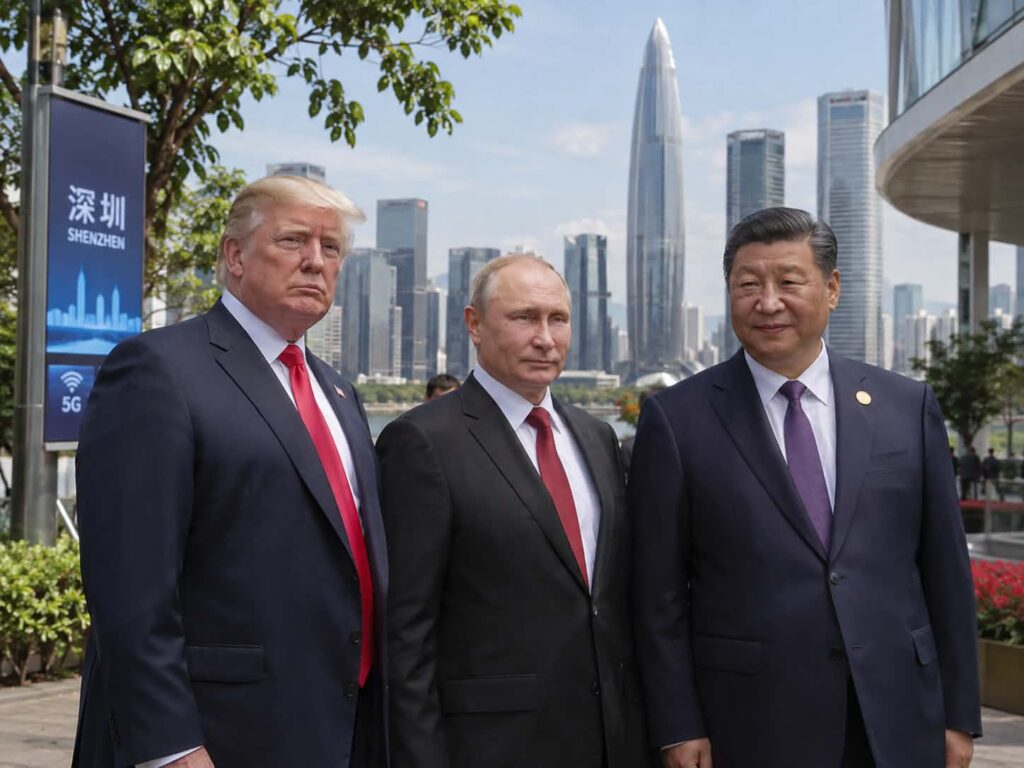
President Donald Trump, Chinese President Xi Jinping and Russian President Vladimir Putin held an unprecedented trilateral meeting in Shenzhen, China, on Thursday, November 19, 2026. The gathering brought together leaders of three major nuclear powers to discuss international security, nuclear risks, energy cooperation and global conflicts. Although the summit generated significant diplomatic attention, it ended without a sweeping agreement on trade, arms control or the wars in Ukraine and Iran.
Trump’s visit to China placed economic competition and international diplomacy at the center of discussions involving Washington, Beijing and Moscow. Chinese President Xi Jinping personally welcomed the American president at Shenzhen Bao’an International Airport on Wednesday, November 18, in a highly visible gesture ahead of the Asia-Pacific Economic Cooperation (APEC) summit.
The trilateral meeting took place the following day at Kylin Villa in Shenzhen. It marked the first gathering of its kind involving the leaders of the United States, China and Russia, three countries with substantial influence over international security, trade and energy markets.
The meeting was presented as an opportunity to explore cooperation despite longstanding disagreements. However, the final outcome was considerably narrower than the expectations surrounding the summit.
Trump, Xi and Putin Meet for First-Ever Trilateral Talks
The meeting brought together three leaders whose countries have competing economic, political and security interests. Trump described the gathering as an opportunity to make history, emphasizing the importance of communication between governments that possess enormous nuclear arsenals.
Xi also highlighted the importance of cooperation, describing the meeting as significant for international peace and strategic stability. Putin similarly expressed support for direct discussions, arguing that international disagreements could be addressed through negotiations.
The leaders spent approximately 70 minutes in closed-door discussions. According to reporting by The Associated Press, the meeting produced no major breakthroughs on the central security issues that had helped generate international interest in the gathering.
Instead, the discussions resulted in a narrower set of shared priorities involving United Nations reform, energy production and the International Criminal Court.
The summit nevertheless created an unusual diplomatic setting in which Washington, Beijing and Moscow could communicate directly about issues affecting international stability.
Nuclear Security Becomes a Central Issue
Nuclear weapons were among the most consequential subjects discussed during the Shenzhen meeting.
The three countries possess some of the world’s largest nuclear arsenals, making their relationships particularly important to international security. Their discussions came after the expiration of the New START treaty between the United States and Russia earlier in 2026.
Trump has expressed interest in pursuing a new nuclear arms agreement that would also include China. Such an arrangement would represent a significant change from previous bilateral arms-control frameworks.
However, bringing Beijing into formal nuclear negotiations presents substantial challenges. China’s nuclear arsenal is considerably smaller than those of the United States and Russia, and Beijing has shown limited enthusiasm for accepting restrictions designed around the existing American and Russian stockpiles.
The leaders’ joint statement emphasized that there can be no winners in a nuclear war and that such a conflict must never occur. It also committed the three governments to dialogue intended to reduce nuclear risks and prevent nuclear proliferation.
Although the statement established a basis for continued communication, it did not announce a new arms-control treaty, specific reductions in nuclear weapons or a binding timetable for negotiations.
The distinction is important because diplomatic commitments do not automatically translate into enforceable security agreements. Any meaningful arms-control arrangement would require further negotiations and agreement on verification, monitoring and compliance.
Ukraine War Remains a Major Challenge for Washington and Moscow
Russia’s war against Ukraine remained an important issue during Trump’s diplomatic engagements in China.
Before the trilateral gathering, Trump held separate discussions with Putin. The meeting represented their first direct talks since their previous presidential discussions in Alaska in 2025.
Trump said the two leaders had discussed the conflict and expressed hope that progress toward ending the war could emerge from their engagement.
Kremlin aide Yuri Ushakov described the bilateral discussion as positive and said the Ukraine conflict was addressed directly.
However, Ukraine was not represented at the trilateral meeting. That absence highlighted the diplomatic complications surrounding negotiations involving Russia’s war against its neighboring country.
Any durable settlement would require addressing Ukraine’s security, territorial and political concerns, as well as the positions of the countries supporting Kyiv.
The Shenzhen discussions did not produce an announced peace agreement or a confirmed framework for ending the conflict. The meeting instead provided another opportunity for Trump and Putin to communicate directly about the war.
Trump and Xi Discuss Trade, Agriculture and Economic Cooperation
Economic relations between the United States and China were another major part of Trump’s visit.
The world’s two largest economies maintain extensive commercial relationships, but their governments continue to face disagreements involving tariffs, market access, technology restrictions and strategic industries.
Trump said trade and tariffs were among the principal subjects of his discussions with Xi. He also indicated that he wanted China to purchase additional American agricultural products.
American farmers have a significant interest in the outcome of negotiations because China represents an important potential market for agricultural exports.
A White House fact sheet published in May 2026 said China had committed to purchasing at least $17 billion annually in American agricultural products during 2026, 2027 and 2028, in addition to separate soybean commitments.
The administration also identified opportunities involving American aircraft manufacturing, beef exports and critical minerals.
Those commitments could provide commercial opportunities for American producers if they are implemented. However, announced purchasing commitments should not be confused with completed transactions or guaranteed future sales.
For American agricultural communities, the practical value of the arrangements will depend on actual purchase volumes, market access and whether outstanding commitments are fulfilled.
Critical Minerals and Technology Remain Important Negotiating Priorities
Critical minerals were another important part of the broader economic relationship between Washington and Beijing.
These materials are essential to industries involving electronics, advanced manufacturing, batteries, renewable energy and defense technologies.
China occupies an influential position in several critical-mineral supply chains, creating concerns among American policymakers about potential disruptions to manufacturing and national security.
The White House previously said China had agreed to address American concerns involving rare earth materials and related processing technologies.
For the United States, improving access to these resources could help reduce supply-chain vulnerabilities and support domestic industrial production.
Technology competition also remains a major source of disagreement between the two governments.
Artificial intelligence, semiconductor development and advanced computing are increasingly important to economic competitiveness and national security. Although both countries have reasons to maintain communication about technological risks, their strategic competition makes comprehensive cooperation difficult.
Any future arrangements will need to balance shared security concerns with each government’s interest in protecting its own technological capabilities.
Leaders Discuss Energy Supplies and International Cooperation
Energy cooperation emerged as one of the more concrete areas of common ground in the trilateral discussions.
The joint statement released after the meeting said the United States, China and Russia planned to increase the production and supply of refined petroleum products.
The governments also reaffirmed the importance of stable energy supplies.
This commitment is significant because energy markets are affected by geopolitical conflicts, trade restrictions and disruptions to major shipping routes.
Trump had separately discussed the importance of maintaining oil shipments through the Strait of Hormuz, a strategically important waterway connecting the Persian Gulf with international markets.
The conflict involving Iran has added uncertainty to energy transportation and international security. The three leaders also discussed Iran during their broader diplomatic engagements.
Nevertheless, the statement did not establish a detailed mechanism for coordinating energy production or guarantee that the countries would adopt identical policies.
Their shared interest in stable energy supplies does not eliminate disagreements over sanctions, production strategies or regional security.
United Nations Reform and the International Criminal Court
Beyond nuclear security and energy, the leaders identified reform of international institutions as another area for discussion.
Their joint statement expressed support for reforming the United Nations so that it could respond more effectively to global challenges and fulfill its responsibilities concerning international peace and security.
The three governments also criticized the International Criminal Court and supported protections for government officials against what they described as excessive jurisdiction.
The issue carries particular significance because the court has been involved in investigations and legal proceedings concerning international conflicts and alleged crimes.
Russia’s president is subject to an arrest warrant issued by the court, while the Trump administration has also taken measures against the institution and some of its officials.
The leaders’ position reflects their shared objections to aspects of the court’s authority. However, their statement does not itself change the court’s legal powers or establish a new international legal framework.
What the Shenzhen Summit Means for the United States
The meeting demonstrated that the United States, China and Russia remain willing to participate in direct discussions despite major differences in their foreign policies and strategic objectives.
For Washington, engagement with Beijing and Moscow provides opportunities to address nuclear risks, discuss energy security and pursue economic interests.
For American businesses, farmers and manufacturers, the most important developments may ultimately come from separate bilateral trade arrangements rather than the trilateral meeting itself.
The administration’s previously announced agricultural and industrial commitments could provide opportunities if they translate into completed purchases and reliable access to Chinese markets.
However, businesses will need to monitor implementation rather than rely exclusively on political announcements.
The same caution applies to nuclear security. A declaration supporting dialogue is a starting point, not a substitute for a negotiated agreement with specific obligations.
What Happens After the Trump-Xi-Putin Meeting?
Trump’s diplomatic schedule includes another planned meeting with Xi at the Group of 20 summit in Florida in December 2026.
That gathering could provide another opportunity for the American and Chinese presidents to address trade, tariffs, agricultural purchases and broader economic relations.
The Shenzhen summit also leaves several difficult questions unresolved, including the future of nuclear arms-control negotiations, Russia’s war against Ukraine and the international consequences of the conflict involving Iran.
The three governments have demonstrated interest in maintaining communication, but their competing interests will continue to shape the prospects for cooperation.
For the United States, the central challenge will be converting diplomatic discussions into measurable outcomes that support national security, economic stability and international cooperation.
Conclusion: Historic Meeting Produces Dialogue, but Major Agreements Remain Ahead
The November 19 meeting between Donald Trump, Xi Jinping and Vladimir Putin was an unprecedented diplomatic event involving three of the world’s most influential military and economic powers.
The leaders discussed nuclear security, energy supplies, international institutions and regional conflicts, while their separate bilateral engagements also addressed economic and geopolitical disagreements.
The meeting produced a joint commitment to continued dialogue and cooperation in selected areas, but it did not deliver a major nuclear arms agreement, a resolution to the Ukraine war or a comprehensive new trade deal.
For American workers, farmers and businesses, the long-term significance of Trump’s China visit will depend on whether announced commitments result in enforceable agreements, expanded market access and measurable economic benefits.
The Shenzhen summit has opened another channel for communication among Washington, Beijing and Moscow. Whether that diplomatic engagement produces lasting progress will depend on what the three governments do after the cameras and formal meetings have ended.

Benjamin Harris is a RapidReports front page contributor and editor,proud father of four.