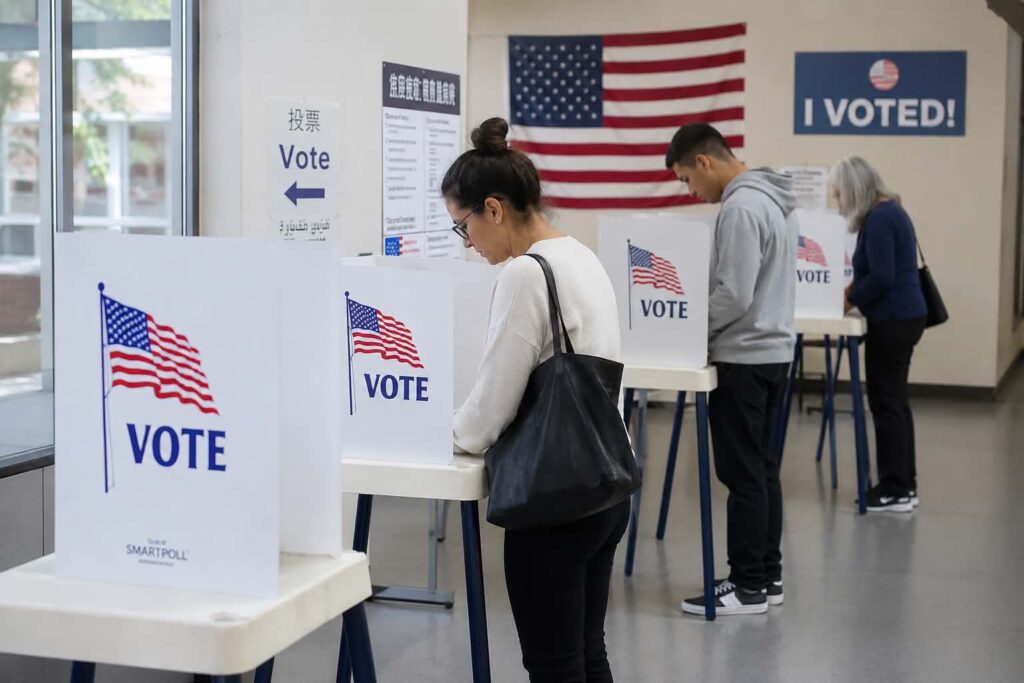
People cast their votes (Rapid Reports Photo /Benjamin Harris)
Federal Judge Blocks Key Trump Election Order in Major Voting Rights Ruling
A federal judge has permanently blocked most of President Donald Trump’s executive order aimed at changing federal election procedures, delivering a significant legal setback to the administration’s election reform agenda.
The ruling, issued by U.S. District Judge Denise Casper in Boston, prevents the administration from enforcing several provisions contained in the executive order, including a proposal that would have required documentary proof of citizenship when registering to vote in federal elections.
The decision converts a preliminary injunction previously issued by the court into a permanent order, effectively halting implementation of the challenged provisions unless higher courts overturn the ruling.
Court Cites Constitutional Limits on Presidential Authority
In her decision, Judge Casper concluded that the Constitution grants primary authority over election administration to the states and Congress rather than the president.
The court rejected arguments from the administration that legal challenges to the executive order were premature because the rules had not yet been fully implemented.
According to the ruling, election regulations must operate within constitutional limits and respect the separation of powers established by the U.S. Constitution.
“The Constitution does not grant the President any specific powers over elections,” Casper wrote in the decision.
Proposed Election Changes Sparked National Debate
The executive order contained several election-related proposals that generated significant public and legal debate.
Among the provisions challenged in court were requirements for documentary proof of citizenship during voter registration, restrictions on counting certain mail ballots received after Election Day, and measures that could affect federal funding for states that declined to adopt specific election procedures.
Supporters of the proposals argued that they were intended to strengthen election security, improve voter confidence, and create more uniform election standards nationwide.
Critics contended that some provisions exceeded presidential authority and could create obstacles for eligible voters.
State Attorneys General Challenged the Order
The lawsuit was brought by a coalition of Democratic attorneys general who argued that the executive order improperly attempted to regulate elections without congressional approval.
Following the ruling, Letitia James praised the decision and described the executive order as an unconstitutional expansion of executive power.
James stated that her office would continue efforts to defend voting rights and election access as future elections approach.
The administration is expected to evaluate its legal options, including the possibility of appealing the ruling to a higher court.
Why the Case Matters
The decision highlights the continuing national debate over election administration, voter registration requirements, mail voting procedures, and the constitutional balance of power between federal and state governments.
Election law has become one of the most actively litigated areas of public policy in recent years, with courts frequently asked to resolve disputes involving voting procedures, ballot access, and election oversight.
The outcome of future appeals could influence how election-related powers are interpreted and exercised by future administrations.
Opinion: Supporters See Election Integrity Questions as Unresolved
From a pro-Trump perspective, supporters argue that requiring proof of citizenship for voter registration is a common-sense safeguard designed to strengthen confidence in the electoral process.
Many conservatives believe that election security measures should receive the same level of attention as other forms of identity verification used in everyday life. They contend that ensuring only eligible citizens participate in federal elections helps protect public trust in election outcomes.
Supporters also argue that the legal dispute is less about the policy itself and more about which branch of government has the authority to implement such changes. While the court ruled against the administration, many conservatives believe Congress should consider election integrity reforms through the legislative process.
As the legal battle continues, the broader national conversation over voting rights, election security, and constitutional authority is likely to remain a major issue in American politics.

Benjamin Harris is a RapidReports front page contributor and editor,proud father of four.