AI Predicts the Winner of a Hypothetical AOC vs. JD Vance 2028 Election — And the Race Is Surprisingly Close
A Potential 2028 Showdown Is Already Getting Attention
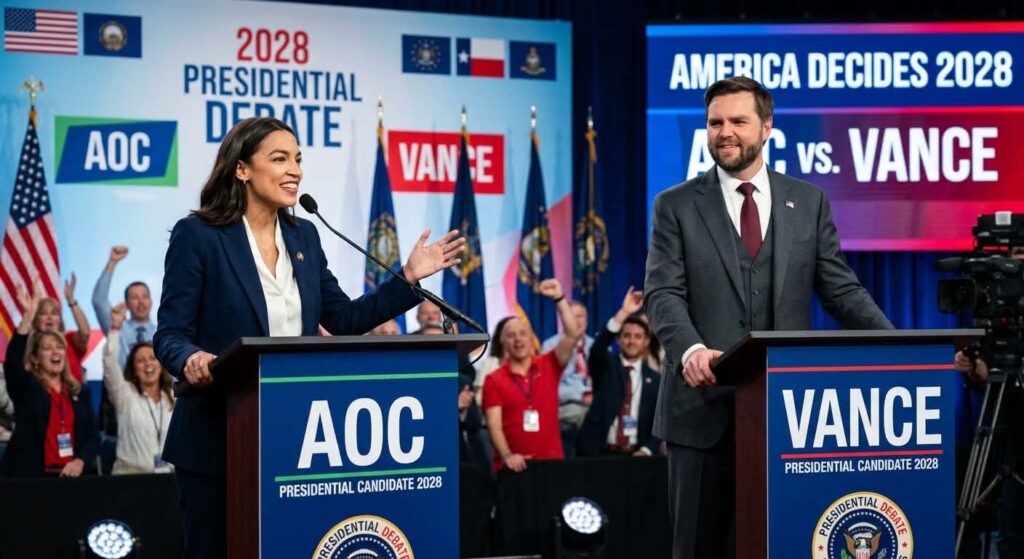
The 2028 presidential election is still more than two years away, but speculation about a possible matchup between Alexandria Ocasio-Cortez and JD Vance is already generating significant interest.
Neither politician has formally secured a party nomination, and neither has officially announced a 2028 presidential campaign. Still, both names have emerged as major possibilities in early discussions about the next presidential race.
Ocasio-Cortez, the Democratic congresswoman from New York, has left open the possibility of seeking the White House. Vance, currently serving as vice president, is widely viewed as one of the Republican Party’s leading potential candidates for the nomination.
That has created an intriguing hypothetical question: What could happen if the two eventually faced one another in a general election?
One recent AI-assisted analysis and early polling snapshot suggests the answer may be considerably closer than either party’s supporters might expect.
An Early Prediction Shows Only a Narrow Difference
A recent hypothetical survey conducted by Quantus Insights tested a potential matchup between Ocasio-Cortez and Vance.
The survey, conducted among likely voters in late August, found Vance with a small advantage of roughly 3.3 percentage points.
That is hardly the kind of margin that would allow anyone to confidently declare a future winner.
The reported margin of error was approximately plus or minus 3.2 percentage points, meaning the underlying contest could be considerably tighter than the headline numbers suggest.
More importantly, this is not a forecast of the actual 2028 election.
There is no finalized Democratic or Republican ticket, no general-election campaign, no complete set of debates, and no certainty that these two politicians will even become their parties’ nominees.
Instead, the numbers provide an early look at how voters might react to a hypothetical contest between two of the most recognizable political figures being discussed for the next presidential cycle.
Why AI Predictions Need to Be Viewed Carefully
Artificial intelligence is increasingly being used to analyze political data, but an AI-generated prediction should not be confused with a guaranteed election outcome.
Political models depend heavily on the information they receive.
If voter preferences change, candidates change their messages, economic conditions shift, major international events occur, or unexpected candidates enter the race, an early model can quickly become outdated.
The 2028 election is still at an extremely early stage.
That makes any AI prediction better understood as a snapshot rather than a final verdict.
Nevertheless, these early comparisons can reveal interesting patterns about voter coalitions, age groups, gender differences, party identification, and the challenges each potential candidate could face.
AOC Shows Strength Among Younger Voters
One of the most striking elements of the reported matchup involves age.
Ocasio-Cortez performed particularly well among younger voters in the survey.
Among voters between 18 and 29, she received support from more than half of respondents, while Vance’s support was considerably lower.
That gap highlights one of Ocasio-Cortez’s biggest potential advantages.
She has developed a strong following among younger Americans since entering national politics and has become one of the Democratic Party’s most recognizable progressive voices.
Her social-media presence, outspoken communication style, and focus on issues such as wages, housing, climate policy, healthcare, and economic inequality have helped her build a national profile far beyond her New York congressional district.
Whether that enthusiasm could translate into a national electoral coalition remains a much larger question.
Vance Has an Advantage With Older Voters
Vance, meanwhile, performed much better among older voters.
The survey showed voters aged 65 and above favoring Vance over Ocasio-Cortez by a significant margin.
That creates an important contrast between the two potential candidates.
AOC’s strongest numbers came from younger Americans, while Vance’s strongest support appeared among older voters.
Presidential elections are ultimately decided by the electorate that actually turns out to vote, however, and turnout patterns can change dramatically from one election to another.
Young voters historically have participated at different rates than older Americans, meaning enthusiasm alone does not necessarily translate into votes.
For Ocasio-Cortez, one of the central challenges of a hypothetical presidential campaign could therefore be converting strong youth support into reliable nationwide turnout.
The Gender Divide Could Become Important
The survey also identified a significant difference between male and female voters.
Ocasio-Cortez performed substantially better among women, while Vance held a stronger position among men.
Such differences could become strategically important in a general election.
Both campaigns would have to consider which issues matter most to different demographic groups and whether their messages could expand beyond their traditional political bases.
For Ocasio-Cortez, appealing to voters who may be uncomfortable with progressive policies could be critical.
For Vance, expanding support among women and younger voters could become equally important.
A presidential election is not won simply by maximizing enthusiasm among an existing base. Candidates generally need to build a coalition broad enough to compete across regions, age groups, economic backgrounds, and demographic categories.
The Race Could Change Dramatically Before 2028
The biggest reason to avoid treating any early prediction as definitive is simple: the campaign has barely begun.
Presidential races typically evolve through several stages.
First comes speculation about potential candidates.
Then candidates decide whether to run.
After that comes the primary campaign, where politicians compete against members of their own party.
Only after nominations are settled does the general-election contest fully take shape.
Each stage can change public perceptions.
A candidate who appears extremely strong today could encounter difficulties during a primary. Another politician who currently receives little attention could suddenly become a major contender.
Fundraising, endorsements, debates, campaign organization, economic conditions, international developments, and voter sentiment can all reshape the race.
Neither Candidate Has Secured a Nomination
It is also important to remember that a hypothetical AOC-Vance matchup assumes both politicians first overcome their respective primary fields.
That is far from guaranteed.
Current prediction-market activity shows Vance among the leading Republican possibilities, while Ocasio-Cortez is also receiving significant attention on the Democratic side. But early markets are not the same thing as party nominations.
Ocasio-Cortez has recently left open multiple possibilities for 2028, including a potential presidential campaign or a Senate challenge in New York.
That means her ultimate political path remains uncertain.
Vance has likewise avoided making a definitive commitment to a 2028 presidential campaign, emphasizing his current responsibilities rather than formally launching a future bid.
Why the Potential Matchup Is So Interesting
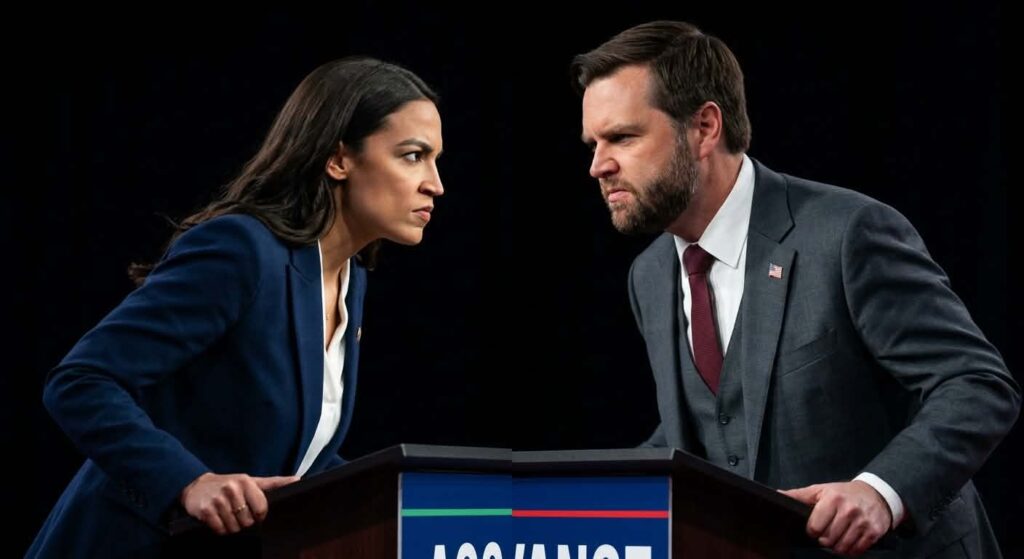
AOC and Vance represent very different political visions.
Ocasio-Cortez is closely associated with the progressive wing of the Democratic Party.
Vance has become one of the most prominent figures in the modern Republican movement and is closely connected to the political coalition surrounding President Donald Trump.
A contest between them could therefore become a broader debate about the future direction of American politics.
Voters could be asked to choose between competing approaches to taxation, government spending, healthcare, immigration, energy, labor policy, foreign affairs, technology, and the role of government in everyday life.
The contrast could make such a campaign particularly intense.
The Economy Could Be a Deciding Factor
Economic conditions would likely play an enormous role in any 2028 presidential election.
Issues such as inflation, housing costs, wages, interest rates, employment, taxes, and consumer confidence can strongly influence voter attitudes.
A candidate who is ahead today could lose ground quickly if voters become dissatisfied with economic conditions.
Conversely, strong economic performance could improve the standing of the party in power.
This is one reason early presidential predictions should be treated cautiously.
It is impossible to know with confidence what the economic environment will look like in November 2028.
Housing and Cost of Living Could Matter
For younger Americans in particular, housing affordability could become a central campaign issue.
High home prices, rent costs, student debt, insurance expenses, and wages have already become major political concerns.
Ocasio-Cortez has frequently emphasized economic issues affecting working- and middle-class Americans.
Vance has also increasingly focused on economic nationalism, manufacturing, wages, and the interests of working-class voters.
That creates an interesting overlap: the two candidates could approach similar economic concerns from very different ideological perspectives.
The candidate who successfully convinces voters that their policies would improve household finances could gain an important advantage.
Immigration Would Likely Be Another Major Issue
Immigration would almost certainly become one of the defining subjects in a Vance-Ocasio-Cortez campaign.
Republicans and Democrats have significant disagreements over border enforcement, legal immigration, asylum policy, deportations, and the broader role of immigration in the economy.
Vance has taken a hard-line approach to immigration and border security.
Ocasio-Cortez has generally advocated substantially different policies and has been a prominent critic of many Republican immigration proposals.
A general election would force both candidates to explain how their policies would work in practical terms.
For voters, the debate could extend beyond political slogans to questions about national security, labor markets, public resources, humanitarian concerns, and legal enforcement.
Technology and Artificial Intelligence Could Also Shape the Race
By 2028, artificial intelligence itself could be an even bigger political issue than it is today.
AI is already affecting employment, education, media, national security, cybersecurity, and business investment.
Ocasio-Cortez has been outspoken about concerns surrounding AI infrastructure and the expansion of data centers, while Democrats more broadly are debating how aggressively the technology should be regulated.
Republicans, meanwhile, have emphasized technological competitiveness, innovation, national security, and reducing regulatory barriers in various contexts.
That could create a fascinating policy debate.
The same technology being celebrated as an economic opportunity could also be criticized for its potential effects on jobs, privacy, energy consumption, and misinformation.
The Electoral College Would Change the Equation
Even if a national poll showed one candidate narrowly ahead, the Electoral College would remain crucial.
A presidential candidate can win the national popular vote while losing the presidency, as American elections have demonstrated.
That means the real battle would likely center on competitive states.
Pennsylvania, Michigan, Wisconsin, Arizona, Georgia, Nevada, and other closely contested states could become central to the electoral strategy of either campaign.
The candidates would need to build coalitions that work not only nationally but also within specific states.
Regional economic concerns and local political issues could therefore matter just as much as national polling.
Prediction Markets Tell a Different Story
Early prediction markets provide another interesting perspective.
Current market data place Vance among the leading potential 2028 presidential contenders, while Ocasio-Cortez is also among the prominent Democratic names being traded.
But market prices should not be interpreted as guaranteed probabilities.
They reflect the views of participants buying and selling contracts and can change rapidly as new information emerges.
Interestingly, some market analysis suggests that Vance’s strength in the overall winner market is heavily connected to his position within the Republican field rather than evidence that he would automatically dominate a general election.
That distinction is important.
Winning a party nomination and winning the presidency are two separate challenges.
What Could Help AOC?
Ocasio-Cortez’s greatest potential advantage could be enthusiasm among younger and progressive voters.
She also has an unusually recognizable national profile for a member of the House of Representatives.
Her communication style has helped her attract considerable attention, particularly through social media and public appearances.
If she were able to expand that coalition to suburban voters, independents, working-class communities, and moderate Democrats, her national prospects could become considerably stronger.
However, she would also face the challenge of convincing voters outside her existing political base that her policies could work on a national scale.
What Could Help Vance?
Vance’s potential advantages are different.
As vice president, he already has national visibility and experience operating at the highest level of federal government.
He also has a strong connection with the Republican base and currently ranks among the leading names in early 2028 prediction markets.
His challenge would be broadening his coalition.
A successful general-election campaign would likely require strong support from Republicans while also attracting enough independents and voters outside the party’s traditional base.
His ability to address economic concerns, foreign policy, immigration, and the broader direction of the Republican Party could therefore become central to his prospects.
The Biggest Takeaway From the AI Prediction
Perhaps the most interesting part of the hypothetical matchup is not who is ahead.
It is how small the gap appears.
A difference of only a few percentage points, especially with a margin of error of roughly three points, is not enough to establish a reliable winner.
It indicates a competitive theoretical contest.
The numbers also demonstrate how dramatically voter preferences can differ depending on age and gender.
AOC appears particularly strong among younger voters and women, while Vance has advantages among older voters and men.
That creates two very different electoral coalitions.
A Long Road Before Election Day
The 2028 presidential election remains far away.
There will be primary elections, debates, endorsements, fundraising battles, campaign launches, policy announcements, controversies, economic developments, and international events before voters make their final decision.
Either candidate could rise or fall significantly during that period.
It is also entirely possible that neither becomes a nominee.
For now, the AOC-versus-Vance scenario remains a hypothetical matchup rather than a confirmed election contest.
Final Thoughts
An AI-assisted prediction showing a close potential race between Alexandria Ocasio-Cortez and JD Vance offers an intriguing glimpse into how the 2028 presidential election could develop.
The current numbers do not establish a winner, and they should not be presented as a definitive forecast.
What they do show is that a hypothetical contest between the two could produce a remarkably divided electorate.
Ocasio-Cortez appears capable of generating strong enthusiasm among younger voters and women, while Vance has significant support among older voters and men.
Those contrasting coalitions could make the eventual campaign one of the most closely watched political contests of the decade — if both politicians ultimately decide to run.
For now, the most accurate conclusion is also the simplest: the 2028 race is wide open, and an early AI prediction is only the beginning of the conversation.

Benjamin Harris is a RapidReports front page contributor and editor,proud father of four.