Trump Predicts Iran War Will End After November Midterm Elections as Fighting Escalates
President Donald Trump said Wednesday that he expects the war with Iran to end “immediately after” the November midterm elections, offering his most specific timeline yet for a conflict that has now entered its seventh month.
Speaking with reporters before leaving for the Republican National Midterm Convention in Dallas, Trump said Iran was attempting to prolong the conflict in an effort to influence American voters but would not be able to sustain the confrontation indefinitely.
“I think the war is going to end immediately after the election because they can’t hold out any longer,” Trump said.
The U.S. midterm elections are scheduled for November 3. Trump did not provide evidence for his assertion that Tehran is deliberately extending the war to influence the election, and his timeline represents his own prediction rather than an announced agreement with Iran.
Trump Says Iran Is Under Increasing Pressure
Trump pointed to recent U.S. military operations against Iranian oil tankers as evidence that Tehran’s ability to continue the conflict is being reduced.
“We’ve knocked out nine of their ships,” Trump told reporters, referring to what he described as U.S. attacks on Iranian vessels. The U.S. military has publicly confirmed the destruction of five Iranian oil tankers in the latest round of operations.
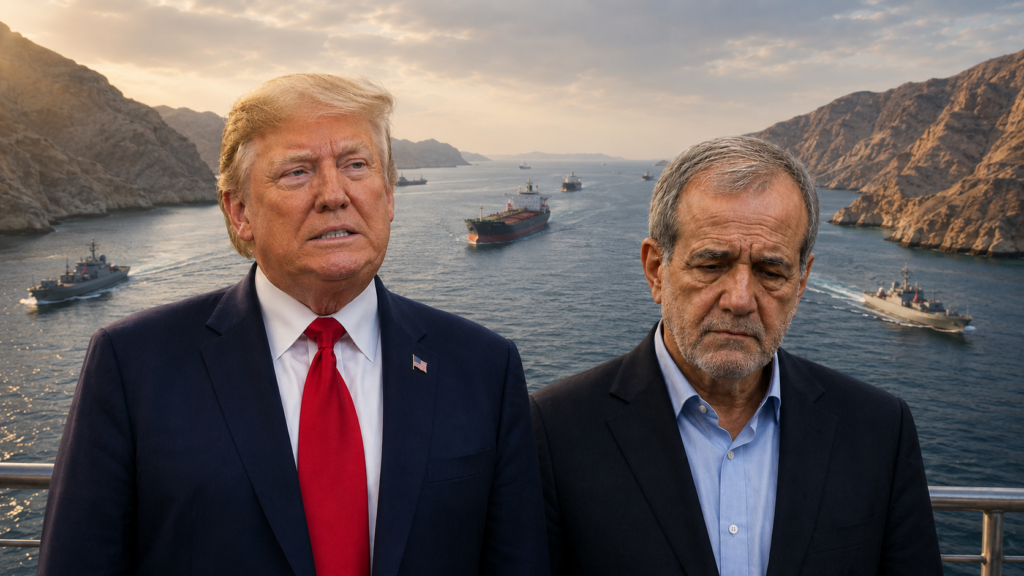
According to U.S. Central Command, the five tankers were struck after Iran attempted to attack a U.S. Navy warship with ballistic missiles on two occasions. Four of the vessels were targeted in the Gulf of Oman and another near Iran’s Kharg Island.
Iran subsequently claimed that its forces had attacked 10 vessels around the Strait of Hormuz. The Islamic Revolutionary Guard Corps said the targets included two U.S. vessels and eight oil tankers.
U.S. Central Command disputed the claim that American ships had been damaged, saying the attempted attacks failed.
Fighting Around the Strait of Hormuz Intensifies
The latest exchange represents one of the sharpest escalations in the maritime conflict in recent weeks.
The Strait of Hormuz is a critical route for global energy shipments. Before the war, roughly one-fifth of the world’s oil and gas supplies moved through the waterway, making disruptions there particularly significant for energy markets and consumers.
The renewed attacks have already affected oil prices. Brent crude moved above $100 a barrel Wednesday for the first time since July as traders reacted to the growing threat to commercial shipping.
The conflict has also spread beyond the immediate waters around Iran.
Iran launched ballistic missiles toward a military base in Jordan used by U.S. forces. Jordanian officials said 18 of 20 missiles were intercepted, while two landed in unpopulated areas. U.S. officials said American personnel were accounted for.
Oil Prices and Gasoline Costs Become a Major Concern
Trump also predicted that oil prices would fall after the election if the war ends.
The latest jump in crude prices comes as Americans are already dealing with higher fuel costs. The escalation around Hormuz has increased concern that a prolonged disruption could affect transportation, energy-intensive businesses and consumer prices.
The Strait’s importance means even uncertainty over shipping can influence global oil markets. The latest attacks have therefore placed additional pressure on governments and energy companies attempting to assess how long commercial traffic can continue operating safely.
Trump Says a Nuclear Deal Would Not Be Enough
Trump also indicated that Washington’s objectives extend beyond Iran’s nuclear program.
“All they want is a nuclear weapon,” Trump said, arguing that such an outcome would pose a broader security threat.
When asked whether a new nuclear agreement could bring the conflict to an end, Trump said he wanted “much more than a nuclear deal.”
He said nuclear issues would remain central to any future agreement but suggested that other issues would also be part of negotiations.
At the same time, Trump acknowledged that diplomacy remains possible, although he said negotiations were not currently being pursued as the administration’s preferred course.
No Immediate Diplomatic Breakthrough Announced
Trump’s prediction of an end to the war after the midterms should not be interpreted as confirmation that a ceasefire or peace agreement has been reached.
As of Wednesday, there was no announced agreement establishing November 3 or the period immediately afterward as a deadline for ending hostilities.
Instead, fighting continued around the Strait of Hormuz, with Iran claiming attacks on commercial and military vessels and the United States maintaining that its latest strikes were carried out in response to Iranian attacks on U.S. naval forces.
The two sides therefore remain engaged in an active military confrontation despite Trump’s stated expectation that Iran will eventually seek an end to the conflict.
Regional Risks Continue to Grow
The latest developments are occurring alongside renewed fighting involving Iran-aligned Houthi forces and Saudi Arabia.
Houthi attacks on Saudi cities and energy infrastructure have added another layer of uncertainty to regional oil supplies and shipping routes. Reuters reported that the latest attacks left dozens of people wounded and caused fires at oil-related facilities.
That means the economic consequences of the conflict are no longer limited to the direct confrontation between Washington and Tehran. Multiple shipping corridors and energy-producing areas across the region are facing increased security risks.
What Happens Next
Trump’s latest comments provide a political and diplomatic timeline he expects, but they do not establish when the war will actually end.
The conflict has already lasted substantially longer than Trump’s earlier public expectations, and recent fighting has intensified rather than moved clearly toward a settlement.
For now, the immediate focus remains on developments around the Strait of Hormuz, the safety of commercial shipping, Iranian and U.S. military operations, and the effect of the conflict on global energy prices.
Whether the fighting ends shortly after the November 3 election, continues beyond it, or moves toward negotiations earlier remains unresolved.

Benjamin Harris is a RapidReports front page contributor and editor,proud father of four.