The deliveryman was already halfway back to his truck when I called after him.
“Excuse me. Are you certain those flowers are meant for me?”
He stopped beside the path, checked the slip in his hand, and looked at the name again.
“Mary?”
“Yes. That’s me.”
“Then they’re yours, ma’am.”
He gave me a hesitant smile. It was the kind of smile a young delivery driver gives an elderly woman standing alone in her doorway with an enormous bouquet in her arms, as though he cannot tell whether he has just delivered happiness or accidentally disturbed a private memory.
“Have a nice day.”
Then he climbed into his van and drove away.
I remained in the doorway, staring after him.
The bouquet was enormous.
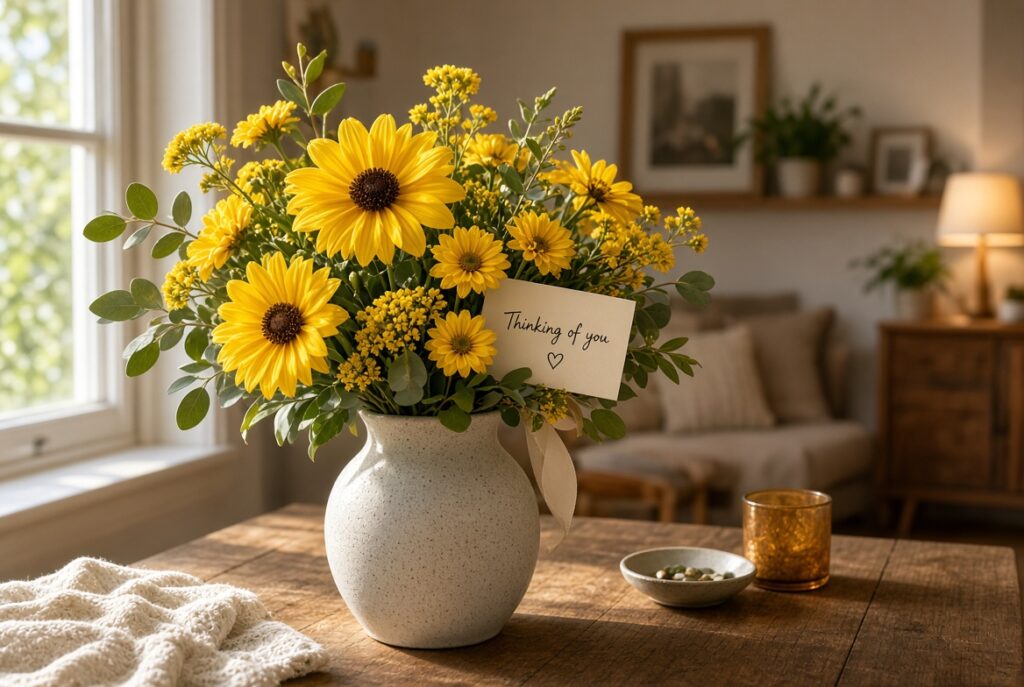
Yellow roses filled my arms from wrist to shoulder, their fragrance drifting around me in the crisp morning air. There were so many stems that I could barely see the front steps.
I carried them into the kitchen and placed them carefully on the table.
Then an old habit took over.
I counted them.
Once.
Then again.
Fifty-six.
I stopped with my fingers resting on the final stem.
Fifty-six roses.
Today would have been my fifty-sixth wedding anniversary.
For several seconds, I simply stood there.
No one had sent me flowers in years.
Most of the friends I had known when I was young were gone now. The few who remained lived far away or had their own families and concerns. And fifty-six long-stemmed roses were not an inexpensive gift.
My monthly Social Security check certainly did not leave room for extravagances like that.
Besides, I had never been the sort of woman who bought flowers for herself.
The number was too exact.
This wasn’t random.
Someone had remembered.
I opened the cabinet beneath the sink and took out my largest vase—the crystal one my parents had given us as a wedding present.
In fifty-six years, I had used it only a handful of times.
I filled it with water and began separating the stems.
That was when something scratched my thumb.
“Ouch.”
I pulled my hand away.
I expected a thorn.
Instead, something yellow and wrinkled was caught among the roses.
Paper.
I carefully pulled it free.
It was supposed to be a rose.
A paper rose, folded from faded yellow material.
It was terrible.
The petals were uneven. One side was higher than the other. Several folds had been pressed so sharply that the paper had begun to crack.
The stem was little more than a narrow strip of paper held together with old, discolored tape.
I almost smiled.
It was probably the ugliest flower anyone had ever given me.
Then I turned it over.
There was a single letter written near the bottom.
J.
My breath stopped.
I knew that handwriting.
I would have known it anywhere.
James.
My husband.
The man who had been missing for fifty-six years.
I sat down hard.
One of the real roses slipped from the table and landed softly on the kitchen floor.
“No,” I whispered.
But the paper rose was still in my hand.
It was real.
And suddenly a question I had buried for more than half a century rose from somewhere inside me.
Could James have made this?
Could my husband, the man I had spent fifty-six years believing was dead, somehow have left something behind for me?
Before you can understand what that little paper flower meant, you have to understand the two days that shaped my entire life.
James and I married in my parents’ backyard on a warm afternoon.
There were twenty-three guests.
The church had lent us folding chairs, and my aunt had baked our wedding cake.
Unfortunately, the cake leaned so badly to one side that I spent half the reception trying not to laugh whenever I looked at it.
My mother cried throughout most of the ceremony.
Afterward, James found her holding a paper cup of punch and gently teased her.
“Mrs. Doyle,” he said, “you don’t have to cry. I’m only borrowing your daughter.”
My mother pointed the cake knife at him.
“You bring her back,” she warned. “And you bring her back happy.”
James looked across the yard at me.
“I plan to,” he said. “That’s the whole plan.”
We had only two days together as husband and wife.
Two days.
We spent those precious hours doing ordinary things that seemed extraordinary simply because we were newly married.
He made coffee too strong the first morning and refused to admit it.
We walked around the neighborhood holding hands.
We talked about the little house we wanted someday.
We imagined children.
Two, perhaps three.
We talked about getting a dog and having a porch where we could sit together when we were old.
At twenty-three, the future seemed endless.
We believed there would always be another anniversary.
Another Christmas.
Another birthday.
Another morning.
Then the third morning arrived.
We stood together at the old train station.
I was wearing a yellow cotton dress James loved.
He told me the color made me look like sunshine.
Before he boarded, he pulled me close.
“Next anniversary,” he whispered, “I’m going to bring you the biggest bunch of yellow roses you can imagine.”
I laughed.
“You’d better. I only married you for the flowers.”
He laughed so loudly that people nearby turned to look.
It was the last time I ever heard that laugh.
Weeks later, his unit came under heavy attack overseas.
Several men were killed.
Others disappeared during the confusion.
James was listed as missing.
Eventually, Adrian, his closest friend from the unit, came home.
He sat in my parents’ living room with his military cap between his hands.
He couldn’t look at me.
Finally, he spoke.
“I saw the explosion, Mary.”
His voice was quiet.
“I was there. I’m so sorry, but I don’t think James survived.”
There was never a body.
There was no grave.
There was only uncertainty.
Eventually, official documents arrived.
Two words reduced the man I loved to a line on a page.
Presumed dead.
That was what I had.
Not certainty.
Not a grave.
Not a final goodbye.
Just presumed.
I never remarried.
People encouraged me to.
My mother did.
Friends did.
There were kind men who asked me to dinner, men who might have given me a comfortable life.
But some stubborn part of me continued waiting.
Maybe it was loyalty.
Maybe it was because I had never been able to say goodbye.
You can’t completely close a door when nobody ever tells you whether the person on the other side is gone.
So I built a life.
I worked for thirty-one years as a bookkeeper at a lumber company.
I liked numbers because they behaved.
If you added two and two, you could trust the answer.
People were not always so predictable.
I eventually bought a small house of my own.
I made every mortgage payment.
The year I turned sixty, I finally paid it off.
I kept a garden.
I helped my sister’s children whenever I could.
Later, I became the great-aunt who spoiled everyone else’s children.
It was a quiet life.
A good life.
But there was always an empty space inside it.
There was always one unanswered question.
Then, on what would have been my fifty-sixth anniversary, I found a crooked paper rose among fifty-six perfect yellow ones.
And I found a letter.
I searched the bouquet again.
This time I noticed a small cream-colored envelope beneath the ribbon.
My name was written across the front.
Mary.
I opened it.
There were only a few lines.
The first sentence made my hands shake.
“Darling, you won’t believe why I had to disappear. Adrian lied to you.”
I read it again.
Then again.
My chair scraped backward.
There was more.
“Act normally. If you still have the yellow dress, bring it with you. Take the roses to the old station at eleven. Follow these instructions carefully.”
I looked at the kitchen clock.
10:17.
Forty-three minutes.
My first thought was impossible.
James was alive.
My second thought was much more frightening.
If James had been alive all these years, then he had been somewhere without me.
He had lived.
He had breathed.
He had grown older.
And I had spent more than half a century believing he was dead.
I picked up the telephone.
My hand was already reaching for the receiver when I stopped.
Act normally.
Why?
If James had really written the message, why hadn’t he simply come to my house?
Why the old station?
Why the secrecy?
And who else could know about my yellow dress?
I put the telephone down.
Then I went upstairs.
At the back of my closet stood an old cedar chest.
I hadn’t opened it in years.
Inside, beneath layers of tissue paper, was the dress.
The yellow dress.
Its bright color had faded with time, but I recognized it immediately.
I held it against myself.
For one moment, I was twenty-three again.
Then my thumb brushed against the side seam.
Three crooked stitches.
I smiled despite myself.
James had sewn those stitches.
The night after our wedding, I had caught the dress on a nail near my parents’ porch.
James insisted he could repair it.
He couldn’t.
His stitches were crooked and uneven.
They looked as though someone had sewn the seam while riding in a moving car.
I had laughed until tears came to my eyes.
James had threatened to divorce me before we’d even been married forty-eight hours.
Looking at those stitches now, I thought about the paper rose.
Crooked petals.
Uneven folds.
A badly repaired stem.
James had never been good at delicate work.
He could repair an engine.
He could build a fence.
He could lift things that seemed impossible.
But ask him to fold paper or sew something, and patience disappeared.
My heart began beating faster.
At 10:42, I left the house.
I carried the yellow dress over one arm.
The roses were gathered against my chest.
The old station was only a short distance away.
Passenger trains had stopped running there decades earlier.
The town had eventually restored the building as a small historical site, preserving the old clock and wooden benches.
I had avoided that place for fifty-six years.
That morning, I walked inside.
At exactly eleven, an elderly man slowly stood from a bench near the far wall.
For a second, I didn’t recognize him.
Then he removed his cap.
“Mary.”
My heart dropped.
“Adrian?”
He was holding an old military duffel bag.
Across the side were faded letters.
James’s name.
I nearly dropped the flowers.
Adrian took one step toward me.
“Mary, please.”
“Where is he?”
My voice sounded nothing like my own.
“Where is James?”
Adrian closed his eyes.
That tiny movement told me something was wrong.
“Is he alive?”
“No,” Adrian whispered.
The answer struck harder than I expected.
For nearly all my life, James had been dead.
But for the past forty-three minutes, I had allowed myself to believe he was alive.
Now Adrian had taken him away from me a second time.
I pushed the card against his chest.
“Who wrote this?”
He looked down.
“I did.”
My mouth went dry.
“You wrote this?”
“Yes.”
“You made me believe my husband was alive.”
“I knew you wouldn’t come if I told you it was me.”
“You could have called.”
“You would have hung up.”
“You don’t know that.”
“I think I do.”
My hands were shaking.
“You gave me my husband back for an hour,” I said, “and then you took him away again.”
Adrian lowered his eyes.
I pulled the crooked paper rose from my pocket.
“What is this?”
His expression changed.
“James made it.”
I stared at him.
“James?”
“Yes.”
“Where?”
Adrian took a slow breath.
“Not where you think.”
I demanded the truth.
And finally, after fifty-six years, he began telling me what had really happened.
The attack had been real.
James had been there.
Adrian had been there.
But neither man died in the explosion.
They were captured.
James had survived the initial attack.
He was badly wounded.
And he remained alive for several weeks.
I could barely breathe.
“Several weeks?”
Adrian nodded.
“We were kept together for much of that time.”
My eyes went to the paper rose.
“He made this while he was there?”
“Yes.”
Adrian told me James had found a scrap of paper and tried to fold it into a flower.
“He looked at it and said it was terrible.”
A small smile appeared on Adrian’s face.
“I told him it was the worst flower I’d ever seen.”
Despite everything, a broken laugh escaped me.
“That sounds like him.”
“It does.”
Adrian told me James had kept the flower.
Then, before he died, he gave it to Adrian.
“He told me that if I returned home without him, I was supposed to give it to you.”
I closed my eyes.
Fifty-six years.
James had been alive long enough to make something for me.
Alive long enough to remember his promise.
Alive long enough to think about me.
“What happened to him?”
Adrian’s expression became serious.
“He became weaker.”
“That’s not enough.”
I looked directly at him.
“I have waited fifty-six years. Tell me the truth.”
Adrian hesitated.
Then he explained that James had known he probably wouldn’t survive.
James made Adrian promise something.
He wanted Adrian to tell me that he had died instantly.
In the explosion.
Without suffering.
Without fear.
“He wanted to spare you,” Adrian said.
I felt something inside me break.
“He decided what I could handle.”
Adrian said nothing.
“He was twenty-three,” I continued.
“So was I.”
That silenced him.
We were both young.
James had been dying.
I had been waiting.
And he had decided, out of love, that a gentle lie would be easier for me than the truth.
But there was more.
I looked down at the paper rose.
“Did he ever change his mind?”
Adrian’s eyes filled with tears.
“Yes.”
“When?”
“The last few days.”
I could barely speak.
“What did he say?”
Adrian swallowed.
“He told me, ‘Tell her I was here.’”
I closed my eyes.
“He said I should know he was alive after the attack.”
Adrian continued.
“And near the end, he told me something else.”
I waited.
“He said, ‘Tell her everything. She’s stronger than I gave her credit for.’”
For a moment neither of us spoke.
Then I asked the question that had haunted me for decades.
“Why didn’t you?”
Adrian looked away.
“At first I thought I was honoring James’s original request.”
“And later?”
“Later, I was protecting myself.”
He explained.
He had already lied to me.
Then a month passed.
Then a year.
Then five.
Each year made the truth harder to confess.
Eventually, the lie became so old that admitting it seemed impossible.
“You weren’t protecting me,” I said.
“No.”
“You were protecting yourself.”
“Yes.”
He finally admitted it.
I looked at the old man standing in front of me.
“You knew James.”
“Yes.”
“You knew me.”
“Yes.”
“You sent me Christmas cards.”
His eyes filled again.
“And all those years you knew the truth.”
“Yes.”
Then he told me something else.
He knew where James was buried.
I stared at him.
“You know where my husband is buried?”
“Yes.”
“How long?”
“Many years.”
My anger returned.
I had spent fifty-six years without a grave to visit.
No place to leave flowers.
No marker bearing his name.
No physical place where I could tell him the things I had carried inside me.
And Adrian had known.
He had decided I didn’t need to know.
Again.
“Where is he?”
Adrian gave me the name of the military cemetery.
It was only a few hours away.
Then he offered to take me.
This time, I stopped him.
“No.”
He looked surprised.
Then I reconsidered.
“Yes. You will drive.”
I handed him the yellow dress.
“But I decide what happens now.”
He nodded.
We drove for hours.
The scenery outside the windows seemed to belong to another lifetime.
New buildings.
New roads.
New businesses.
A world that had changed almost completely since James boarded that train.
I watched it all pass by.
My love for James, however, had remained exactly where I’d left it.
On a train platform.
In a yellow dress.
After miles of silence, I finally asked Adrian why he had waited until now.
He kept his eyes on the road.
“Because I kept promising myself I’d tell you next year.”
“And every year?”
“I didn’t.”
Then he explained that he had recently learned he had advanced cancer.
“I realized I might not have another anniversary left.”
For the first time that day, my anger loosened.
“I’m sorry,” I said.
“Don’t be,” he replied. “I should have told you when I had decades left. Not when I was afraid of dying with the secret.”
I understood.
He wasn’t asking me to excuse him.
He knew what he had done.
At the cemetery, we walked between long rows of white markers.
Then Adrian stopped.
He pointed.
I saw the name.
James.
My husband’s name.
After fifty-six years.
Adrian stepped back.
“Mary—”
“Please go wait in the car.”
He nodded.
For the first time in more than half a century, I stood alone with my husband.
No explanation stood between us.
No official wording.
No old lie.
Just his name.
I lowered myself onto the grass.
Then I placed the fifty-six yellow roses beneath his marker.
All of them.
The promise had finally been kept.
I took out the paper flower.
“You really were terrible at this,” I whispered.
A laugh escaped me through my tears.
“This may be the ugliest rose anyone has ever made.”
I touched the stone.
“I would have wanted to know.”
My voice broke.
“If I’d known you were alive and suffering, I would have been terrified. I would have been helpless.”
I paused.
“But I would have known.”
That mattered.
“I would have carried the fear with you.”
I traced my finger across his name.
“You didn’t have the right to choose the truth for me.”
I stayed there for a long time.
I told him about my parents.
About the years.
About the house.
About the garden.
About the people who had come and gone.
I told him about the yellow dress.
And about how I had never stopped remembering the young man who promised me flowers.
Eventually, I stood.
I left the fifty-six real roses at his grave.
But I kept the paper one.
That little crooked flower was different.
It wasn’t something purchased from a florist.
It wasn’t perfect.
It wasn’t beautiful in the ordinary sense.
It was something James had made with his own hands while he was still alive.
It was his last attempt to keep a promise.
I carried it back to the car.
Adrian was waiting.
The yellow dress rested across his lap.
When I opened the door, he looked at me.
“Do you hate me?”
I sat down.
I thought carefully before answering.
“Today?”
I looked at him.
“Yes.”
He nodded.
“But I don’t know what tomorrow will bring.”
He lowered his head.
“You finally brought me the truth,” I continued. “You should have done it decades ago. I don’t know whether I will ever forgive you.”
“I understand.”
“But you also brought me something I didn’t know I was missing.”
He looked at me.
“You brought me the real last part of James’s story.”
Adrian said nothing.
“Ask me again someday,” I told him. “Maybe my answer will change.”
“I will.”
We both knew he might not have many days left.
That evening, I finally returned home.
I was exhausted.
Not ordinary tired.
The kind of exhaustion that reaches into your bones after a lifetime of emotion suddenly has somewhere to go.
At 11:57 p.m., I stood alone in my kitchen.
Three minutes remained in our anniversary.
I took the crystal vase from the table.
It was empty now.
I placed the little paper rose inside.
Its crooked stem leaned slightly to one side.
Then I brought out our wedding photograph.
There we were.
Twenty-three years old.
He was wearing his uniform.
I was wearing the yellow dress.
We were laughing.
I placed the photograph beside the vase.
The enormous crystal container looked almost ridiculous with one tiny paper flower inside it.
And somehow, it was perfect.
I touched one faded petal.
“You were late,” I whispered.
“Fifty-six years late.”
I smiled through my tears.
“You promised me yellow roses.”
I looked at the little flower.
“You weren’t very good at making them.”
Then I laughed softly.
“But you kept your promise.”
I touched the vase one final time.
“After all these years, James, your roses finally made it home.”

Benjamin Harris is a RapidReports front page contributor and editor,proud father of four.