My name is Megan Callaway. I am forty-one years old, and I have two crooked fingers on my left hand that bend stiffly in cold weather and ache in a way that is both memory and reminder, the kind of ache that reminds you, each time the temperature drops, of the specific morning when everything that could go wrong did, and you kept moving anyway.
I served sixteen years in the United States Army as a 68W medic specialist. Three deployments. Two theaters of operation. I have a Silver Star in a drawer in my apartment and a photograph in my wallet that I have carried for seven years without once thinking of leaving it behind.
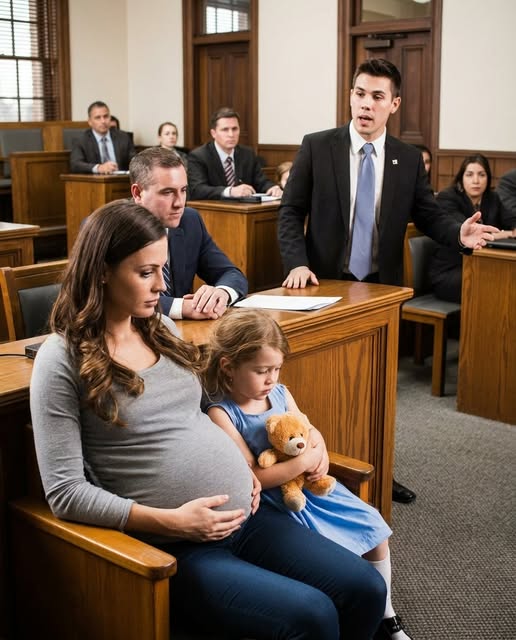
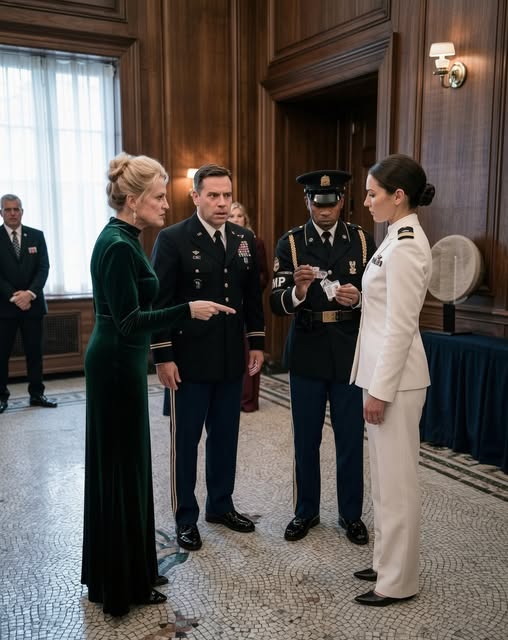
And on a late October evening in Fairfax, Virginia, I stood in a ballroom at Brierwood Country Club and listened to my stepmother tell two hundred people that I was a fraud, a washout, and a disappointment to the uniform, while a colleague whose life I had helped protect stood ten feet behind her holding a glass of water and the truth folded twice in his jacket pocket.
That is the sentence I will carry the rest of my life. Not because it was the worst thing Diane Callaway ever did to me, but because it was the last.
I enlisted in 2002 at nineteen. My mother, my real mother, Claire Callaway, had been dead for ten years by then, and the house my father built with her had been redecorated by a woman named Diane Patricia Whitfield, who became Diane Patricia Callaway in 1995 when I was twelve and who spent the next twenty-five years ensuring that everyone in Richard Callaway’s life understood one organizing principle: the first family was a rough draft. She was the final copy.
I didn’t leave home for the Army. I left home because there was no home left. The enlistment was simply the paperwork that made the departure official.
Basic training at Fort Sam Houston, then Advanced Individual Training, then my first duty station, and the world opened in a way I hadn’t known it could. Not wider, exactly. Sharper. Everything had edges. Everything counted. You learn that fast as a medic. The snap of gloves in a medical tent means work has begun. It means someone needs help. It means your hands are the only available distance between that person and serious harm, and there is no room in that distance for hesitation or self-doubt. Half a second is a unit of measurement that matters.
You learn to move before you think. You learn to think while you move. You learn that the memory of your patients stays with you for hours after the work is done, and you keep going because there is always another person to help, and the work is the only honest thing in the room.
I deployed to Iraq in 2005. I came back a sergeant. I deployed to Afghanistan in 2010. I came back a staff sergeant. I deployed to Mosul in 2016, and I came back with a Silver Star and two injured metacarpals that I had supported myself so I could keep providing care, and a photograph in my wallet of a young corporal named Devon Wade, whose life I could not save.
I lied to him. That is the part the citation doesn’t mention.
Back in Fairfax, Virginia, in the house on Maple Crest Drive that my mother had chosen and my father had maintained, a different version of my life was being presented. A version I had not written. A version I did not know existed until it had hardened into family expectation.
Diane had started small. That was her particular talent, the incremental adjustment, the quiet editorial revision, the story shifted by just enough that no one noticed until the original shape was no longer visible. After my first deployment she told Richard’s friends I’d barely passed training, that the Army was being patient with me, that I struggled under pressure. I was at Fort Hood conducting drills when this was happening. I was twenty-four and still believed the people back home were proud of me.
After my second deployment, she escalated. She told the family I had anger problems, that I had been written up, that officers had concerns about my reliability. She used words like struggling and difficult and we’re all so worried about her, words that sounded, at the right distance, like concern, but which had the structural logic of a campaign.
And then Mosul.
In 2017, while I was working under extreme conditions with my hand injured, Diane told my father’s social circle that I had been dishonorably discharged. She used those specific words. Dishonorably discharged. She delivered them the way she delivered everything, with a practiced tone of regret, a slight shake of her head, the expression of someone trying to appear responsible while rewriting reality.
She told them while I was still deployed. She told them while I was still wearing the uniform.
And my father, Richard Allen Callaway, the quietest man I ever knew, heard this and said nothing. Not because he believed it entirely, but because Diane’s voice was the one in the room and mine was seven thousand miles away. Richard was a man who had learned to survive by not making waves in water someone else controlled. That is not condemnation. That is grief, taking the shape available to it.
I came home in 2019 with an honorable discharge after sixteen years. I took a job as an emergency department nurse at a regional hospital in Northern Virginia, which required exactly the skills the Army had refined in me. I tried to see my father. I drove to the house. I called. I sent letters. Diane managed access the way she managed everything, with the appearance of reasonableness and the reality of a locked door. Phone calls went unreturned. Holiday invitations were not extended. When I asked Tyler, my half-brother, if I might come for Thanksgiving, he said awkwardly that his mother thought it might be too stressful for Dad.
Tyler was not cruel. He had been raised inside Diane’s version of the family. He had no frame of reference for a different shape.
Richard Callaway’s sixty-ninth birthday was in February 2023. I drove four hours from Northern Virginia to Fairfax with a card and a box of cigars he liked. I parked in the driveway of the house on Maple Crest. I walked up the steps. I rang the bell.
Diane answered.
She stood in the doorway with a dish towel in her hand and looked at me the way you look at a solicitor you’re about to turn away.
“He’s resting,” she said. “He doesn’t want visitors.”
It was four in the afternoon. Through the front window I could see the living room lights were on. I could hear the television.
“Can you give him these?” I said.
She took the box without looking at it.
“I’ll let him know you stopped by.”
The door closed before I had finished turning. I left the card on the porch because there was nowhere else to put it.
Three weeks later, Harold Mitchell, a retired Army major who had been my father’s oldest friend, called me and said carefully that my father had been awake that afternoon and had asked where I was. Diane had told him I canceled.
I sat in my car in the hospital parking lot with the engine off and my hands on the steering wheel.
I flexed my left hand. The third and fourth fingers bent wrong, as they always bend wrong, the metacarpals healed slightly crooked. They ached in the cold the way old injuries ache, like a conversation the body refuses to finish.
Richard Callaway died of a heart attack eleven months later, at sixty-nine years old.
I learned about it from Harold Mitchell, not from Diane, not from Tyler.
I attended the funeral. Diane introduced me to mourners as Richard’s older daughter and added that I had had a difficult time. Then she filed paperwork to have me removed as beneficiary on my father’s life-insurance policy. One hundred and twelve thousand dollars. She forged a notarized letter claiming I had voluntarily relinquished my share, and had the document executed by a paralegal.
That was the woman who organized the memorial.
Late October. Brierwood Country Club. Two hundred guests. A three-tier cake with my father’s photograph printed on the edible topper. Prime rib, glazed salmon, champagne flutes on silver trays. A raw bar on a terrace.
Richard Callaway would have wanted pulled pork and paper plates and a cooler of beer and his fishing buddies telling the story about the largemouth bass he caught in his neighbor’s pond. He would not have wanted this. But Diane was throwing his memorial for the guests she wanted in the room, the real-estate colleagues and charity-board members and country-club acquaintances who comprised the social architecture she had spent twenty-five years building, and the event reflected her, not him.
There was a printed program.
It listed the Callaway family’s accomplishments in descending order of visibility. Tyler’s insurance career. Diane’s volunteer work. Richard’s years at the postal service. The phrase small but strong appeared twice, as both header and benediction.
My name was not in the program.
I walked through the front entrance at 4:15 in dark slacks and a navy cardigan and flat black shoes, my hair pulled back. I drew no attention. Diane stood near the entrance in a charcoal dress and pearls, greeting guests with the rehearsed warmth of a woman who has practiced hospitality until it no longer requires sincerity.
“Oh, Megan.” A pause calibrated to convey surprise. “I didn’t think you’d come.”
No embrace. A half turn to the next guest before I could respond. No seat with my name on it, no entry in the printed program, no acknowledgment that I had driven two hours to be in a room that had been arranged to make me invisible.
I found an empty chair near the emergency exit.
The memorial table stood near the far wall: fifteen photographs of Richard Callaway arranged in matching silver frames. Richard at his postal-service retirement. Richard and Diane at a charity gala. Richard with Tyler at a baseball game. Richard and his friends fishing.
I was in three of those original photographs.
Diane had them reprinted and cropped.
In the visual record of my own father’s life that occupied one full wall of this ballroom, I no longer existed.

Benjamin Harris is a RapidReports front page contributor and editor,proud father of four.