Trump vs. Obama in 2028? Hypothetical Poll Shows How Voters Responded
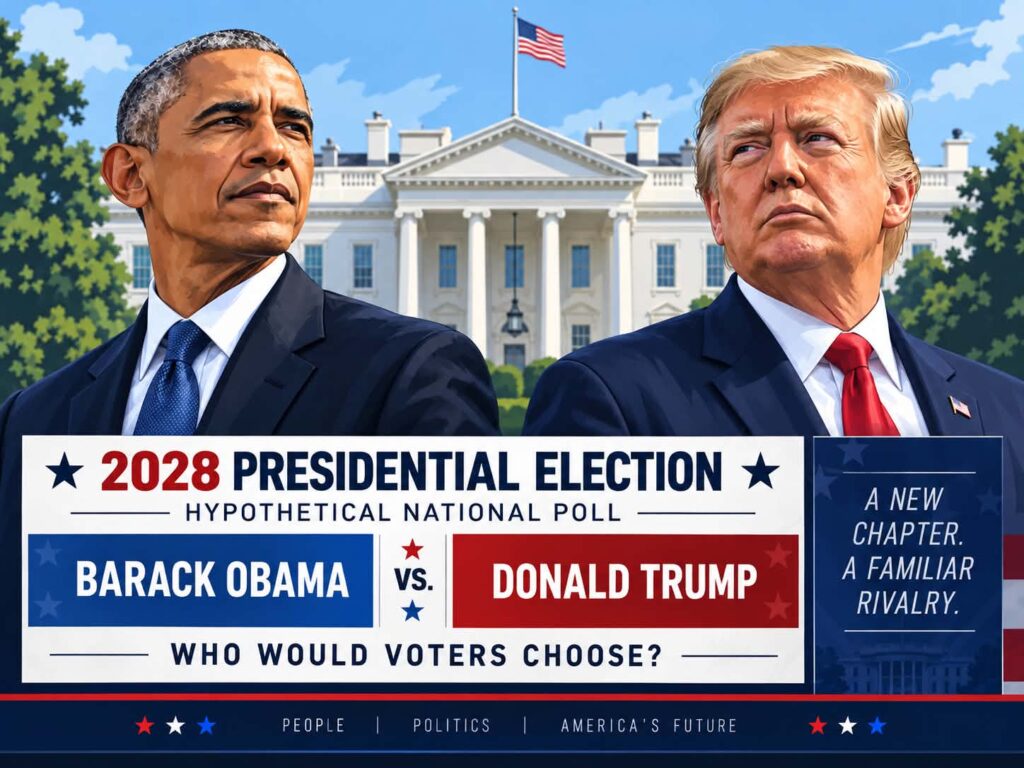
A presidential race between Donald Trump and Barack Obama would be one of the most unusual political matchups imaginable.
The two men have never faced one another as presidential candidates, but their names remain closely associated with two very different eras of American politics. Trump returned to the White House after winning the 2024 presidential election, while Obama left office in January 2017 after serving two terms.
Now, a new hypothetical poll has asked Americans to imagine what might happen if the two former and current presidents somehow appeared on the same presidential ballot in 2028.
The result gives an indication of how registered voters responded to the matchup — even though current constitutional rules make an ordinary Trump-Obama presidential contest impossible.
What the Hypothetical Poll Found
According to a Daily Mail and J.L. Partners survey of 1,013 registered voters, respondents were asked to choose between Trump and Obama in a hypothetical 2028 presidential contest.
The reported result was:
- 52% chose Barack Obama
- 41% chose Donald Trump
The remaining respondents did not select either candidate or otherwise fell outside those two choices.
These figures should be understood as the results of a hypothetical survey rather than an election forecast. A poll conducted several years before an actual election cannot establish who would win an election that does not currently exist.
The survey is nevertheless notable because Obama was presented against Trump in a hypothetical matchup at a time when both men remain highly recognizable figures in American political life.
Black and Hispanic Voters Showed Large Differences in the Hypothetical Matchup
The reported survey also broke down responses by demographic groups.
Among Hispanic voters, 73% reportedly selected Obama in the hypothetical contest.
Among Black voters, the figure was 68%.
Those subgroup results should be interpreted cautiously. Demographic subgroup percentages can have larger margins of error than the overall survey, depending on the number of respondents in each category.
Still, the figures illustrate the different responses produced when voters were asked to imagine a contest involving two presidents who have occupied very different positions in the country’s recent political history.
Why Would Anyone Poll a Race That Cannot Happen?
The obvious question is why pollsters would ask Americans to choose between two people who cannot ordinarily appear together on a 2028 presidential ballot.
The answer is that hypothetical polling can be used to measure public sentiment toward well-known political figures even when the precise matchup is not legally or politically realistic.
It can also provide a snapshot of how voters react to particular candidate combinations.
That is different from conducting a conventional election poll.
There is currently no Trump-Obama 2028 campaign, no such presidential nomination contest and no legal mechanism under existing constitutional rules that would simply place both men on the ballot for a third presidential election.
What the 22nd Amendment Says
The constitutional obstacle is the 22nd Amendment.
Its first section states that no person may be elected to the office of president more than twice. The amendment also contains a separate provision concerning someone who served more than two years of another president’s term.
Both Trump and Obama have already been elected president twice.
Obama won the presidency in 2008 and was reelected in 2012.
Trump won in 2016 and again in 2024.
Under the current constitutional text, that means neither man could simply run for and be elected president for a third time in 2028.
Consequently, a normal Trump-versus-Obama presidential election in 2028 is not currently a realistic ballot scenario.
Trump Has Continued to Discuss the Idea of a Third Term
The hypothetical matchup has nevertheless attracted attention because Trump has repeatedly discussed the possibility of serving another term beyond his current presidency.
Trump has said that supporters have encouraged him to pursue a third term and has publicly referred to possible “methods” for doing so.
Those comments have generated constitutional and legal discussion because the 22nd Amendment expressly limits presidential election to two times.
Importantly, discussion of possible methods is not the same thing as a change to the Constitution or a legal determination that a third elected term is currently available.
The constitutional language remains in effect.
Obama Has Not Announced a 2028 Presidential Campaign
Obama presents a different situation.
The former president has not announced a campaign to return to the White House.
After leaving office in 2017, Obama has remained active in public life through political advocacy, speeches, the Obama Foundation and other projects, but that is distinct from seeking another presidential term.
His two previous presidential victories also place him under the same 22nd Amendment limitation that applies to Trump.
Therefore, the hypothetical poll does not represent an actual contest between two declared 2028 presidential candidates.
Obama and Trump Represent Different Political Eras
The interest in the hypothetical matchup is partly explained by the extraordinary political visibility of both men.
Obama entered the national spotlight during his 2008 presidential campaign and became the first Black president of the United States.
Trump entered presidential politics from a very different background and won the presidency in 2016 before losing the 2020 election and returning to the White House after the 2024 election.
Their presidencies were separated by four years of the Biden administration.
Even though they never competed directly for the presidency, each has remained a major figure in national political debates.
That makes comparisons between them a recurring feature of political polling and commentary.
The Poll Also Tested Other Democratic Figures
The reported survey included hypothetical matchups involving other prominent Democratic figures.
According to the figures cited in the original report, Obama was the only Democratic figure among the tested candidates who defeated Trump in the hypothetical comparisons.
Trump was reported to have led when respondents were asked about matchups involving Hillary Clinton and Kamala Harris.
These results should not be treated as a ranking of the politicians or as evidence about the actual 2028 election.
The candidates tested, the wording of questions, the timing of the survey and the composition of the sample can all influence hypothetical polling results.
Moreover, the actual field of candidates for 2028 will not be known for some time.
Why Hypothetical Polls Can Be Misleading
A hypothetical presidential poll several years before an election comes with obvious limitations.
First, voters are being asked about a contest that is not on the ballot.
Second, respondents are making a choice without knowing the circumstances that would surround a real election.
Third, political conditions can change considerably between a hypothetical survey and an actual presidential campaign.
Candidates can enter or leave races, public opinion can change, economic conditions can shift and major domestic or international events can reshape political priorities.
For those reasons, the reported 52%-to-41% result is best understood as a snapshot of responses to a hypothetical question, rather than a prediction of a future election result.
The 2028 Race Is Still a Separate Question
The actual 2028 presidential race will involve a process of candidate recruitment, campaigns, primaries, caucuses and eventually a general election.
Neither Obama nor Trump can simply be treated as ordinary 2028 candidates under the current constitutional framework.
The 22nd Amendment remains the controlling constitutional provision concerning presidential election limits.
That means any scenario in which either man appeared on a 2028 presidential ballot would raise legal and constitutional questions that go beyond the ordinary process of choosing a presidential candidate.
What the Hypothetical Result Really Tells Us
The most defensible takeaway from the survey is relatively narrow.
When the 1,013 registered voters surveyed were presented with a hypothetical Trump-Obama presidential matchup, the reported responses favored Obama by the stated margin.
That tells us something about the preferences expressed by those respondents at the time of the survey.
It does not establish that Obama would win a real 2028 election, nor does it establish that Trump would lose one.
There is currently no actual Trump-Obama 2028 race to measure.
A Matchup That Exists Mainly in the “What If?” Category
For now, a Trump-versus-Obama presidential election remains a hypothetical scenario.
The two men have already been elected president twice, and the 22nd Amendment limits a person to two presidential elections.
Trump’s public comments about a possible third term have nevertheless kept the constitutional question in the public conversation.
Meanwhile, Obama’s name continues to appear in hypothetical polling because of his enduring prominence among Democratic voters and the broader American public.
That combination makes the imagined matchup an attention-grabbing polling exercise, even though it does not correspond to an ordinary 2028 presidential contest.
The reported survey found that 52% of respondents chose Obama and 41% chose Trump when asked to imagine the two facing each other.
Whether those numbers would have any relationship to an actual election is impossible to establish from a hypothetical poll alone.
For now, the Trump-Obama matchup remains exactly that: a “what if?” scenario that offers a glimpse into how some Americans respond to an extraordinary hypothetical choice, rather than a forecast of the 2028 presidential election.

Benjamin Harris is a RapidReports front page contributor and editor,proud father of four.