
House Votes 220-204 to Restrict Trump’s War Powers in Iran Conflict
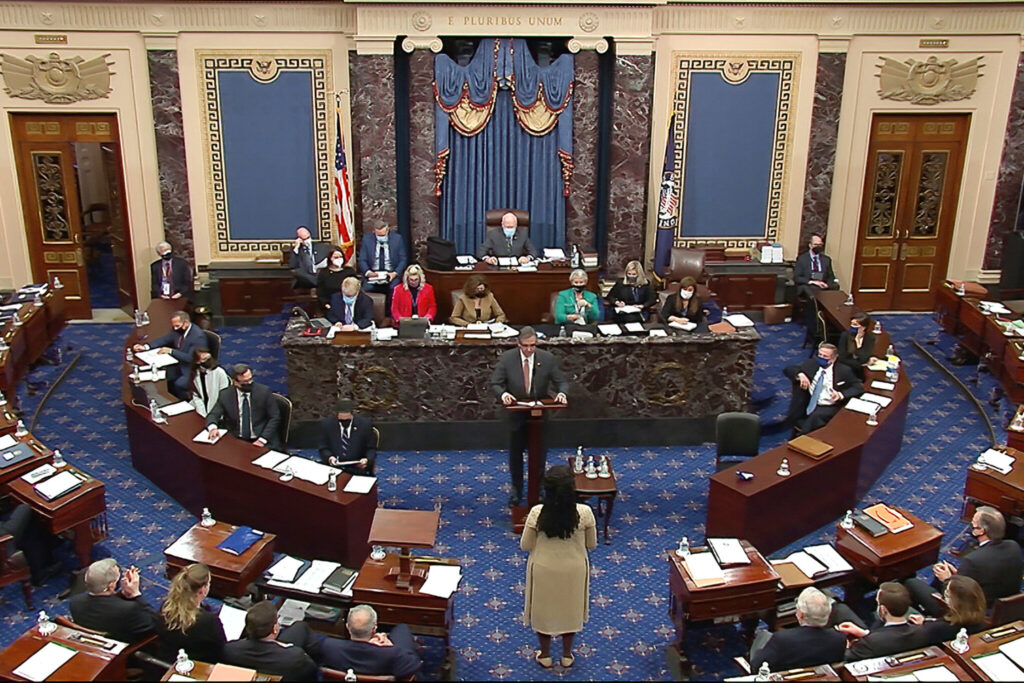
The U.S. House of Representatives has voted for the third time to restrict President Donald Trump’s authority to continue military operations against Iran without additional congressional authorization.
The war-powers resolution passed 220-204 late Tuesday, with all Democrats who voted joined by seven Republicans. The vote marks the latest attempt by Congress to assert a greater role in decisions over the continuing U.S. military involvement in the conflict.
The measure, however, does not immediately end U.S. military operations. Previous House resolutions addressing the conflict did not become law, and the latest measure would still have to clear the Senate and reach the president.
Seven Republicans Join Democrats
Seven Republican representatives voted in favor of the resolution:
- Tom Barrett of Michigan
- Warren Davidson of Ohio
- Brian Fitzpatrick of Pennsylvania
- Thomas Massie of Kentucky
- Nancy Mace of South Carolina
- Mariannette Miller-Meeks of Iowa
- Zach Nunn of Iowa
The seven Republicans joined House Democrats in supporting the measure. The number of Republican votes in favor was higher than in the House’s two previous attempts to limit the administration’s war powers over Iran.
The vote therefore produced a bipartisan coalition, although the overwhelming majority of House Republicans opposed the resolution.
What the Resolution Would Do
The measure invokes the congressional authority established under the War Powers Resolution, directing the president to remove U.S. forces from hostilities against Iran unless Congress provides authorization for continued military action.
The War Powers Resolution, enacted in 1973 following the Vietnam War, was designed to establish procedures governing the president’s use of U.S. military forces without a formal declaration of war.
The constitutional division of war powers has remained a recurring source of disagreement between Congress and presidents of both parties.
This Is the Third House Vote
The House has now taken similar action three times during the Iran conflict.
Earlier resolutions passed in June and July but did not result in the termination of U.S. military operations.
The Senate has also considered measures seeking to restrict the administration’s authority. In one previous instance, the Senate approved a war-powers resolution, but Republican senators subsequently reversed their position and the measure did not advance.
The repeated votes demonstrate the continuing disagreement in Congress over the scope of presidential authority in the conflict.
Why the Resolution Is Unlikely to Immediately End the War
Passing the House is only one step in the legislative process.
The Senate would have to approve the measure before it could be presented to the president. Even then, the White House could reject it.
The administration has disputed congressional efforts to use the War Powers Resolution to terminate the military campaign and has maintained its own legal interpretation of the president’s authority to conduct military operations.
As a result, Tuesday’s vote is principally a congressional assertion of authority rather than an immediate operational order ending the conflict.
Cost of the Conflict Has Become a Congressional Issue
The financial consequences of the war have also become part of the congressional debate.
The Congressional Budget Office estimated that the conflict had cost the United States more than $38 billion as of August 1 and projected that the military operation was costing approximately $2 billion to $3 billion per month, depending on the intensity of fighting.
The CBO also projected that the conflict could contribute to higher inflation heading into 2027.
Those costs come as lawmakers are already debating federal spending and the economic effects of higher energy prices.
Republican Support Has Increased
The latest vote also shows a modest increase in Republican support for congressional restrictions on the war.
Four Republicans had supported the most recent earlier House effort. Seven Republicans backed Tuesday’s resolution.
Among them were Nunn and Miller-Meeks, two Iowa Republicans, as well as Mace, who is retiring from the House. Massie has been one of the most persistent Republican critics of the administration’s approach to the Iran conflict.
Their votes do not necessarily indicate identical reasons for supporting the resolution. Members have cited constitutional authority, military strategy, the duration of the conflict and its economic consequences in explaining their positions.
The Vote Comes Ahead of the Midterm Elections
The House action comes less than two months before the November midterm elections.
The Iran conflict has become an increasingly prominent issue in congressional politics as lawmakers debate military authority, spending, energy prices and U.S. foreign policy.
The timing is particularly relevant for members facing reelection contests, although individual lawmakers have offered different explanations for their votes. The House is scheduled to return to its districts as the November 3 elections approach.
Trump Has Said the Conflict Will Eventually End
Trump has previously said that the Iran conflict would end after the November elections, while also maintaining that the United States has objectives that must be achieved before military operations conclude.
The administration and congressional opponents therefore differ over both the appropriate scope of presidential authority and the circumstances under which U.S. military involvement should end.
The House resolution seeks to place Congress more directly in control of whether continued hostilities are authorized.
What Happens Next?
The next major question is whether the Senate will take up the House measure and, if so, whether it can secure sufficient support.
Even if the Senate approves it, the resolution would still face the president.
That means Tuesday’s 220-204 vote does not itself terminate the Iran conflict or automatically withdraw American forces.
Instead, it represents the House’s latest effort to invoke congressional war powers and require additional authorization for continued U.S. military involvement.
The Bottom Line
The House voted 220-204 to restrict President Trump’s ability to continue military operations against Iran without congressional authorization.
Seven Republicans joined Democrats in supporting the measure, marking the third time the House has approved a war-powers resolution concerning the conflict.
The vote is significant because it reflects bipartisan support in the House for greater congressional involvement in decisions over the war. But it does not immediately end U.S. military action.
The measure still faces the Senate and presidential action, leaving the question of whether it will ultimately change U.S. policy unresolved.

Benjamin Harris is a RapidReports front page contributor and editor,proud father of four.