Ashley Moody and Angie Nixon Deadlocked at 45% in New Florida Senate Poll
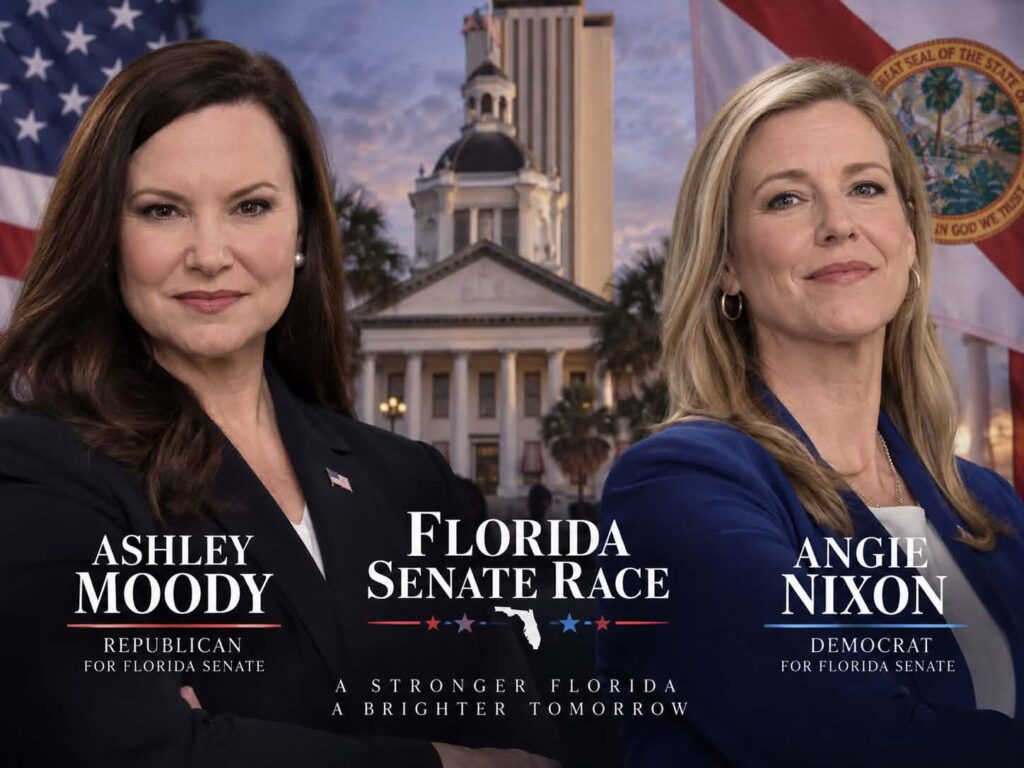
Republican Sen. Ashley Moody and Democratic challenger Angie Nixon are virtually tied in a new Florida Senate poll, with each receiving 45% support among likely voters.
The St. Pete Polls survey, conducted September 15-17 for Florida Politics, found Moody at 45.2% and Nixon at 44.8% before rounding. Another 3% selected someone else, while 7% remained undecided.
The survey included 913 likely voters and has a margin of error of ±3.2 percentage points. The four-tenths-of-a-point difference between the candidates is therefore well within the poll’s margin of error.
A Dramatic Difference From the Previous Poll
The St. Pete Polls numbers differ significantly from another survey conducted only days earlier.
A Quantus Insights poll conducted September 8-10 found Moody at 50.1% and Nixon at 42.7% among 733 likely voters.
A Change Research survey conducted September 7-9, meanwhile, put the candidates at 47% each. Earlier University of North Florida and Emerson College surveys had also shown Moody ahead.
Those differences demonstrate why individual polls should be interpreted cautiously. Pollsters use different sampling, weighting and likely-voter methodologies, and a single survey does not establish a trend or determine the eventual result.
Nixon’s Support Among Independent Voters
One of the most striking findings in the new St. Pete Polls survey is Nixon’s advantage among voters who are not affiliated with either major party.
Nixon leads Moody 50% to 37% among independent and minor-party voters, according to the survey.
Nixon also receives 12% support from Republican voters, while Moody receives 8% among Democrats. The poll found Nixon retaining 85% of Democratic voters, compared with Moody retaining 77% of Republicans.
The survey was weighted to reflect Florida’s active voter population, with the final sample consisting of approximately 42% Republicans, 31% Democrats and 27% voters without a major-party affiliation or registered with minor parties. Republicans have a substantial voter-registration advantage statewide.
Age Differences Stand Out
The candidates’ support also varies sharply by age.
Nixon leads among voters younger than 30 by 64% to 25%, according to the poll.
Among voters ages 30 to 49, Nixon leads 54% to 35%.
Moody leads among voters ages 50 to 69, 47% to 42%, and has a larger advantage among voters 70 and older, 61% to 32%.
Subgroup findings generally have greater uncertainty than the overall result because they are based on smaller numbers of respondents.
Race and Ethnicity Show Different Patterns
The survey also found substantial differences by race and ethnicity.
Nixon leads among Black voters 74% to 14%, while Moody leads among White voters 53% to 37%.
Nixon also leads among Hispanic voters, 51% to 39%, according to the survey.
The Hispanic result is particularly notable because Hispanic voters have been an important part of Florida’s changing electoral coalition in recent presidential elections. But the Senate poll is a statewide survey of likely voters and should not be treated as evidence that any particular demographic group will vote a certain way in November.
Both Candidates Have Different Political Backgrounds
Moody currently holds Florida’s Senate seat after Gov. Ron DeSantis appointed her to replace Marco Rubio, who left the Senate after being selected to serve as secretary of state.
Before joining the Senate, Moody served as Florida attorney general and won statewide elections in 2018 and 2022.
Nixon is a Democratic member of the Florida House representing Jacksonville. She won the Democratic Senate nomination over Alex Vindman, receiving 56% of the vote.
The Democratic primary was closely watched because Vindman had substantially greater campaign spending, according to reporting on the contest.
Fundraising Remains a Major Difference
The two campaigns also entered the general election with substantially different financial resources.
Moody reported raising approximately $11.3 million through the end of July and having about $8.4 million cash on hand after the primary.
Nixon had raised less than $1 million by that point, although her campaign reported a subsequent increase in fundraising following her primary victory.
Nixon has also criticized Moody over her handling of campaign debates. Moody declined the first of three debate invitations issued earlier this month, according to Florida Politics.
Florida’s Governor’s Race Is Also Close
The same St. Pete Polls survey found a similarly narrow contest in the Florida governor’s race.
Republican Rep. Byron Donalds received 44%, compared with 43% for Democrat David Jolly.
The one-point difference also falls well inside the poll’s margin of error.
The simultaneous closeness of the two statewide contests provides a snapshot of the political environment in Florida, but the Senate and governor’s races involve different candidates, campaigns and issues.
The Survey Comes After Conflicting Polling
The latest survey stands out partly because of how sharply it differs from several previous polls.
Quantus Insights’ September 8-10 survey gave Moody a roughly seven-point advantage after rounding. The University of North Florida’s July poll showed Moody ahead by eight points, while an Emerson College survey conducted in March showed a larger Moody advantage. A Change Research survey conducted earlier this month had the Senate race tied at 47% each.
Consequently, the 45%-45% result should not be interpreted in isolation.
It is one new measurement taken during a campaign in which the candidates’ support has varied considerably across surveys.
What the Poll Actually Shows
The clearest finding from the St. Pete Polls survey is that the two candidates are currently separated by less than one percentage point among the voters surveyed.
It does not establish that either candidate has a statistically significant statewide advantage. The 3.2-point margin of error is substantially larger than the four-tenths-of-a-point difference between Moody and Nixon.
The survey also leaves 7% undecided, while another 3% selected a candidate other than Moody or Nixon.
Those voters represent an important portion of the electorate that was not committed to either major-party candidate when the survey was conducted.
Election Day Is Still Ahead
The 2026 general election is scheduled for November 3. Polling conducted in September provides information about voter preferences at that particular point in the campaign, but it does not determine the eventual result.
For now, the Florida Senate race presents a sharp contrast between recent surveys: one showed Moody with a sizable numerical advantage, another showed the candidates tied, and the newest St. Pete Polls survey again places them essentially level.
The coming weeks of campaigning, additional polling, debates and voter decision-making will provide further information about how the race develops.

Benjamin Harris is a RapidReports front page contributor and editor,proud father of four.