Marco Rubio Leads JD Vance by 20 Points in New 2028 Republican Primary Poll
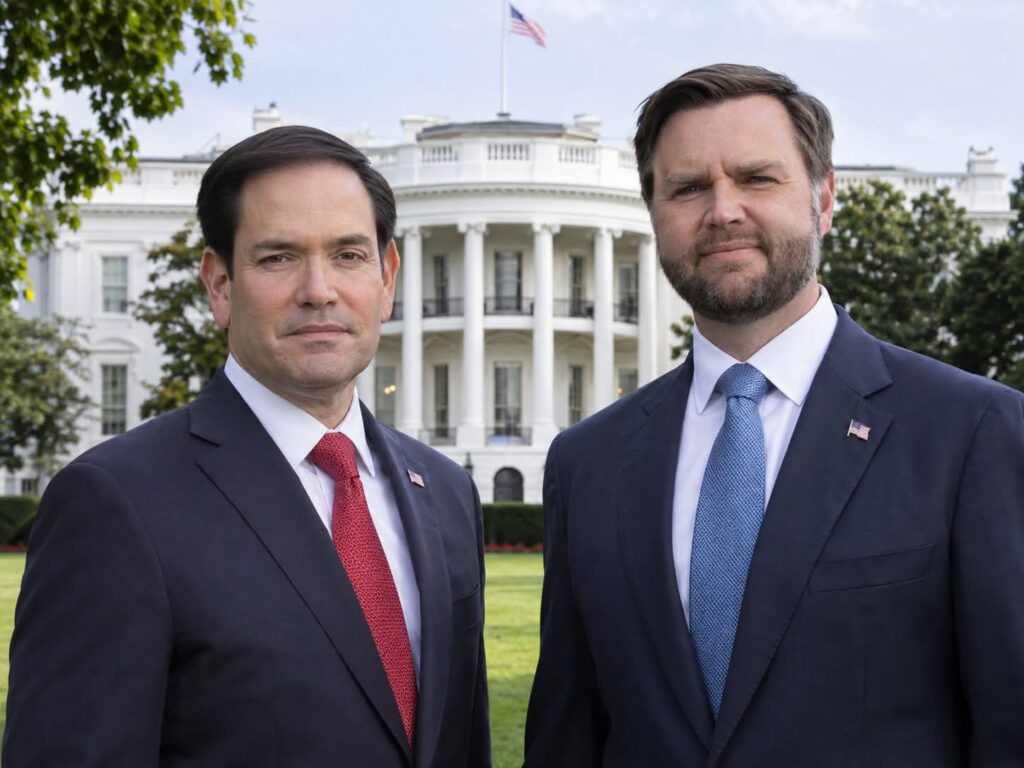
Secretary of State Marco Rubio has opened a substantial lead over Vice President JD Vance in one early national survey of potential Republican presidential candidates for 2028, according to an Emerson College poll released November 19. Rubio received 44% support when Republican primary respondents were shown a list of potential candidates, compared with 24% for Vance. Florida Gov. Ron DeSantis placed third with 9%, followed by Donald Trump Jr. at 6%.
The findings put Rubio 20 percentage points ahead of the sitting vice president in the survey’s list-based question. However, the results represent an early measurement of voter preferences rather than a forecast of the eventual Republican nomination. The presidential election is still two years away, and neither Rubio nor Vance has formally announced a 2028 campaign.
Rubio Leads Vance in Emerson College’s Republican Primary Survey
The Emerson College national survey, conducted November 14–16, asked respondents whom they would support for their party’s presidential nomination in 2028. Researchers first used an open-ended question, allowing participants to name a preferred candidate without being shown a list. They then presented respondents with a selection of potential candidates.
In the closed-ended Republican primary question, Rubio received 44% support, while Vance attracted 24%. DeSantis followed with 9%, and Donald Trump Jr. received 6%.
The open-ended results also placed Rubio ahead of Vance, although the percentages were lower. Thirty-six percent of respondents named Rubio without being prompted by a candidate list, compared with 20% who selected Vance. DeSantis, President Donald Trump and Republican Rep. Thomas Massie each received 7%.
The difference between the two questions is important. The list-based question measures support when respondents are reminded of specific potential candidates, while the open-ended question provides a view of whom voters identify on their own. In both versions of the Emerson survey, Rubio placed ahead of Vance.
Rubio’s Position in the Trump Administration
Rubio’s role as secretary of state has given him a prominent position within the Trump administration and regular exposure to major foreign policy developments.
As the country’s top diplomat, he represents the United States in international discussions and deals with issues involving diplomatic relations, national security and foreign governments. That public-facing role has kept him in the national political spotlight.
Rubio also has an established history in Republican presidential politics. He competed against Trump during the 2016 Republican nomination contest, when both were among a large group of candidates seeking the party’s nomination.
His current Cabinet position places him close to the president and gives him a significant platform within the administration. Whether he decides to pursue the presidency in 2028, however, remains unknown.
Vance also occupies a prominent position in the Republican Party. As vice president, he has a national platform and a close working relationship with Trump. He has frequently defended the administration’s policies and political priorities, making him a central figure in discussions about the party’s future leadership.
The Emerson results indicate that Rubio and Vance are both receiving measurable support among Republican primary respondents, but the survey does not establish whether either official intends to enter the race.
One Poll Does Not Establish a National Republican Frontrunner
Although Rubio’s 20-point advantage is a notable finding in the Emerson survey, other recent polling has produced different results.
An Echelon Insights survey conducted November 12–16, for example, placed Vance ahead of Rubio, with 40% support for the vice president compared with 26% for the secretary of state. Other recent surveys have also shown varying levels of support for the two potential candidates.
These differences demonstrate why individual polls should be considered within the wider polling environment. Surveys can produce different results depending on when they are conducted, how questions are worded, which candidates are included and how respondents are recruited.
The Emerson poll also reported a smaller Republican primary sample than its overall national sample of 1,000 registered voters. The college said the full survey had a credibility interval of approximately three percentage points, while cautioning that smaller demographic and political subgroups carry greater uncertainty.
Consequently, the Republican primary figures should not be interpreted as having the same statistical precision as the overall survey. The findings provide a snapshot of opinion among the respondents surveyed, not a definitive measurement of the preferences of every Republican voter.
Republican Party Favorability Falls Below 40%
The survey also examined public attitudes toward the two major political parties.
Only 35% of respondents said they had a favorable opinion of the Republican Party, while 56% viewed it unfavorably. That left the party with a 21-point unfavorable balance in the Emerson survey.
The Democratic Party also received more unfavorable than favorable ratings, although the difference was narrower. Forty-seven percent viewed the Democratic Party unfavorably, compared with 44% who expressed a favorable opinion.
Emerson reported that the Republican Party’s favorable rating had declined by nine points over the previous year, while its unfavorable rating had increased by 12 points. The Democratic Party’s favorable rating, meanwhile, had risen by nine points during the same period.
These figures measure general public attitudes toward the parties, rather than support among voters participating in a particular primary. They therefore provide a broader picture of the political environment in which the next presidential campaign is expected to develop.
Trump’s Approval Rating Stands at 37%
President Trump’s job approval rating was another major finding in the survey.
According to Emerson College, 37% of registered voters approved of Trump’s performance as president, while 54% disapproved. The remaining respondents did not fall into either of those two categories.
The approval figures offer context for the early discussion surrounding the Republican Party’s future. Trump’s political influence remains central to the party, and potential candidates are likely to face questions about their relationship with his administration and the movement that helped return him to the White House.
However, the survey does not establish how Trump’s approval rating will affect the 2028 Republican nomination contest. The relationship between presidential approval, primary preferences and the eventual selection of a nominee can change as political circumstances develop.
Jon Ossoff Leads the Democratic Field in List-Based Results
The Emerson survey also examined potential Democratic presidential contenders for 2028.
In the closed-ended Democratic primary question, Georgia Sen. Jon Ossoff received 17% support, narrowly ahead of former Vice President Kamala Harris at 16%. Rep. Alexandria Ocasio-Cortez followed with 15%, while former Transportation Secretary Pete Buttigieg received 14%.
California Gov. Gavin Newsom recorded 11%, with other potential candidates receiving smaller shares.
The open-ended Democratic results were different. When respondents were allowed to name a candidate without seeing a list, Ossoff received 17%, followed by Ocasio-Cortez at 12%. Newsom received 8%, while Harris and Buttigieg each recorded 6%.
The distinction matters because the closed-ended results show how respondents reacted to a supplied list of names, while the open-ended findings measure spontaneous candidate preferences.
Ossoff’s position in both questions makes him one of the figures to watch in early discussions about the Democratic Party’s next presidential nomination. Nevertheless, the survey does not establish that he will seek the nomination or that the current preferences will remain unchanged.
Cost of Living Is Voters’ Top Priority for Congress in 2027
Beyond presidential politics, the survey found that economic concerns remain a major priority for registered voters.
Fifty-seven percent said addressing the cost of living should be a top priority for Congress in 2027. That was the highest figure among the issues included in the question.
Other issues also received substantial support. Forty-nine percent said ending the war in Iran should be a top priority, while the same percentage identified banning stock trading by members of Congress. Healthcare reform received 45%, and 37% identified regulation of the artificial intelligence industry as a top priority.
Twenty-eight percent said investigating the Trump administration should be a top priority for the next Congress.
The results suggest that voters are weighing a range of domestic and international issues as lawmakers prepare for the next congressional session. The cost of living, in particular, remains a prominent concern across party lines. Emerson’s executive director, Spencer Kimball, said 71% of Democrats, 58% of independents and 42% of Republicans identified it as a top priority.
How the Emerson College Poll Was Conducted
Emerson College conducted the national survey from November 14 through November 16, 2026. The overall survey included 1,000 registered voters and carried a reported credibility interval of approximately three percentage points.
The poll used a combination of a probability-based voter panel recruited through text-to-web invitations and additional panel interviews. Respondents were matched against voter-file information, and the data were weighted by factors including gender, education, race, age, party affiliation and region.
Emerson cautioned that results from smaller groups within the overall sample carry greater uncertainty. That qualification is especially relevant when interpreting presidential primary preferences, since those results are based on subsets of the full national sample.
The survey was conducted and funded by Emerson College. Its findings should be considered alongside other polling and future surveys as the 2028 election approaches.
Early 2028 Presidential Contest Remains Unsettled
Rubio’s lead over Vance in the Emerson College survey has added a new dimension to early speculation about the Republican Party’s post-Trump leadership. The secretary of state led the vice president in both the open-ended and list-based Republican primary questions, while other recent surveys have shown a different balance between the two potential candidates.
The same poll also found that the Republican Party’s unfavorable rating exceeded its favorable rating, Trump’s job approval stood below 40%, and voters continued to place significant emphasis on the cost of living.
For now, the figures offer an early snapshot of the political landscape rather than a reliable indication of how the 2028 presidential race will unfold. Candidate announcements, policy debates, campaign organization, economic conditions and changes in public opinion could all reshape the field before Republican voters select their nominee.

Benjamin Harris is a RapidReports front page contributor and editor,proud father of four.