Seattle’s $165 Million Downtown Library Overrun by Open Drug Use and Disorder
Disturbing footage captured inside Seattle’s landmark Central Library has ignited fresh outrage over the condition of a publicly funded institution meant to serve families, students, and readers.
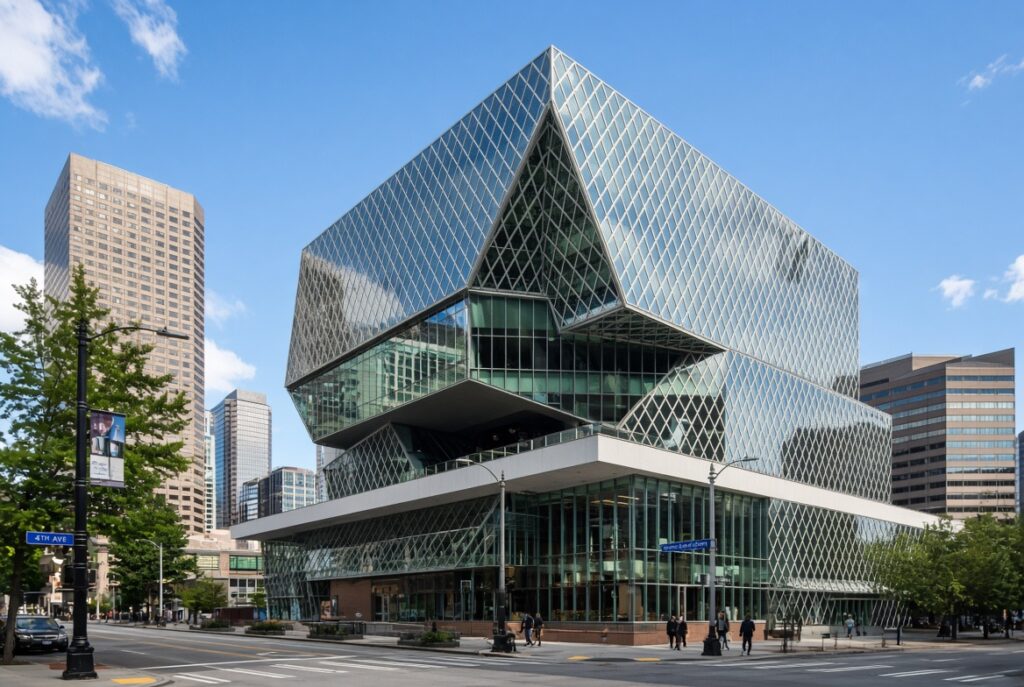
Savanah Hernandez of Turning Point USA’s Frontlines released a video report on August 6 showing the $165 million glass-and-steel building plagued by vagrancy, open drug use, and the open distribution of drug paraphernalia.
“I visited Seattle’s $165 million dollar downtown library and it was OVERRUN with drug addicts,” Hernandez said. “Not only is this library filled with adults who are high on drugs, but they also offer FREE fentanyl test strips, syringes and injectable narcan that anyone, including children, can access.”
She described foul odors, unusable restrooms, and harassment by homeless individuals—problems she said she personally experienced during the visit. The report comes just after Seattle voters approved a new seven-year library levy expected to raise roughly $480 million for operations, maintenance, security, and collections across the system’s 27 locations.
What the Video Shows
The video begins outside the library’s distinctive modern structure before moving inside. Footage captures interior walkways lined with bookshelves, open seating areas with purple chairs, and wooden floors. Individuals are visible throughout the spaces. In one sequence, a person is shown bent over near a red backpack in an area Hernandez identified as the floor containing the children’s section.
The posture is consistent with the “nodding out” behavior commonly associated with fentanyl or other opioid use.
Close-up shots focus on free supplies laid out on a table: vials of naloxone labeled for injectable use, packaged syringes, and green packets of fentanyl test strips. These items are available without requiring identification or a library card.
The video also overlays a Google review from a visitor citing foul odors and safety concerns related to transients, along with a Seattle Times excerpt discussing maintenance needs for the building’s windows.
In a related post, Hernandez shared a photograph of herself standing near magazine racks while a person in a gray hoodie remains bent forward beside a red backpack on the floor—again illustrating the visible impact of drug activity inside a public library.
How a Landmark Building Reached This Point
The Seattle Central Library, located at 1000 Fourth Avenue, opened on May 23, 2004. It was the centerpiece of the “Libraries for All” program, funded primarily by a $196.4 million bond measure approved by Seattle voters in November 1998. The central building itself cost approximately $165.5 million, including about $10 million for a temporary facility used during construction.
Designed by the Office for Metropolitan Architecture in collaboration with LMN Architects, the 11-story structure spans roughly 363,000 square feet of interior space plus underground parking. It features open platforms, a continuous book spiral, meeting rooms, and dedicated areas for children and teens.
What was once celebrated as an architectural landmark and civic achievement is now described by visitors and critics as a space where drug use and disorder interfere with its intended purpose. The presence of free syringes and injectable naloxone in a facility that includes children’s areas has drawn particular criticism from those who argue public libraries should prioritize safe environments for learning rather than serve as de facto harm-reduction distribution points.
Official Harm-Reduction Policies and Their Consequences
In recent months, the Seattle Public Library system has expanded efforts to address drug-related activity. Beginning in April 2025, the system began distributing free naloxone—available as nasal spray or intramuscular injection—and fentanyl test strips at branches in partnership with Public Health – Seattle & King County and the Washington State Department of Health.
Supplies are provided without requiring a library card or identification. The central library receives allocations as part of monthly distributions of hundreds of kits. Officials have framed the program as a response to overdose deaths.
By early 2026, air-quality sensors designed to detect vapor from substances such as fentanyl and methamphetamine were installed in restrooms at several branches, including Lake City, Ballard, Capitol Hill, and the International District.
When sensors register elevated levels, restrooms are closed for at least 15 minutes or until air quality improves. A library spokeswoman noted that staff had previously reported feeling unwell from drug-related fumes and presented the sensors as a measure to maintain a safer environment.
Critics contend these steps treat symptoms while leaving the underlying disorder unaddressed. Making drug supplies freely available inside a public library, they argue, normalizes the presence of active users and deters families, students, and ordinary residents who simply want a clean, quiet place to read or study. The combination of open drug use, foul odors, and harassment undermines the civic purpose of the institution.
Taxpayer Money and Public Priorities
The timing of Hernandez’s report is especially pointed. Seattle residents recently approved a substantial new library levy of approximately $480 million. Supporters of the measure argued the funds were necessary for operations, maintenance, security, collections, and related services.
Opponents and now critics of conditions inside the Central Library question whether additional taxpayer dollars will improve the environment or simply sustain a status quo in which drug activity remains highly visible.
Public libraries traditionally function as shared civic spaces. When they become associated with open drug use and the routine distribution of paraphernalia, trust erodes. Parents may hesitate to bring children. Students may seek quieter alternatives.
The architectural investment and voter-approved funding lose their intended impact if the building no longer feels safe or welcoming to the broader public.
A Broader Pattern in Progressive Cities
Seattle’s experience is not isolated. Similar complaints have surfaced in other cities that have pursued expansive harm-reduction strategies alongside reduced enforcement of public-order offenses. The result, critics say, is the degradation of shared public assets—parks, transit systems, and now libraries—while residents who follow the rules absorb the costs in the form of reduced access and diminished quality of life.
Hernandez’s video has amplified these concerns by documenting conditions that many Seattle residents have described anecdotally for months. The availability of free syringes and injectable naloxone inside a facility that houses a children’s section crystallizes the tension between public-health intentions and the practical reality of maintaining functional civic spaces.
What Comes Next
The Seattle Public Library system continues to operate under policies that prioritize overdose prevention supplies and environmental monitoring in restrooms. Whether those measures restore public confidence remains an open question. For many observers, the more fundamental issue is whether city and library leaders are willing to reassert basic standards of conduct so that libraries can again serve their core educational and community mission.
A $165 million landmark and a newly approved $480 million levy represent significant public investments. Taxpayers reasonably expect those investments to deliver clean, safe, and usable facilities.
When video evidence shows open drug use and free paraphernalia in the same building, the gap between funding and outcomes becomes impossible to ignore. The conversation now turns to whether Seattle will continue on the current path or begin restoring order to one of its most prominent public institutions.

Benjamin Harris is a RapidReports front page contributor and editor,proud father of four.