POLL: SHOULD CONGRESS STAY IN SESSION UNTIL THE SAVE ACT IS PASSED ?
[poll id=”10″]
Trump-Backed SAVE Act Gains New Momentum as Senate Republicans Push Election Integrity Reform
President Donald Trump’s efforts to strengthen election integrity received a significant boost this week after a late-night Senate vote demonstrated growing Republican support for the SAVE America Act, a proposal designed to require proof of U.S. citizenship for participation in federal elections.
TRENDING: NEW: Trump’s SAVE America Act Roars Back To Life After Key Senator Flips Vote
The development came during the Senate’s marathon vote-a-rama on a $70 billion Republican immigration enforcement package, where lawmakers made multiple attempts to attach the Safeguarding American Voter Eligibility (SAVE) Act to the broader legislation.
Although procedural hurdles prevented the measure from advancing, supporters say the vote revealed that a majority of Senate Republicans remain committed to one of the Trump administration’s top election reform priorities.
[poll id=”4″]
Election Integrity Remains a Top Republican Priority
The SAVE Act would require individuals registering to vote in federal elections to provide proof of U.S. citizenship, a policy many conservatives argue is necessary to protect election integrity and restore public confidence in the voting process.
Supporters contend that citizenship verification is a common-sense safeguard supported by millions of Americans who believe only U.S. citizens should participate in federal elections.
The legislation previously passed the House and has been strongly endorsed by President Trump and numerous conservative organizations.
Senate Vote Reveals Growing Support
Sen. Lindsey Graham of South Carolina first introduced an amendment containing a revised version of the SAVE Act along with several additional conservative priorities, including protections for women’s sports.
That amendment failed after four Republican senators joined Democrats in opposition.
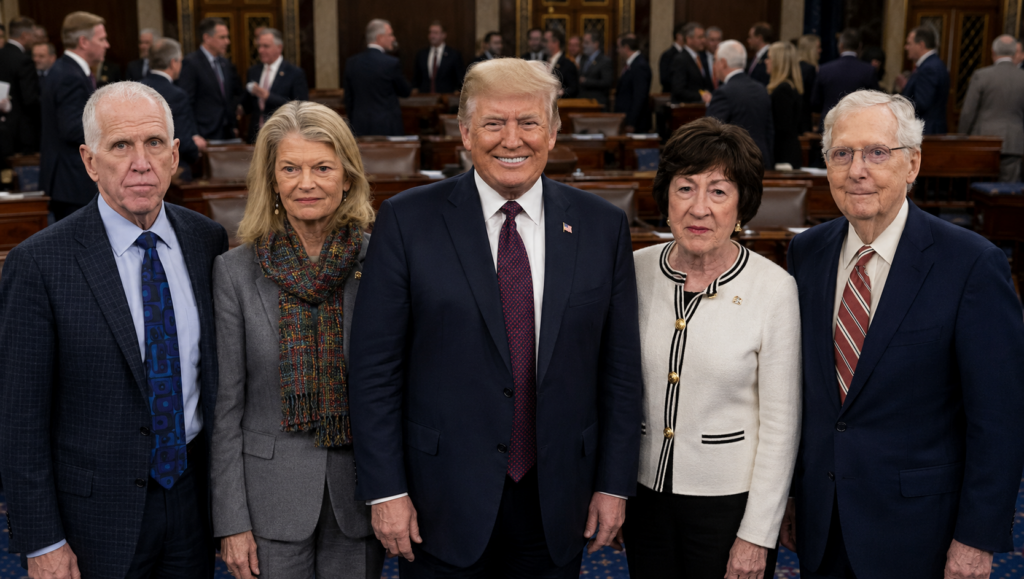
Sens. Susan Collins of Maine, Lisa Murkowski of Alaska, Mitch McConnell of Kentucky, and Thom Tillis of North Carolina voted against the proposal, preventing Republicans from reaching the threshold needed to pursue additional procedural options.
A second amendment led by Sen. Mike Lee of Utah focused on the original SAVE Act and performed considerably better.
Collins switched her vote, allowing the measure to secure support from 50 senators.
Conservatives quickly pointed out that with Vice President JD Vance available to cast a tie-breaking vote, the legislation effectively demonstrated majority support within the Senate Republican conference.
Republicans Target the Filibuster Roadblock
Following the vote, Lee argued that Senate procedural rules—not a lack of support—remain the primary obstacle preventing passage.
“That means that but for the Zombie Filibuster, the House-passed SAVE America Act would now be on its way to the White House for President Trump’s signature,” Lee stated.
Many conservatives have increasingly criticized what they view as outdated Senate procedures that allow legislation supported by a majority of senators to be blocked indefinitely.
Several Republicans have urged Senate Majority Leader John Thune to pursue a talking filibuster strategy that would require opponents to continuously defend their position on the Senate floor.
Supporters believe such an approach could eventually allow the legislation to pass with a simple majority vote.
Debate Continues Over Senate Rules
While some Republicans advocate procedural reform, others remain cautious about weakening Senate traditions that could later be used by Democrats when political control changes.
The debate highlights a broader struggle within the Republican Party over how aggressively to advance President Trump’s legislative agenda.
Conservatives argue that Democrats have repeatedly signaled a willingness to eliminate the filibuster when politically advantageous, making unilateral restraint increasingly difficult to justify.
Trump Calls for Action on SAVE Act
President Trump has also criticized Senate Parliamentarian Elizabeth MacDonough after she ruled that the SAVE Act could not be included in the immigration package through the budget reconciliation process.
That ruling blocked Republicans from advancing the measure through a simple-majority vote.
Trump has repeatedly called on Senate leadership to take action, arguing that procedural decisions should not stand in the way of election security reforms supported by voters.
“We have every right to change her, and should do so immediately,” Trump wrote on Truth Social. “As long as she’s there, we will never get our desperately needed SAVE AMERICA ACT approved and put into full force and effect.”
Signs of Life for a Key Trump Agenda Item
While the SAVE Act remains stalled for now, the latest Senate vote has renewed optimism among conservatives who view election integrity as one of the defining policy issues of the Trump administration’s second term.
For supporters, the outcome demonstrated that the legislation has majority backing and remains very much alive despite months of resistance from Senate Democrats and procedural obstacles.
As debates over voter identification, citizenship verification, border security, and election reform continue heading into future legislative battles, Republicans are expected to keep the SAVE Act at the center of their agenda.

Benjamin Harris is a RapidReports front page contributor and editor,proud father of four.