Trump Praises Hakeem Jeffries While Defending Stephen Miller, Signals Openness to Negotiations
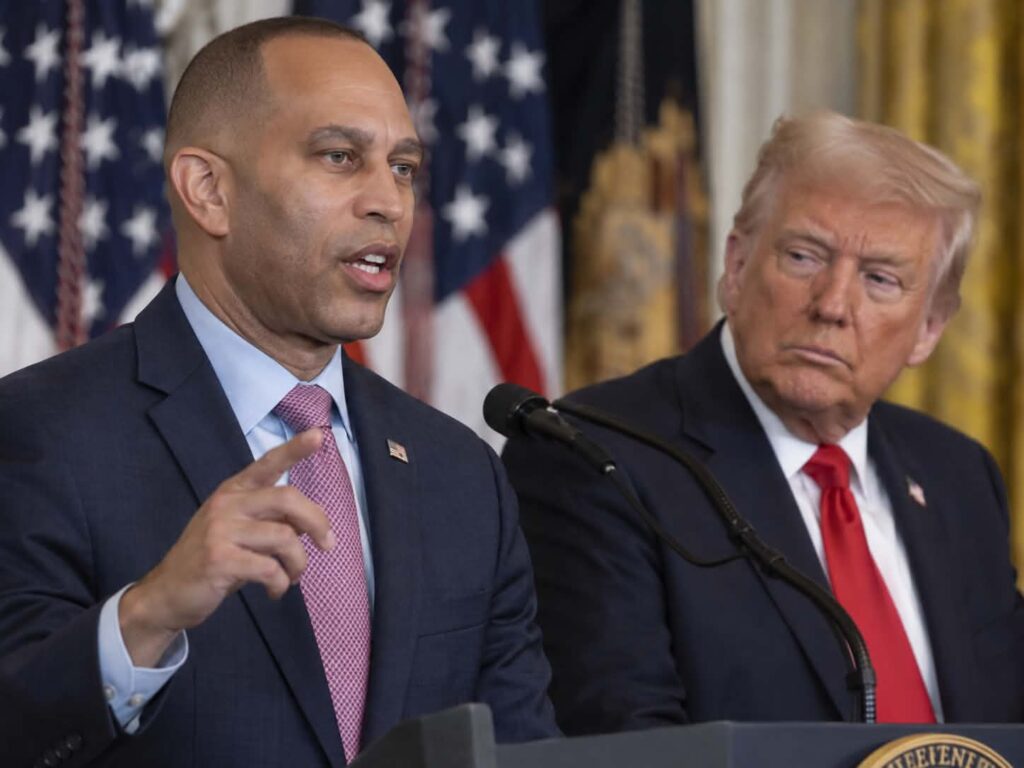
President Donald Trump has signaled that he wants to maintain a working relationship with incoming House Speaker Hakeem Jeffries, even as the Democratic leader continues to criticize one of the president’s closest advisers.
In a Saturday interview with Fox News host Kayleigh McEnany on Saturday in America, Trump defended White House Chief of Staff Stephen Miller after Jeffries described him as a “stone cold racist” and ruled out meeting with him.
Rather than respond with a personal attack against the incoming Democratic leader, Trump praised Jeffries, congratulated him on his leadership position and suggested that the two sides could find common ground on major policy issues.
The president specifically identified health care and immigration as areas where negotiations might produce meaningful results.
“They’re going to get their points across, I’ll get our points across meaning a more conservative view, and there’s a chance we could do tremendous things on health care and maybe even we can touch the subject of immigration,” Trump told McEnany.
His remarks offered an indication of how he intends to approach a Congress in which Democrats are preparing to exercise greater influence over the legislative agenda.
Trump Defends Stephen Miller After Jeffries’ Criticism
One of the most contentious issues between Trump and Jeffries concerns Stephen Miller, a central figure in the administration’s immigration policy.
Jeffries has repeatedly criticized Miller’s role in developing and implementing the president’s deportation agenda. The New York Democrat has described the chief of staff as a “stone cold racist” and said he would not agree to meet with him.
Trump rejected that characterization during his Fox News interview.
“The one thing with Stephen who was very strong on the border, so he called him a racist, but we had to be strong,” the president said.
Trump portrayed Miller’s approach as a reflection of the administration’s commitment to border enforcement rather than the characterization offered by Democrats.
Miller has played a prominent role in shaping Trump’s immigration agenda, including policies involving border security, deportations and enforcement by federal immigration agencies.
The disagreement illustrates the wider political divide over immigration enforcement. Republicans have generally defended the administration’s actions as necessary to enforce federal law and strengthen border security, while Democrats have raised concerns about enforcement methods, due process and the treatment of immigrant communities.
Despite the sharp criticism, Trump suggested that Jeffries might eventually develop a more favorable view of Miller.
The president’s comments indicate that he does not necessarily view the dispute as an obstacle to broader negotiations with Democratic congressional leaders.
Trump Congratulates Jeffries on His Incoming Leadership Position
Trump also took time during the interview to recognize Jeffries’ political achievement.
He congratulated the New York Democrat on securing the incoming House leadership position and acknowledged the historic significance of becoming the first Black person to hold the speakership.
The president described Jeffries as intelligent and suggested that the Democrat should be proud of reaching such a prominent position in American politics.
Trump also said he looked forward to working with him.
The comments were notable because the two politicians have frequently disagreed over immigration, federal spending, health care and other major issues.
However, Trump’s approach suggested that he wants to distinguish personal and political disagreements from the practical need to negotiate with congressional leaders.
The president’s remarks also appeared intended to establish a more constructive tone ahead of the next congressional session.
Health Care and Immigration Could Become Areas for Negotiation
Trump identified health care and immigration as two areas where he believes the administration and congressional Democrats could potentially reach agreements.
Health care has remained a major point of disagreement between the two parties, particularly over insurance costs, government spending, federal subsidies and the role of private insurers.
Democrats have generally supported maintaining or expanding access to federal health care programs and protections for people with preexisting conditions. Republicans have often emphasized reducing costs, increasing competition and changing the structure of federal health spending.
Although the parties differ significantly, the issue affects millions of American households, creating political pressure to find solutions.
Immigration presents an even more difficult challenge.
Trump has made border security and deportation enforcement central priorities of his presidency. His administration has argued that stronger enforcement is necessary to address illegal immigration and restore control over the country’s borders.
Democrats have criticized aspects of the administration’s approach, particularly its interior enforcement operations and the potential impact on families and communities.
Jeffries has been among the administration’s prominent congressional critics on immigration.
Nevertheless, Trump suggested that the two sides could present their competing positions and look for areas of agreement.
He emphasized that Democrats would have an opportunity to advance their priorities while his administration would continue advocating a more conservative approach.
Whether that approach can produce legislation remains uncertain, but Trump’s comments indicate an interest in keeping negotiations open.
Trump Points to Presidential Veto Power as a Source of Leverage
Although Trump expressed optimism about working with Jeffries, he also reminded viewers that the presidency carries significant constitutional powers.
He specifically mentioned the presidential veto and pardon powers.
The veto is particularly relevant because it allows a president to reject legislation passed by Congress. Lawmakers can attempt to override a presidential veto, but doing so requires a two-thirds majority in both the House and Senate.
Trump indicated that he understands the political leverage available to him, especially when legislation from a Democratic-controlled House conflicts with his administration’s priorities.
However, he also said he did not want the next two years to become a cycle of repeatedly rejecting bills.
“I will say that I don’t want to veto every time,” Trump said.
He suggested that Democratic lawmakers would eventually send legislation to the White House that could become the basis for negotiations.
“I am sure that they’ll send something up and we can negotiate,” he added.
The president’s comments suggest that he wants to avoid a complete legislative stalemate during the next Congress.
His position also reflects the practical reality that passing major legislation often requires cooperation between the White House and congressional leaders, particularly when the parties disagree over policy.
Jeffries Refuses to Meet With Miller
Trump’s willingness to work with Jeffries contrasts with the incoming speaker’s continued refusal to meet with Stephen Miller.
In a New York Times interview published Saturday, Jeffries was asked whether he would sit down with the White House chief of staff.
He answered no.
When the interviewer expressed surprise, Jeffries repeated his position.
The Democrat defended his refusal by again criticizing Miller and accusing him of being the architect of what Jeffries called the administration’s violent mass deportation operation.
The criticism reflects the intense opposition among many Democrats to the president’s immigration enforcement policies.
For Jeffries, Miller represents a central figure in the development of those policies, making a direct meeting politically and personally unacceptable.
His position does not necessarily mean he is unwilling to negotiate with the Trump administration as a whole.
Instead, it establishes a distinction between refusing to meet with a particular White House official and continuing discussions with other administration representatives.
That distinction could prove important as Congress begins considering legislation involving immigration, government funding and other national priorities.
Jeffries Points to Previous Bipartisan Negotiations
Although Jeffries ruled out meeting with Miller, he acknowledged that negotiations between the White House and Congress do not always require direct discussions with every senior administration official.
He cited previous political negotiations involving Democratic and Republican leaders as examples of how agreements can be reached through alternative channels.
One example involved former Treasury Secretary Steve Mnuchin and then-House Speaker Nancy Pelosi.
Their discussions during Trump’s first administration helped demonstrate how senior administration officials and congressional leaders can negotiate over major economic and spending issues despite significant partisan disagreements.
Jeffries also referred to negotiations involving then-Vice President Joe Biden and Senate Republican leader Mitch McConnell.
Those examples suggest that the incoming speaker sees opportunities for cooperation through other officials, even if he refuses to engage directly with Miller.
This could leave room for discussions involving the president, cabinet members, congressional committee leaders and other senior administration representatives.
It also suggests that the disagreement over Miller may not prevent all communication between the White House and Democratic leadership.
A New Political Balance Will Test Trump’s Relationship With Congress
The coming congressional session is expected to create a different political environment for the president.
Democrats are preparing to take control of the House of Representatives in January, giving the party greater influence over legislation, congressional investigations and oversight of the executive branch.
Republicans will retain control of the Senate, creating a divided legislative landscape.
That arrangement is likely to make negotiations more important.
The House majority will have substantial influence over which bills receive consideration and how congressional committees conduct their work. However, legislation must also pass the Senate and receive the president’s approval to become law, unless Congress overrides a veto.
The Senate’s legislative rules and the need for bipartisan support on many measures could further complicate the process.
For Trump, the challenge will be finding ways to advance his agenda while responding to a House leadership team that is likely to oppose several of his priorities.
For Jeffries, the challenge will be balancing opposition to the administration’s policies with the responsibility to negotiate over issues that affect voters.
The two leaders may find opportunities for cooperation on specific legislation even while remaining deeply divided on immigration and other contentious subjects.
What Trump’s Comments Could Mean for the Next Two Years
Trump’s remarks suggest that he is not interested in treating every disagreement with Democrats as a reason to abandon negotiations.
His praise for Jeffries, defense of Miller and references to presidential veto powers illustrate three parts of the approach he outlined during the interview.
First, he wants to recognize the political authority of the incoming House speaker and establish a working relationship.
Second, he intends to defend the senior officials responsible for implementing his administration’s policies, particularly on immigration.
Third, he wants to preserve his ability to reject legislation while leaving open the possibility of reaching agreements.
That combination could allow the White House to pursue a more selective negotiating strategy.
The administration may seek compromises on issues where bipartisan support is achievable while continuing to oppose Democratic proposals that conflict with Trump’s priorities.
For Jeffries, refusing to meet with Miller does not necessarily close the door to discussions with other administration officials.
The coming months will show whether that distinction allows the two sides to cooperate on specific issues.
Conclusion: Trump Signals Cooperation Despite Deep Divisions Over Immigration
Trump’s interview offered a glimpse of how he intends to approach the next phase of his presidency as Democrats prepare to take control of the House.
The president defended Stephen Miller against Jeffries’ accusations while praising the incoming speaker and expressing confidence that negotiations could produce meaningful results.
Health care and immigration were among the issues Trump identified as possible areas for cooperation.
Jeffries, meanwhile, has maintained his refusal to meet with Miller, whom he blames for the administration’s deportation policies. However, his comments about previous bipartisan negotiations suggest that he remains open to working through other channels.
The political differences between the two sides remain substantial, particularly over immigration enforcement.
Trump’s acknowledgment of his veto authority also makes clear that he is prepared to use presidential powers if negotiations fail.
Nevertheless, his preference for reaching agreements rather than rejecting every Democratic proposal suggests that the next two years may involve a combination of political confrontation and selective cooperation.
Whether that approach produces significant legislation will depend on the willingness of both parties to compromise and the extent to which they can separate individual disputes from broader policy negotiations.

Benjamin Harris is a RapidReports front page contributor and editor,proud father of four.