Evan saved for eleven months and three weeks.
I remember the exact stretch of time because he began the morning after Christmas, when his grandmother gave him a book about mountain biking trails in our region, and because I watched the entire process from the particular distance a parent learns to maintain when a child is doing something well without needing to be directed.
He was eleven when he started putting money aside and twelve when he finally reached his goal.
Most of the money came from mowing lawns.
He had five regular customers on our street, each paying him fifteen dollars for a cut, and they kept hiring him because he was dependable. Evan showed up when he said he would, finished the work carefully, and rarely needed anyone to remind him what came next.
He kept records.
That was his idea.
He bought a spiral notebook and divided the pages into columns for customer names, dates, payments, and a running savings balance that he updated every Saturday evening before bed.
I discovered the notebook accidentally.
I was walking past his bedroom one night when I noticed the door was open. Evan sat at his desk with the notebook spread in front of him, adding numbers with the concentration of someone working on something that mattered.
I asked him what he was doing.
He said he was checking his bike savings.
He showed me the notebook.
I studied the dates, payments, and running total.
He had organized it remarkably well, almost the way I had organized financial records when I worked in an office years earlier. Every dollar had a place, and every entry told him how much closer he was to his goal.
I hadn’t shown him how to do it.
He had figured it out himself.
I told him it was organized.
He said organization made it easier to see his progress.
Then he added that keeping track of everything also made it harder to spend the money.
I asked how close he was.
He said sixty-three percent.
At his current pace, he expected to have enough by August.
I asked which bicycle he wanted.
He reached for the notebook and opened it to the last page.
He had printed a picture from the manufacturer’s website and taped it inside the back cover.
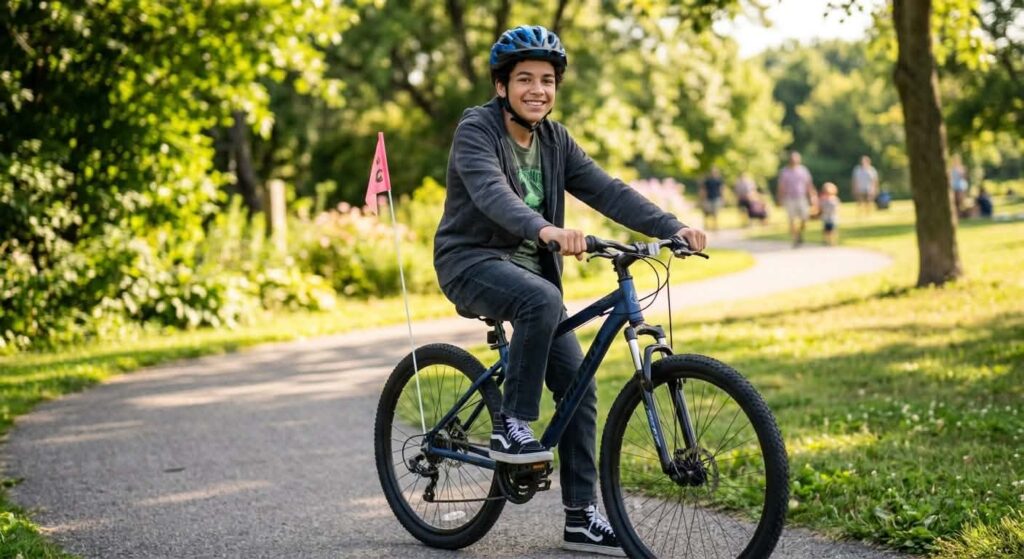
It was a mountain bike with a matte-green frame.
He had circled the price.
Four hundred and twenty dollars.
I told him it looked like a good choice.
He said he had read nearly every review he could find.
He had also watched several videos about the components and maintenance requirements.
I asked whether he had compared it with other bikes.
He said there were three models in the same general price range and that he believed this one offered the best value.
Then he told me he had made a spreadsheet.
He opened it on his tablet.
There were three columns, one for each bicycle, and rows comparing features, maintenance considerations, warranty information, and components.
At the bottom, he had created an overall score.
He had even assigned greater importance to the categories he considered most important.
Durability came first.
Component quality came second.
Frame design came third.
He had done all of this at eleven because he wanted a bicycle badly enough to plan for it.
My name is Daniel Mercer.
I’m forty-one, I teach history at a middle school a few miles from our house, and I’ve been Evan’s father for twelve years.
One of the strange things about being a parent is discovering that your child is quietly developing skills you never realized you were teaching.
The spreadsheet was one of those moments.
My wife, Laura, had known about it for months.
She told me that evening after the kids were asleep.
I asked why she hadn’t mentioned it.
She said she wanted me to discover it myself.
I asked why that mattered.
She said there was something different about watching your child develop than hearing a report about it afterward.
She was right.
Evan eventually reached his savings goal in August.
The night before buying the bicycle, he counted the money twice.
He put it in an envelope and wrote BIKE SAVINGS — DO NOT SPEND across the front.
The next morning he woke earlier than usual.
We drove to the bicycle shop.
I offered to come inside with him.
He said he wanted to look around himself first.
He walked to the counter and asked about the mountain bike he had researched.
An employee brought one out.
Evan inspected it carefully.
He checked the tires.
He examined the gears.
He looked closely at the frame.
Then he asked whether he could take it for a short test ride.
The employee agreed.
Evan rode around the parking area for several minutes.
When he returned, he smiled.
He said he wanted it.
He placed his envelope on the counter.
The employee counted the money.
Then she looked at Evan.
She asked whether he had saved it himself.
He said yes.
She asked how long it had taken.
He said almost a year.
She congratulated him.
It wasn’t an exaggerated compliment.
She simply recognized what he had done.
He had set a goal, earned money, resisted spending it, researched the purchase, and followed through.
He rode the bicycle home.
I followed slowly in the car because part of the route included a busy road.
He hadn’t asked me to.
I did it anyway.
Being independent doesn’t mean a twelve-year-old suddenly stops needing a parent to notice the dangerous parts of the world.
The bicycle stayed in our garage when he wasn’t riding.
Evan cleaned it after trail rides.
He checked the tire pressure.
He learned how to maintain the chain.
His notebook gradually changed, too.
It started as a savings record and became a maintenance log.
He wrote down dates, adjustments, observations, and anything unusual he noticed while riding.
The bicycle belonged to him.
Not merely because we had purchased it.
It belonged to him because he had worked for it.
Every weekend of mowing, every payment recorded in that notebook, every time he decided not to spend his earnings on something else had become part of the purchase.
He had learned something many adults struggle with: a financial goal becomes easier to reach when you can see your progress.
Our neighbor, Richard, lived next door.
We had known him for several years, although we weren’t especially close.
He was in his fifties and worked in sales.
He owned a large pickup truck that he kept remarkably clean.
We rarely disagreed about anything important.
There had been the ordinary neighborhood issues—parking, tree branches, property lines—but nothing serious enough to become a lasting dispute.
Then came the bicycle.
One Friday afternoon, Evan left the bicycle near the edge of our lawn after riding home from school.
It was on our property, away from the sidewalk and out of the street.
I noticed it when I arrived home.
A little later, I heard several unusual sounds outside.
Then I heard Evan say something.
I went out.
Richard’s truck was in the street.
Evan was standing beside the bicycle.
The bicycle had been damaged badly.
The frame was bent.
The front wheel was twisted.
The gears had been damaged.
Evan stood completely still.
He wasn’t crying.
He wasn’t yelling.
He was simply staring at the bicycle he had spent almost a year working toward.
I walked over to Richard.
At first, I was calm.
I assumed we would talk about what happened and figure out a reasonable solution.
I told him his truck had backed over Evan’s bicycle.
Richard said the bicycle shouldn’t have been left there.
I reminded him that it was on our property.
He said he hadn’t seen it.
I told him the security camera would show exactly what had happened.
He said he wasn’t sure the damage was his responsibility.
I explained how much the bicycle had cost and how long Evan had saved for it.
Richard said he felt sorry for Evan but didn’t believe he should have to replace it.
We talked for several minutes.
Neither of us changed his position.
Eventually Richard went inside.
Evan and I remained outside.
I looked at my son.
He was still standing quietly.
I told him we would figure it out.
He said he knew.
Then he said something I didn’t expect.
He said he would handle it.
That weekend I considered our options.
We had the camera footage.
We had the purchase information.
We could have pursued reimbursement through a formal dispute process if necessary.
But before I decided what to do, Evan came into the kitchen Saturday morning.
He looked as though he had spent considerable time thinking.
He told me he had a plan.
I asked what he intended to do.
He said he wanted to talk to Richard himself.
I hesitated.
Then I agreed.
He walked next door.
I stayed home.
About forty-five minutes later, Evan returned carrying a sheet of paper and an envelope.
He sat at the kitchen table.
He told us Richard had agreed to replace the bicycle.
I was surprised.
I asked what had changed.
Evan said he had talked to him.
I reminded him that Richard had already told me he wasn’t planning to pay.
Evan said Richard hadn’t talked to him yet.
Then he explained what happened.
He knocked on the door.
Richard answered.
Evan told him he wasn’t there to argue about the accident.
He wanted to ask him some questions.
Richard apparently invited him inside.
They sat at the kitchen table.
Richard asked what he wanted.
Evan started by asking about the truck.
He asked when Richard had bought it.
Richard told him.
Evan asked whether Richard had saved for it.
Richard laughed and said he hadn’t.
He had simply purchased it.
Evan told him he understood.
Then he explained the bicycle.
He described mowing lawns every weekend.
He explained that he had tracked every payment.
He showed Richard the notebook.
He showed him the date he had finally reached his goal.
He explained that the bicycle wasn’t simply something he had wanted.
It represented months of work and the discipline of waiting for something instead of buying whatever he wanted immediately.
Then Evan told Richard something that surprised me.
He said he understood that Richard might not agree about legal responsibility.
He said he wasn’t there to argue about the law.
He was there because he wanted Richard to understand why replacing the bicycle mattered.
Evan told him that saving had taught him something.
If you decide something is important, you have to make a plan.
Then you have to follow that plan even when something easier is available.
Richard apparently became quiet.
Evan mentioned seeing him working on his truck one Saturday morning.
He said he remembered Richard spending several hours fixing something himself.
Evan told him he figured Richard understood what it meant to work for something you cared about.
Then Evan made his request.
He didn’t demand an apology.
He didn’t threaten him.
He didn’t tell Richard he was a bad person.
He simply asked him to consider doing what he believed was fair.
Richard was quiet for a while.
Then he asked how much the replacement would cost.
Evan told him four hundred and twenty dollars.
Richard left the room.
When he returned, he had an envelope.
Inside was the money.
There was also a handwritten note.
Richard apologized for not being more careful.
I looked at the note.
Then I looked at Evan.
I asked how he knew the conversation would work.
He said he didn’t.
He had spent the week thinking about what outcome he actually wanted.
He could have argued.
He could have asked me to intervene.
We could have pursued a formal claim.
But he realized those approaches might result in money changing hands without changing how Richard felt about what happened.
Evan wanted the bicycle replaced.
But he also wanted Richard to understand why the bicycle mattered.
He said that sometimes getting someone to admit they were wrong isn’t the same thing as giving them an opportunity to make things right.
That sentence stayed with me.
My twelve-year-old had discovered something I had spent years learning in classrooms and workplaces.
People don’t always change their position when you prove them wrong.
Sometimes they change when you give them a reasonable path toward doing better.
My wife looked at Evan.
She told him she was proud of him.
He thanked her.
He didn’t make a big deal of it.
Then he picked up the envelope and asked whether we could go to the bicycle shop.
We went that afternoon.
The same employee recognized him.
She asked whether he was back so soon.
Evan explained that the bicycle had been damaged and that the neighbor had agreed to replace it.
She was surprised.
Then she told him they had one remaining bicycle in the same size.
Evan said he knew.
He had called earlier that morning to check.
The employee brought it out.
Evan inspected it.
He noticed that the newer bicycle had a slightly different component.
He asked whether the change was an improvement.
She said it was.
He asked whether the price was the same.
It was.
He decided to buy it.
He placed the envelope on the counter.
The total was slightly higher than the amount Richard had given him because of tax.
Evan reached into his pocket.
He had brought two extra dollars.
He paid the difference.
On the drive home, he told me he had learned something from that.
He said next time he would include taxes and other purchase costs when setting a savings target.
I told him that was a useful lesson.
He said he would update the spreadsheet.
Of course he would.
At home, he took the bicycle into the garage.
He opened the notebook.
He wrote the date.
Then he wrote that it was his second bicycle and that he wanted to repeat the same setup and maintenance routine.
He adjusted the seat.
Then he asked me about the recommended handlebar torque.
I didn’t know.
He did.
He had already researched it.
I told him we would eventually need the right tool to measure it accurately.
He said he had already added that to his list.
I went inside.
My wife was in the kitchen.
I told her Evan was researching bicycle maintenance tools now.
She smiled.
Then she asked about Richard.
I told her what had happened.
She said the most important part wasn’t that Evan had gotten the money.
I agreed.
She said he had learned how to approach a difficult conversation without turning it into a fight.
I told her that was true.
She asked where he had learned it.
I didn’t have a simple answer.
Maybe from us.
Maybe from school.
Maybe from watching adults solve problems.
Maybe from all three.
Or maybe children sometimes build their own understanding from dozens of small observations we never realize they’re collecting.
Later, I went back into the garage.
Evan was checking the bicycle.
He measured the tire pressure.
He wrote the numbers in his notebook.
Then he looked at me.
He thanked me for following him home on the busy road.
I reminded him that he had said he could handle the situation himself.
He said he meant the conversation with Richard.
He still needed me for the road.
Then he said something that made me stop.
He said some problems were his to solve and some problems still belonged to his parents.
He knew the difference.
I told him that was exactly how growing up was supposed to work.
The next morning he planned to ride the same trail.
He wanted to work on the more difficult sections.
He had been researching riding technique, too.
I wasn’t surprised.
Before we went inside, he mentioned Richard again.
He said that when Richard handed him the envelope, Richard had asked whether anyone had taught him to think that way.
Evan said he told him that his father had.
I asked why.
He shrugged.
He said he’d watched me.
I thanked him.
He looked at the bicycle.
Then he said he wasn’t completely sure whether that was true.
I told him I was.
He closed the notebook.
He put it back on the shelf.
I stood there for another moment.
The bicycle was sitting under the garage light.
The same model.
A new beginning after an unexpected expense.
But the money wasn’t the most important part.
The important part was everything that had happened before the money changed hands.
A child had created a savings goal.
He had learned how to earn money.
He had tracked his income.
He had compared products before spending.
He had practiced delayed gratification.
And when something went wrong, he had thought carefully before reacting.
He had learned that financial decisions are rarely just about dollars.
They are also about preparation, patience, communication, and knowing what outcome you actually want.
My wife was making dinner when I came inside.
She asked whether Evan was still writing.
I said yes.
She asked what he was recording now.
I told her he was making notes about the conversation with Richard.
She smiled.
I asked what was funny.
She said that the notebook had started as a way to save for a bicycle.
Now it was becoming a record of lessons.
I went to Evan’s doorway.
He was writing.
I asked what he wanted to remember.
He said he wanted to remember that talking to people as though they were capable of doing the right thing could sometimes accomplish more than accusing them of doing the wrong thing.
He said he wanted to remember it because he might need the lesson later.
I told him not to forget it.
He said he wouldn’t.
Then he continued writing.
The notebook.
Always the notebook.
I returned to the kitchen.
My wife handed me a glass of water.
She asked whether he understood what had happened.
I said I thought he did.
She said sometimes children surprise you by turning ordinary experiences into principles they carry for years.
I agreed.
The savings goal had started with a bicycle.
But somewhere along the way, it had become a lesson about money, responsibility, patience, and character.
We made dinner.
From the other room came the faint sound of a pencil moving across paper.
Outside, the new bicycle waited in the garage.
And I thought about eleven months and three weeks.
I thought about five lawns, a notebook, a spreadsheet, a damaged bicycle, and one difficult conversation at a neighbor’s kitchen table.
I thought about how easily a financial setback could have become an argument.
Instead, it became an opportunity to learn.
I had been watching my son grow for twelve years.
Apparently, I hadn’t been watching closely enough.
Because sometimes the lesson you think you’re teaching your child is actually the lesson your child is teaching you.
And sometimes you don’t realize it until the notebook is already full.

Benjamin Harris is a RapidReports front page contributor and editor,proud father of four.