Riyadh Airport Attacked Again as Houthi Strikes Kill 13 and Injure Hundreds
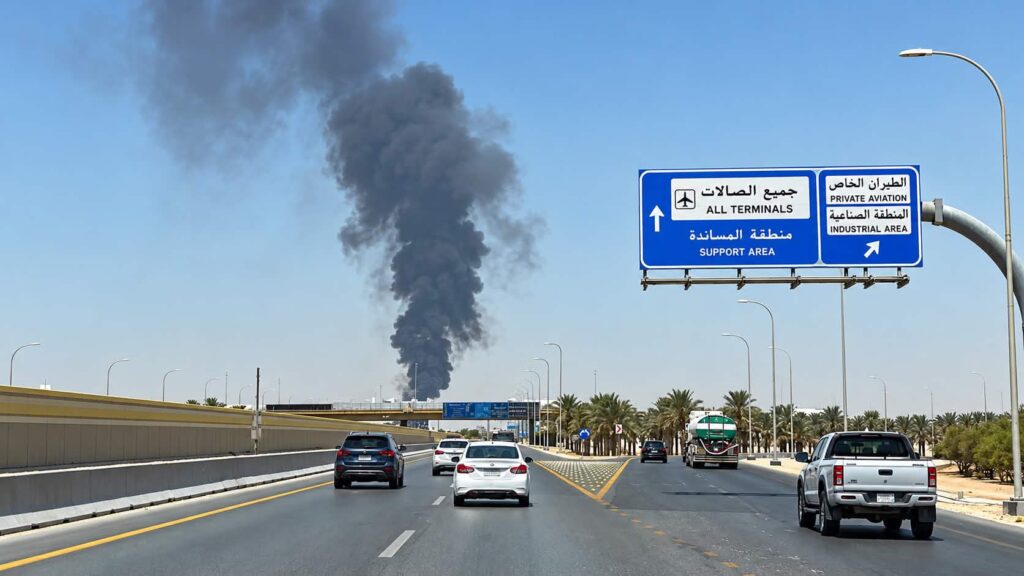
A projectile struck a passenger terminal at King Khalid International Airport in Riyadh on Sunday, October 11, sparking a fire and killing one person while injuring 11 others, Saudi authorities said. The attack came a day after a separate missile strike on the airport killed 13 people and wounded more than 300, sharply escalating tensions between Saudi Arabia and Yemen’s Houthi rebels.
The Saudi-led coalition fighting the Houthis said the latest projectile hit Terminal 4. Saudi air defenses also intercepted a cruise missile near the airport, while authorities assessed the damage and maintained flight disruptions following the successive attacks. The Houthis claimed responsibility for the broader series of strikes.
The attacks have raised concerns about the security of Saudi Arabia’s civilian infrastructure and the potential for a wider regional conflict. President Donald Trump said Washington was considering whether to support Saudi military action against the Houthis, a move that could draw the United States further into the expanding confrontation.
Second Strike Hits Riyadh Airport
The Sunday attack targeted the passenger terminal complex at King Khalid International Airport, which serves the Saudi capital and surrounding region. The Saudi civil aviation authority reported one fatality and 11 injuries from the strike.
The attack followed Saturday’s missile strike, which killed 13 people and injured more than 300, including individuals who suffered serious wounds. The death toll from Saturday’s attack rose after an injured Indian national died in hospital, according to reports.
The victims included Saudi citizens and foreign nationals from several countries. An Egyptian flight attendant employed by a Saudi airline was among those killed in the Saturday attack. The successive strikes disrupted airport operations and heightened concerns for passengers, airline staff and other civilians.
Houthis Claim Responsibility for Wider Missile and Drone Campaign
Yemen’s Houthi movement claimed responsibility for Saturday’s attack and additional operations it said targeted Saudi facilities over the following 24 hours.
The group said its operations involved ballistic missiles, cruise missiles and drones. It also claimed attacks targeting King Fahd International Airport in Dammam and two Saudi Aramco facilities.
The Houthis renewed warnings to airlines, airport employees and travelers against using Saudi airports and airspace, while announcing exceptions for airports in Mecca and Medina. The group framed its actions as retaliation for Saudi-led military operations in Yemen, which it said had caused civilian casualties.
Those explanations represent the Houthis’ stated justification for the attacks. The strikes on airport facilities, however, have placed civilians at direct risk and prompted condemnation from the Saudi-led coalition.
Saudi-Led Coalition Threatens a Response
The Saudi-led coalition described Saturday’s attack on the airport as a war crime against a civilian facility and said it would respond.
The renewed strikes come amid intensifying fighting between the Houthis and forces backed by Saudi Arabia in Yemen. A period of relative calm following a ceasefire that had largely held since 2022 ended earlier in 2026, contributing to renewed hostilities and growing concerns about regional security.
The latest attacks have also exposed the vulnerability of airports and other critical infrastructure as the conflict expands. Repeated strikes could further disrupt commercial aviation and threaten facilities connected to Saudi Arabia’s energy sector.
The Houthis’ warnings against using Saudi airspace have added uncertainty for airlines and travelers, while the airport closures and flight disruptions have complicated travel plans.
Trump Weighs Possible U.S. Involvement
Trump said Washington would consider whether to join Saudi Arabia in military action against the Houthis following the deadly airport attack.
Asked whether the United States would support Saudi strikes, Trump said, “We may. We’re going to look at it,” according to reports of his remarks on Saturday. His comments suggested that the administration had not yet announced a final decision on direct U.S. participation.
Greater U.S. involvement could widen the conflict and increase the risks to regional shipping and energy supplies. The Houthis operate in Yemen near the Bab el-Mandeb Strait, a strategically important maritime passage linking the Red Sea with the Gulf of Aden. Instability in the area can affect commercial shipping routes and add pressure to already tense regional energy markets.
For now, the immediate focus remains on the airport attacks, the casualties and the potential for further strikes. Saudi authorities are assessing the damage, while the Houthis have threatened additional operations unless Saudi military action in Yemen stops.
READ MORE:
The next steps by Riyadh and Washington could determine whether the latest escalation remains concentrated in Yemen and Saudi Arabia or develops into a broader regional confrontation.
READ ALSO: Capital City of Major US Ally Targeted in Reported Missile Attack
Saudi Arabia Faces Renewed Security Threat as Houthi Missile Claim Raises Regional Tensions
Saudi Arabia’s capital, Riyadh, faced renewed security concerns on Thursday after Yemen’s Iran-aligned Houthi movement claimed it had launched a ballistic missile toward the city’s main international airport.
The reported attack adds another layer of uncertainty to an already volatile regional security environment. Loud explosions were reported in parts of Riyadh, while flight operations at King Khalid International Airport were disrupted and several businesses reportedly advised employees to work remotely.
The Houthi claim had not been independently confirmed by Saudi authorities at the time of reporting. The lack of immediate official confirmation means key details surrounding the reported launch, including the missile’s trajectory, interception status and potential damage, remained unclear.
Nevertheless, the incident has heightened concerns about the vulnerability of major transportation hubs and commercial centers as fighting involving Yemen’s Houthis continues to spill beyond Yemen’s borders.
Missile Claim Puts Riyadh on Alert
The Houthis said King Khalid International Airport was the target of their latest missile operation. The group also renewed threats to disrupt Saudi airspace if attacks against its positions continue.
Riyadh is home to major government institutions, international companies, financial organizations and transportation infrastructure. Any prolonged disruption to the capital’s aviation network could therefore have consequences extending well beyond the immediate security situation.
For travelers, airlines and businesses, uncertainty surrounding airport operations can create delays, cancellations and logistical complications. Airports are also closely monitored during periods of heightened regional tension because even the possibility of another attack can affect flight schedules and corporate travel decisions.
Saudi authorities had not immediately confirmed the latest Houthi allegation, leaving questions about the precise circumstances of Thursday’s incident.
Flights Disrupted at King Khalid International Airport
Flight-tracking information indicated that a number of arrivals and departures at King Khalid International Airport experienced delays.
Airport disruptions can have a wider economic impact because Riyadh serves as an important connection point for business travelers, international companies, government delegations and tourists.
When security alerts affect a major airport, airlines may temporarily adjust operations, delay aircraft movements or review planned routes. Passengers can consequently face longer waiting times even when an airport remains operational.
Travelers scheduled to pass through Riyadh should therefore monitor airline notifications and official airport announcements for the latest information rather than relying solely on reports circulating on social media.
Companies Introduce Remote-Work Measures
Security concerns were also reportedly felt in Riyadh’s business districts.
Several multinational companies operating in the King Abdullah Financial District were said to have instructed employees to work from home following the reported explosions. Such measures are often intended to reduce unnecessary movement during periods of uncertainty while allowing businesses to maintain essential operations.
Some diplomats reportedly received security warnings, while certain schools were also said to have advised parents or students to remain indoors.
The reported precautions highlight how a security incident can affect everyday life even when direct damage to civilian infrastructure has not been established.
For international companies, the situation also raises broader questions about business continuity, employee safety and contingency planning in regions exposed to missile and drone threats.
Previous Attacks Increased Concern
Thursday’s reported incident came only days after Saudi authorities said attacks involving airports in Riyadh and Abha had killed three people and injured dozens of others.
Those incidents have contributed to growing concerns over the protection of Saudi Arabia’s civilian infrastructure.
Airports are particularly sensitive targets because they combine large numbers of passengers with critical transportation links. Any sustained threat against aviation facilities can have implications for tourism, international business and the movement of goods and people.
The latest Houthi claim therefore arrives at a moment when regional authorities and companies are already closely monitoring security developments.
Yemen Conflict Becomes Increasingly Regional
The latest escalation is part of a much broader conflict involving Yemen’s Houthis, Saudi-backed forces and regional powers.
The Houthis have conducted missile and drone operations against targets associated with Saudi Arabia, while forces supported by Riyadh have continued military operations against Houthi positions inside Yemen.
The confrontation has become increasingly connected to wider tensions involving the United States, Iran and other Middle Eastern powers.
That broader context makes individual attacks difficult to view in isolation. A missile launch directed toward a major Saudi city can quickly become part of a larger cycle of retaliation, military preparations and diplomatic pressure.
For governments and businesses across the region, the central concern is whether the latest escalation remains limited or develops into a more sustained confrontation.
Why the Bab el-Mandeb Strait Matters
One of the most strategically important areas affected by the conflict is the Bab el-Mandeb Strait.
The narrow maritime passage connects the Red Sea with the Gulf of Aden and serves as an important route for international shipping. Commercial vessels using the region depend on predictable security conditions to transport energy products, manufactured goods and other commodities between major global markets.
Any deterioration in security around the waterway can increase concerns among shipping companies, insurers and international businesses.
Higher perceived risks can contribute to increased insurance costs, route adjustments and longer journeys if vessels choose to avoid dangerous areas.
The significance of the Bab el-Mandeb Strait means that developments in Yemen can potentially affect economies far beyond the Arabian Peninsula.
Territorial Fighting Continues Inside Yemen
While international attention has focused on missile and drone attacks, fighting continues on the ground inside Yemen.
Saudi-backed Yemeni government forces have launched counteroffensives against Houthi positions, while the Houthis have maintained control or made gains in several strategically important areas.
The situation around Taiz remains particularly significant because of the city’s geographic and strategic importance.
At the same time, developments near the Bab el-Mandeb Strait remain closely watched because of the connection between the conflict on land and the security of international maritime traffic.
This combination of ground fighting, missile launches and regional military involvement makes the Yemen conflict one of the most complicated security challenges in the region.
Humanitarian Consequences Remain Severe
Behind the military developments is an ongoing humanitarian crisis.
The renewed fighting has reportedly displaced more than 200,000 people, adding another layer of hardship to a country that has experienced years of conflict and humanitarian instability.
Displacement can place enormous pressure on families and communities. People forced to leave their homes may lose access to employment, education, healthcare and basic services.
Continued fighting can also make humanitarian assistance more difficult to deliver, particularly when roads, ports and other transportation routes become unsafe.
As regional tensions increase, humanitarian organizations face the challenge of responding to immediate needs while also dealing with the longer-term consequences of displacement and economic disruption.
Saudi Arabia Looks to Regional Partners
The growing pressure on Saudi defenses has prompted Riyadh to seek additional assistance from regional partners.
Turkey has indicated that it is considering defensive support that could include air-defense capabilities, electronic warfare and technical assistance.
Such cooperation could become increasingly important if missile and drone attacks continue.
Modern air-defense systems are designed to detect, track and intercept incoming threats, while electronic warfare capabilities can be used to identify or disrupt certain forms of hostile activity. The effectiveness of any defensive response, however, depends on the specific systems involved, the nature of the threat and the circumstances of each attack.
What Happens Next?
The immediate question is whether Thursday’s reported missile launch represents an isolated incident or the beginning of another sustained period of attacks.
Several developments will be important to watch.
First, Saudi authorities are expected to provide additional information about the reported attack, including whether a missile was launched, whether it was intercepted and whether any infrastructure was damaged.
Second, airlines and airport authorities will determine whether flight operations can return to normal or whether additional security measures are required.
Third, businesses operating in Riyadh will continue assessing whether employees should work remotely and whether travel plans need to be adjusted.
Finally, developments on the ground in Yemen could determine whether the latest escalation expands into a broader confrontation.
Why the Situation Matters Beyond Saudi Arabia
The significance of the latest incident extends beyond Riyadh.
Saudi Arabia is one of the Middle East’s largest economies and plays a major role in global energy markets, international investment and regional diplomacy. Disruptions affecting its airports, cities or critical infrastructure can therefore attract attention from governments and businesses around the world.
The situation also demonstrates how conflicts involving missiles and drones can create economic consequences even when damage is limited.
Airlines may reconsider routes. Companies may adjust travel policies. Insurers may reassess regional risk. Shipping firms may examine alternative routes. Investors may monitor developments more closely.
For ordinary travelers and businesses, the most important priority is reliable information.
As the situation develops, official statements from Saudi authorities, airport operators, airlines and other credible institutions will be more useful than unverified claims circulating online.
Bottom Line
The reported Houthi missile launch toward Riyadh represents another potentially serious escalation in a conflict that has already created major security and humanitarian challenges.
Although Saudi authorities had not immediately confirmed the latest Houthi claim, reports of explosions, flight disruptions and precautionary measures by businesses and schools demonstrated the immediate uncertainty surrounding the situation.
The wider implications will depend on what happens next.
If attacks continue, Saudi Arabia could face greater pressure to strengthen its air defenses and seek additional regional cooperation. Meanwhile, continued fighting in Yemen could further complicate efforts to protect civilians, stabilize important transportation corridors and reduce regional tensions.
The coming days will therefore be closely watched by governments, airlines, businesses, investors and humanitarian organizations as they assess whether the latest developments remain contained or become part of a larger escalation across the region.

Benjamin Harris is a RapidReports front page contributor and editor,proud father of four.