Greg Abbott Faces a Closer Texas Governor’s Race as Democrats Gain Ground in New Polls
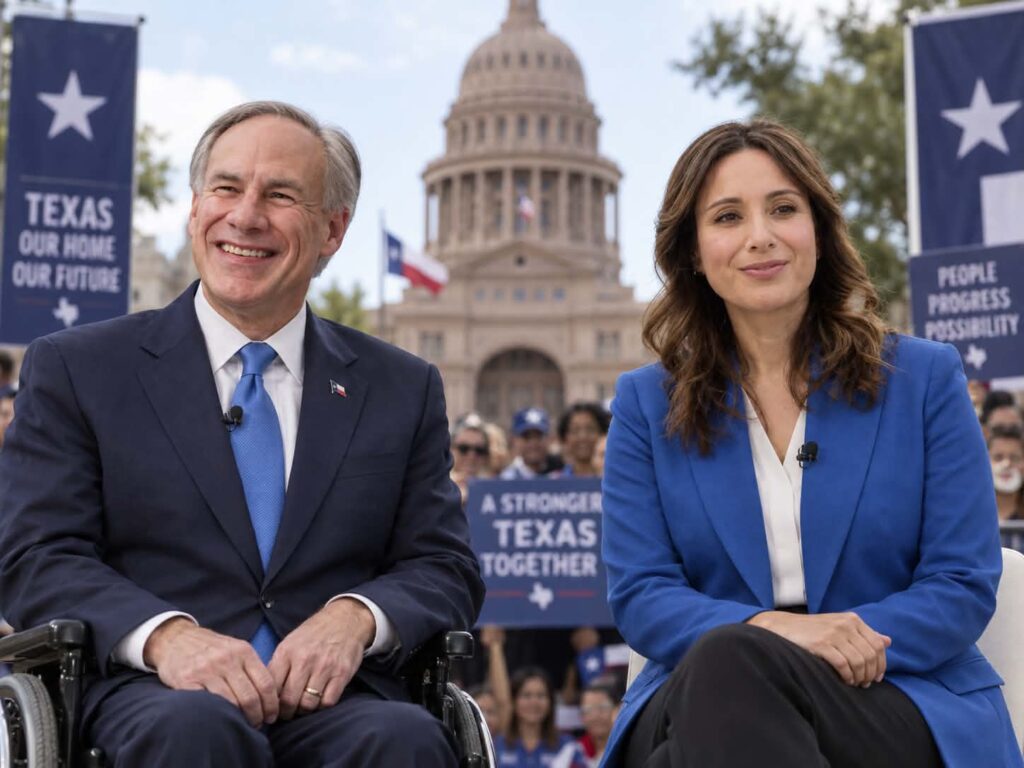
Texas Gov. Greg Abbott is facing a more competitive reelection campaign than in his previous gubernatorial contests, with recent polling showing the Republican incumbent and Democratic challenger Gina Hinojosa separated by only a few percentage points.
The latest public surveys have produced mixed results. An Emerson College/Nexstar poll conducted Sept. 12-14 gave Abbott 49% support among likely voters compared with 46% for Hinojosa. But a Recon MR survey conducted just days earlier found Hinojosa at 49% and Abbott at 45%. Both differences were within the respective margins of error.
A September TelevisaUnivision survey also found the race tied at 47% apiece, while an AARP Texas poll had Abbott ahead 49% to 46%.
The polling does not establish an election outcome. Instead, it shows a contest in which the incumbent’s advantage has been considerably smaller than the margins he recorded in his previous statewide victories.
Recent Polls Show a Narrow Contest
The Texas Politics Project’s statewide polling tracker lists several recent surveys:
| Poll | Field dates | Abbott | Hinojosa |
|---|---|---|---|
| Emerson/Nexstar | Sept. 12-14 | 49% | 46% |
| Recon MR | Sept. 8-11 | 45% | 49% |
| AARP Texas | Aug. 30-Sept. 1 | 49% | 46% |
| TelevisaUnivision | Aug. 27-Sept. 4 | 47% | 47% |
| UT/Texas Politics Project | Aug. 5-13 | 45% | 40% |
The surveys used different samples and methodologies, so they should not be treated as one continuous measurement.
The range nevertheless illustrates why the governor’s race has attracted greater attention this year. Recent polls have generally placed the candidates within single digits, and several have produced differences small enough to fall within their margins of error.
Abbott Has Won Previous Elections by Larger Margins
Abbott’s current numbers look different from the margins he received in his previous reelection campaigns.
He defeated Democrat Beto O’Rourke by about 10.9 percentage points in 2022. Abbott won reelection by roughly 12.3 points in 2018 and by more than 20 points in 2014.
That history provides important context for the 2026 polling. A race showing a margin of only a few percentage points would represent a substantially different electoral environment from Abbott’s previous statewide victories.
It does not, however, mean that the polling margins will necessarily translate into the same margin on Election Day.
Independents Are a Key Group in Recent Polling
The August UT/Texas Politics Project survey illustrated one of the challenges for both campaigns: a substantial portion of voters remained undecided or had not formed an opinion about the candidates.
In that survey, Abbott led Hinojosa 45% to 40% among registered voters, but about 12% either supported another candidate or said they did not know enough to have an opinion.
The same poll showed Hinojosa leading Abbott among independents, 37% to 17%, while nearly four in 10 independents had not formed an opinion.
Because the size and composition of the undecided electorate can vary from poll to poll, individual subgroup numbers should be interpreted cautiously.
Data Centers Have Become a Political Issue
One issue creating unusual political pressure in Texas is the rapid expansion of data centers.
Texas Republicans, including Abbott, have moved toward tighter regulation of the industry after previously emphasizing data centers and artificial intelligence investment as economic opportunities.
Reuters reported earlier this month that Abbott was advocating restrictions on data-center development, including changes involving tax incentives and rural projects. A state audit announced by Abbott has also paused approvals for new grid connections while the state examines the impact of large facilities on the power system.
The political debate centers partly on concerns about electricity demand, infrastructure costs and the effect of large projects on local communities.
A Texas Politics Project survey cited by Reuters found only 30% of respondents supported having a data center in their community.
The Republican Ticket Faces Other Competitive Races
The governor’s contest is taking place alongside a closely watched U.S. Senate race between Republican Ken Paxton and Democrat James Talarico.
The Texas Tribune reported Sept. 17 that Talarico had led Paxton in several recent polls, an unusual development in a state where Republicans have dominated statewide elections for decades.
The Senate race and governor’s race are separate contests, however, with different candidates, issues and electorates.
The broader political environment may affect how campaigns operate, but polling in one race cannot be assumed to predict another.
Abbott Still Leads in Several Recent Surveys
Despite the increased competitiveness, recent polling does not show a uniform shift toward Hinojosa.
The Sept. 12-14 Emerson/Nexstar survey gave Abbott a 49%-46% advantage. The AARP survey similarly showed Abbott ahead 49%-46%, while the University of Texas/Texas Politics Project’s August survey had him ahead by five points.
The 270toWin compilation of recent Texas governor polls likewise shows Abbott ahead in several surveys while Hinojosa leads in others. Its listed five-poll average is 48% for Abbott and 44.4% for Hinojosa, although averaging methodologies can differ among aggregators.
The important point is that the available polling does not produce a single consistent margin.
The 2026 Race Is Different From Abbott’s Earlier Campaigns
Abbott’s previous statewide victories provide a useful historical benchmark, but they do not determine the 2026 contest.
This year’s campaign is taking place amid debates over energy costs, artificial intelligence infrastructure, the economy and national Republican politics. At the same time, Abbott retains the advantages that come with being an incumbent and with Texas’s recent history of Republican statewide victories.
Recent polling shows those factors operating in an environment that is closer than Abbott’s previous reelection margins.
What the Polling Shows
The available surveys show a competitive race, but they do not establish that Abbott is on course to lose or that Hinojosa is on course to win.
Instead, the polling points to several conclusions that can be stated without treating any individual survey as a forecast: Abbott continues to lead in a number of polls, Hinojosa has led in at least one recent survey, and several polls have placed the candidates within their margins of error.
With early voting in Texas scheduled to begin Oct. 19 and Election Day set for Nov. 3, additional surveys and changes in the campaigns’ messages will provide further information about how the race is developing.
For now, the polling describes a closer-than-usual Texas governor’s contest rather than a settled outcome.

Benjamin Harris is a RapidReports front page contributor and editor,proud father of four.