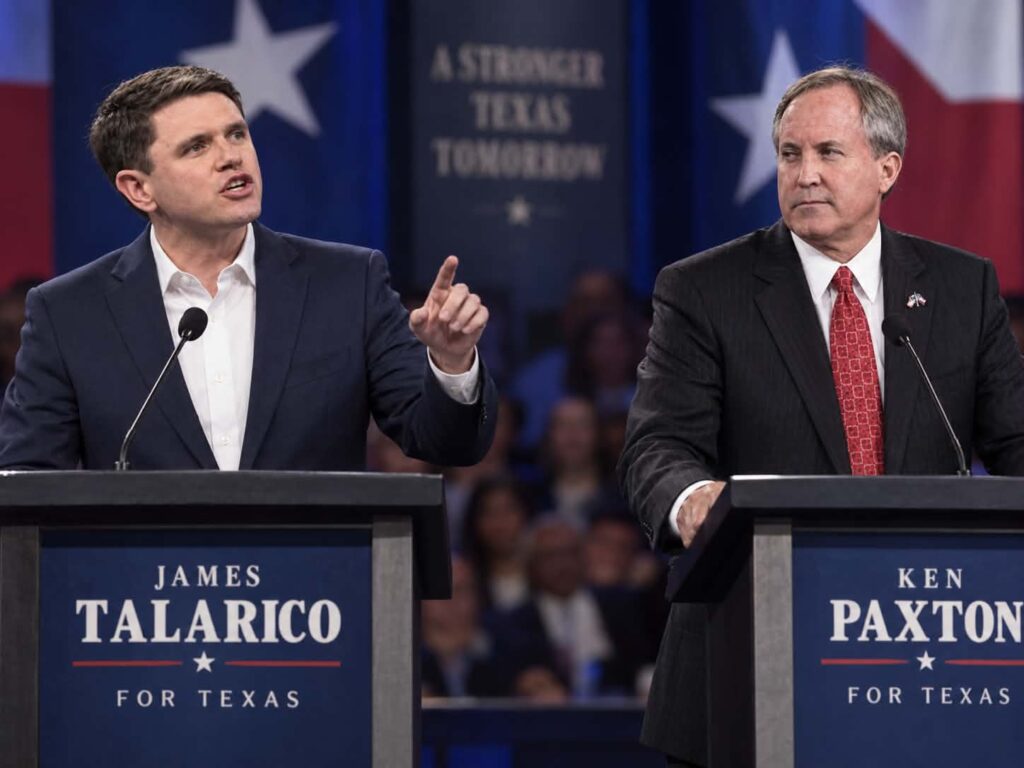
James Talarico and Ken Paxton Deadlocked in New Texas Senate Poll
The Texas Senate race between Democrat James Talarico and Republican Ken Paxton remains closely divided in the latest statewide polling, with the two candidates separated by just one percentage point.
A new Emerson College Polling/Nexstar Media survey conducted Sept. 12-14 found 47% of likely voters supporting Talarico and 46% supporting Paxton. Four percent were undecided, while 2% backed Libertarian candidate Ted Brown.
Because the poll’s credibility interval is plus or minus 3 percentage points, the results indicate a close contest rather than a statistically clear difference between the two candidates.
New Poll Shows Little Movement
The September Emerson survey found relatively little change from the organization’s August polling.
Talarico’s support increased by one percentage point, while Paxton’s fell by one point. The resulting 47%-46% split leaves the race within the poll’s stated range of uncertainty.
The survey included 1,000 likely Texas voters and was weighted according to demographic and regional characteristics using Census and voter-file data.
Polling results can vary depending on methodology, field dates and the voters included in the sample. They therefore provide a measurement of opinion when the survey was conducted rather than a determination of the eventual election result.
Other Recent Polls Also Show a Close Race
The Emerson survey is part of a series of recent polls showing a competitive contest.
A Mason-Dixon Polling & Research survey conducted Sept. 8-10 found Talarico leading Paxton 46% to 43%, with Libertarian Ted Brown at 3% and 8% undecided. That survey of 625 likely voters had a margin of error of approximately 4 percentage points.
An earlier Texas Public Opinion Research survey conducted in July showed Talarico at 45% and Paxton at 40%, although that poll had a different methodology and field period.
The Texas Tribune’s polling tracker has described the contest as closely divided and cautioned that polling averages are not forecasts of the election outcome.
Talarico’s Support Among Hispanic Voters
One of the more significant demographic findings comes from a separate Cook Political Report/TelevisaUnivision survey of Hispanic likely voters.
That survey, conducted Aug. 26 through Sept. 3, found Talarico receiving 63% support among Hispanic likely voters, compared with 30% for Paxton. The survey included 1,000 Hispanic likely voters and had a margin of error of plus or minus 3.7 percentage points.
The survey also found that the economy was the leading issue among Hispanic voters, ahead of immigration and other issues.
Demographic subgroup results should be interpreted with additional caution because their sample sizes are smaller than the full statewide sample.
Paxton’s Republican Base
Paxton is the Republican nominee after defeating incumbent Sen. John Cornyn in the party’s May runoff.
The Republican campaign has emphasized economic issues and conservative policies while seeking to consolidate Republican voters for the general election.
Paxton also received significant attention during the Republican midterm convention in Dallas earlier this month. President Donald Trump criticized aspects of Paxton’s presentation and appearance during the event but also praised his record as Texas attorney general.
Trump’s MAGA Inc. super PAC has also provided financial support to Paxton’s campaign, according to Federal Election Commission filings cited by KERA.
Talarico’s Position in the Race
Talarico, a Democratic state representative from the Austin area, won his party’s nomination and now faces Paxton in the November general election.
The Texas Tribune reported that Talarico has performed competitively in several polls since the Republican runoff, including a July survey in which he led Paxton by five percentage points.
The latest Emerson survey, however, shows a much narrower difference.
Talarico was viewed favorably by 48% of respondents and unfavorably by 42%. Paxton’s favorable rating was 40%, while 48% viewed him unfavorably.
The Economy Is the Top Issue
Economic concerns appear to be particularly important to Texas voters in the latest Emerson survey.
Thirty-six percent of respondents identified the economy as the state’s most important issue, up six percentage points from the previous Emerson poll.
Immigration followed at 14%, education at 12%, health care at 11% and threats to democracy at 11%.
The poll found that Republicans and Democrats were broadly similar in identifying the economy as the state’s leading issue, although independents placed somewhat less emphasis on it.
A Closely Watched Senate Contest
The race is receiving national attention because Texas is one of the country’s largest states and because Democrats have not won a statewide Texas election since 1994.
The Texas Tribune has described the Senate contest as one of the most closely watched and expensive races of the 2026 cycle.
The general election is scheduled for Nov. 3, 2026, with early voting in Texas scheduled to begin Oct. 19.
The Senate contest pits Talarico against Paxton for the seat currently held by Republican John Cornyn.
What the New Poll Means
The latest Emerson survey places Talarico at 47% and Paxton at 46%, with the difference falling within the poll’s stated credibility interval.
Other recent surveys have also shown relatively narrow margins, although the exact numbers differ from one poll to another.
The results highlight a race in which both candidates have substantial support but neither reaches 50% in the latest survey. With undecided voters still in the electorate and several weeks remaining before Election Day, the polling provides a snapshot of the Texas electorate rather than a determination of who will ultimately win.
For voters and observers, the most useful context is therefore the combination of multiple surveys, their methodologies and the issues driving different groups of Texas voters—not any single poll viewed in isolation.
Read More: James Talarico Faces Questions Over Absence as Texas Senate Race Continues
James Talarico’s Texas Senate Odds After Nine-Day Campaign Absence
Democratic Texas Senate nominee James Talarico continued to receive higher win-probability estimates than Republican opponent Ken Paxton on prediction markets on October 11, even after a nine-day absence from in-person campaigning prompted criticism from Republicans.
Kalshi placed Talarico’s implied chance of winning at approximately 63%, while Polymarket put it at around 64%. Paxton’s corresponding figures were approximately 37% and 36%, respectively. These figures reflect market prices, not scientific polling or a guarantee of the election result.
Talarico, a Texas state representative, said he had paused in-person campaign activities while recovering from the flu. His absence became a subject of attacks from Paxton and other Republicans as the November 3 election approached.
Talarico Says He Was Recovering From the Flu
In an interview excerpt posted to X on Sunday by NBC Dallas-Fort Worth reporter Phil Prazan, Talarico said he had been ill with what he described as a “nasty case of the flu.”
He said he had consulted his primary care physician but had not been hospitalized. According to Talarico, he spent much of the period resting, drinking fluids and working from home while avoiding public events to reduce the risk of spreading the illness.
His campaign also rejected online claims that his absence was connected to psychiatric treatment. Campaign spokesperson JT Ennis told Newsweek that Talarico had been at home in Austin recovering from the flu.
A separate claim circulating online alleged that Talarico had been treated at the Lindner Center of HOPE, a mental health facility in Ohio. The facility denied that he had been a patient, according to subsequent reporting. No evidence presented in the reports substantiated the allegation.
Republicans Criticize His Absence
Paxton and other Republican figures used Talarico’s absence to question his whereabouts and criticize his campaign. Paxton’s campaign circulated missing-person-themed material and established a tip line related to Talarico’s absence, according to news reports. President Donald Trump also publicly questioned Talarico’s explanation while campaigning in Texas for Paxton.
Talarico’s campaign maintained that the absence was due to illness. The episode also prompted wider online speculation, including claims about his mental health that were denied by his campaign and the facility named in the rumors.
Debate Pressure Adds to the Senate Contest
The dispute unfolded alongside calls for the candidates to debate before Election Day. Talarico accepted calls for a debate and urged Paxton to participate, but no debate had been scheduled in reporting published October 9.
The Texas contest has attracted national attention as Republicans work to defend their Senate majority. National Republican groups have committed substantial spending to support Paxton, while public polling has shown a competitive race.
What the Prediction Markets Show
The October 11 market prices indicated that traders continued to assign Talarico a higher implied probability of winning than Paxton, despite the attention surrounding his absence. However, prediction markets can move as new information emerges, and their prices should not be confused with the share of voters supporting either candidate.
Talarico has since resumed public appearances, including stops in Austin and Dallas, according to local reporting published October 12.
READ MORE:
With the November 3 election approaching, the race remains closely watched as campaigns focus on voter outreach, advertising and debate negotiations.
READ ALSO:
Michigan Senate Race Remains Close as El-Sayed Trails Democratic Party Preference
A new poll of Michigan likely voters shows Democrat Abdul El-Sayed holding a narrow lead over Republican Mike Rogers in the state’s closely watched U.S. Senate race, while also finding that a larger share of voters would prefer Democrats to control the Senate.
The Washington Post-Schar School survey, conducted Sept. 10-14, found 48% of likely voters supporting El-Sayed and 45% supporting Rogers. The three-point difference falls within the poll’s 3.9-percentage-point margin of error, underscoring how closely divided the contest is at this stage of the campaign.
The poll also found that 53% of likely Michigan voters would prefer Democratic control of the Senate, five percentage points higher than El-Sayed’s share of support in the Senate contest.
El-Sayed’s Lead Is Within the Margin of Error
The Washington Post-Schar School poll surveyed 803 likely voters drawn from Michigan’s statewide voter database. Interviews were conducted by phone and text-to-online methods, with the overall margin of error listed at plus or minus 3.9 percentage points.
That means the poll does not establish a statistically clear separation between the two candidates.
Another survey released Sept. 17 by Emerson College Polling/Nexstar Media likewise showed a close race, with El-Sayed at 48% and Rogers at 46% among 1,000 likely voters. Four percent were undecided, and the poll reported a margin of error of approximately three percentage points.
Taken together, the recent surveys show a competitive race rather than a large polling advantage for either candidate.
Democrats Have an Edge in the Senate Preference Question
One of the more notable findings in the Post-Schar School survey is the difference between the Senate race and the broader party-control question.
While 53% of likely voters said they preferred Democrats to control the Senate, 48% backed El-Sayed in the Michigan contest. That gap suggests that some voters who prefer Democratic control of the chamber are not currently expressing the same level of support for the Democratic nominee.
The poll also found that Democratic nominee Jocelyn Benson held a larger advantage over Republican John James in the Michigan governor’s race. Benson led James by 12 percentage points in the survey.
The comparison does not determine how voters will ultimately vote, but it provides additional context for understanding El-Sayed’s position on the statewide ballot.
Voters’ Views of the Candidates
Neither Senate candidate received a net-positive overall assessment from Michigan voters in the Washington Post survey, although El-Sayed had the stronger favorable rating.
About 44% of likely voters viewed El-Sayed favorably, compared with 39% who viewed Rogers favorably.
The survey also found that 48% of likely voters considered El-Sayed too liberal, while 43% viewed Rogers as too conservative.
Those perceptions reflect the contrasting campaigns the candidates have run.
El-Sayed has emphasized issues including health care, economic policy and changes to the political system. His campaign has also promoted positions such as Medicare-for-all and eliminating Immigration and Customs Enforcement. Rogers, a former congressman who narrowly lost the 2024 Michigan Senate election, has emphasized his Republican credentials and relationship with President Donald Trump.
Demographic Differences Could Shape the Contest
The Post-Schar School survey identified several differences among major voter groups.
Among Black likely voters, 83% said they wanted Democrats to control the Senate, while 67% said they supported El-Sayed. The Washington Post reported that this difference is notable because Black voters have historically been an important part of the Democratic coalition in Michigan.
The poll also found a relationship between attitudes toward Muslim candidates and support for El-Sayed, who would become the first Muslim U.S. senator if elected.
More than four in 10 likely voters said they would be unwilling to support a Muslim candidate for president. El-Sayed received lower support than Benson among voters expressing that view.
These findings describe differences within the electorate; they do not establish why individual voters hold particular positions.
Education Is Another Major Divide
The latest Emerson College/Nexstar survey found a significant education gap in the Senate race.
Among voters without a four-year college degree, Rogers led El-Sayed 48% to 45%. Among college graduates, El-Sayed led 53% to 42%.
That division adds another layer to an already closely contested statewide race.
Earlier polling also showed the contest within a narrow range. A Washington Post report on an August Fox News survey found Rogers ahead among registered voters but El-Sayed ahead among voters who said they would definitely vote.
Because different polls use different samples, methodologies and field dates, individual surveys should not be treated as interchangeable measurements.
Economic Concerns Are Prominent
The Post-Schar School poll found that the cost of living was the most frequently cited top issue, with 48% of likely voters identifying it as their most important concern.
Nearly six in 10 likely voters also disapproved of Trump’s job performance, according to the survey. The political environment has therefore created both opportunities and challenges for the two campaigns, depending on which issues and voter groups ultimately drive turnout.
The Michigan race is also taking place against the backdrop of concerns over inflation, energy prices, tariffs and the broader economy.
A Key Race for Senate Control
Michigan is one of the Democratic-held Senate seats being closely watched nationally.
Sen. Gary Peters, a Democrat, is retiring rather than seeking another term, leaving an open seat for the 2026 election. El-Sayed won the Democratic primary in August after a closely contested campaign against Rep. Haley Stevens. Rogers won the Republican nomination and is seeking another opportunity after narrowly losing Michigan’s 2024 Senate election.
Democrats are seeking to retain Michigan as part of their broader effort to gain control of the Senate, while Republicans are targeting the seat as an opportunity to expand their majority.
What the Poll Shows — and What It Does Not
The latest surveys show a Michigan Senate contest that is currently close.
The Post-Schar School poll gives El-Sayed a 48%-45% edge, while the Emerson/Nexstar survey has the Democrat ahead 48%-46%. Both margins fall within the respective polls’ stated error ranges.
The broader party-control question produces a different result, with 53% of Post-Schar School respondents preferring Democratic control of the Senate. The governor’s race also shows a larger Democratic margin in the same survey.
Those figures provide context for the Senate race, but polling cannot determine the eventual result. Surveys measure voter preferences at the time they are conducted, and their estimates are subject to sampling and other sources of uncertainty.
With the general election still ahead, the Michigan Senate contest remains closely divided, with the candidates competing for support among independents, suburban voters, Black voters, working-class voters and other groups that could affect the final vote.

Benjamin Harris is a RapidReports front page contributor and editor,proud father of four.